

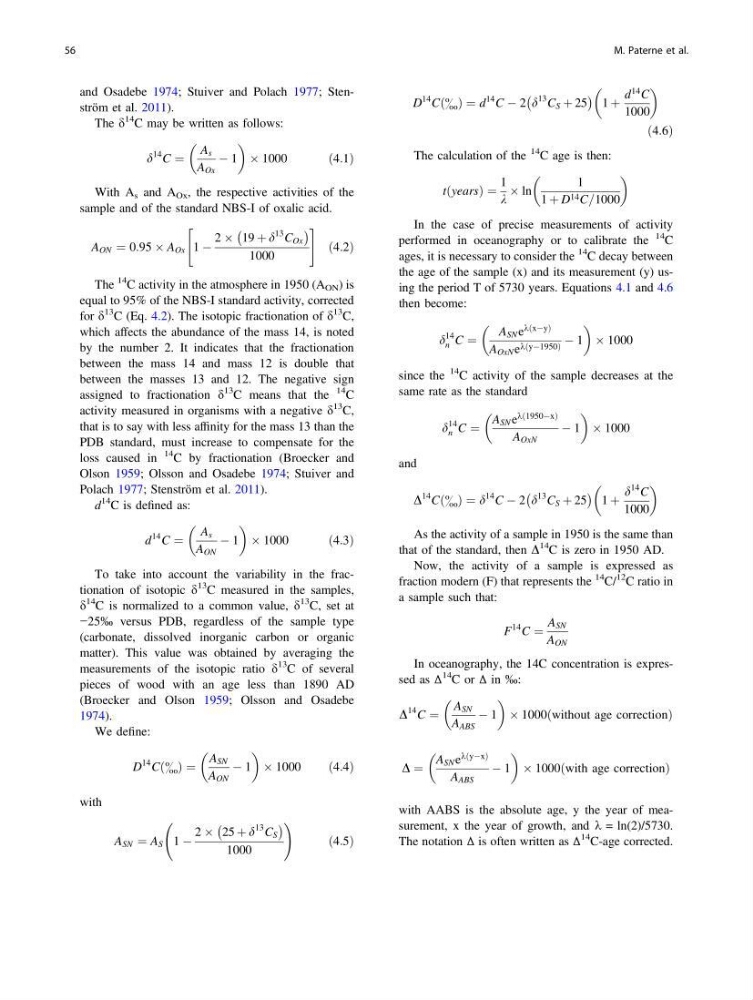
and Osadebe 1974; Stuiver and Polach 1977; Stenström et al. 2011).
The d
14 C may be written as follows:
d
14 C ¼
A s
A Ox
À 1
 1000
ð4:1Þ
With A s and A Ox , the respective activities of the
sample and of the standard NBS-I of oxalic acid.
A ON ¼ 0:95 Â A Ox 1 À
2 Â 19 þ d
13 C Ox
À
Á
1000
"
#
ð4:2Þ
The
14 C activity in the atmosphere in 1950 (A ON ) is
equal to 95% of the NBS-I standard activity, corrected
for d
13 C (Eq. 4.2). The isotopic fractionation of d
13 C,
which affects the abundance of the mass 14, is noted
by the number 2. It indicates that the fractionation
between the mass 14 and mass 12 is double that
between the masses 13 and 12. The negative sign
assigned to fractionation d
13 C means that the
14 C
activity measured in organisms with a negative d
13 C,
that is to say with less affinity for the mass 13 than the
PDB standard, must increase to compensate for the
loss caused in
14
C by fractionation (Broecker and
Olson 1959; Olsson and Osadebe 1974; Stuiver and
Polach 1977; Stenström et al. 2011).
d
14 C is defined as:
d
14 C ¼
A s
A ON
À 1
 1000
ð4:3Þ
To take into account the variability in the fractionation of isotopic d
13 C measured in the samples,
d
14 C is normalized to a common value, d
13 C, set at
−25‰ versus PDB, regardless of the sample type
(carbonate, dissolved inorganic carbon or organic
matter). This value was obtained by averaging the
measurements of the isotopic ratio d
13 C of several
pieces of wood with an age less than 1890 AD
(Broecker and Olson 1959; Olsson and Osadebe
1974).
We define:
D
14 C &
ð Þ ¼
A SN
A ON
À 1
 1000
ð4:4Þ
with
A SN ¼ A S 1 À
2 Â 25 þ d
13 C S
À
Á
1000
!
ð4:5Þ
D
14 C &
ð Þ ¼ d
14 C À 2 d
13 C S þ 25
À
Á 1 þ
d
14 C
1000
ð4:6Þ
The calculation of the
14 C age is then:
t years
ð
Þ¼
1
k
 ln
1
1 þ D 14 C=1000
In the case of precise measurements of activity
performed in oceanography or to calibrate the
14 C
ages, it is necessary to consider the
14 C decay between
the age of the sample (x) and its measurement (y) using the period T of 5730 years. Equations 4.1 and 4.6
then become:
d
14
n C ¼
A SN e
k xÀy
ð
Þ
A OxN e k yÀ1950
ð
Þ
À 1
 1000
since the
14 C activity of the sample decreases at the
same rate as the standard
d
14
n C ¼
A SN e
k 1950Àx
ð
Þ
A OxN
À 1
 1000
and
D
14 C &
ð Þ ¼ d
14 C À 2 d
13 C S þ 25
À
Á 1 þ
d
14 C
1000
As the activity of a sample in 1950 is the same than
that of the standard, then D
14
C is zero in 1950 AD.
Now, the activity of a sample is expressed as
fraction modern (F) that represents the
14 C/
12 C ratio in
a sample such that:
F
14 C ¼
A SN
A ON
In oceanography, the 14C concentration is expressed as Δ
14 C or Δ in ‰:
D
14 C ¼
A SN
A ABS
À 1
 1000 without age correction
ð
Þ
D ¼
A SN e
k yÀx
ð
Þ
A ABS
À 1
 1000 with age correction
ð
Þ
with AABS is the absolute age, y the year of measurement, x the year of growth, and k = ln(2)/5730.
The notation Δ is often written as Δ
14 C-age corrected.
56
M. Paterne et al.
The d
14 C may be written as follows:
d
14 C ¼
A s
A Ox
À 1
 1000
ð4:1Þ
With A s and A Ox , the respective activities of the
sample and of the standard NBS-I of oxalic acid.
A ON ¼ 0:95 Â A Ox 1 À
2 Â 19 þ d
13 C Ox
À
Á
1000
"
#
ð4:2Þ
The
14 C activity in the atmosphere in 1950 (A ON ) is
equal to 95% of the NBS-I standard activity, corrected
for d
13 C (Eq. 4.2). The isotopic fractionation of d
13 C,
which affects the abundance of the mass 14, is noted
by the number 2. It indicates that the fractionation
between the mass 14 and mass 12 is double that
between the masses 13 and 12. The negative sign
assigned to fractionation d
13 C means that the
14 C
activity measured in organisms with a negative d
13 C,
that is to say with less affinity for the mass 13 than the
PDB standard, must increase to compensate for the
loss caused in
14
C by fractionation (Broecker and
Olson 1959; Olsson and Osadebe 1974; Stuiver and
Polach 1977; Stenström et al. 2011).
d
14 C is defined as:
d
14 C ¼
A s
A ON
À 1
 1000
ð4:3Þ
To take into account the variability in the fractionation of isotopic d
13 C measured in the samples,
d
14 C is normalized to a common value, d
13 C, set at
−25‰ versus PDB, regardless of the sample type
(carbonate, dissolved inorganic carbon or organic
matter). This value was obtained by averaging the
measurements of the isotopic ratio d
13 C of several
pieces of wood with an age less than 1890 AD
(Broecker and Olson 1959; Olsson and Osadebe
1974).
We define:
D
14 C &
ð Þ ¼
A SN
A ON
À 1
 1000
ð4:4Þ
with
A SN ¼ A S 1 À
2 Â 25 þ d
13 C S
À
Á
1000
!
ð4:5Þ
D
14 C &
ð Þ ¼ d
14 C À 2 d
13 C S þ 25
À
Á 1 þ
d
14 C
1000
ð4:6Þ
The calculation of the
14 C age is then:
t years
ð
Þ¼
1
k
 ln
1
1 þ D 14 C=1000
In the case of precise measurements of activity
performed in oceanography or to calibrate the
14 C
ages, it is necessary to consider the
14 C decay between
the age of the sample (x) and its measurement (y) using the period T of 5730 years. Equations 4.1 and 4.6
then become:
d
14
n C ¼
A SN e
k xÀy
ð
Þ
A OxN e k yÀ1950
ð
Þ
À 1
 1000
since the
14 C activity of the sample decreases at the
same rate as the standard
d
14
n C ¼
A SN e
k 1950Àx
ð
Þ
A OxN
À 1
 1000
and
D
14 C &
ð Þ ¼ d
14 C À 2 d
13 C S þ 25
À
Á 1 þ
d
14 C
1000
As the activity of a sample in 1950 is the same than
that of the standard, then D
14
C is zero in 1950 AD.
Now, the activity of a sample is expressed as
fraction modern (F) that represents the
14 C/
12 C ratio in
a sample such that:
F
14 C ¼
A SN
A ON
In oceanography, the 14C concentration is expressed as Δ
14 C or Δ in ‰:
D
14 C ¼
A SN
A ABS
À 1
 1000 without age correction
ð
Þ
D ¼
A SN e
k yÀx
ð
Þ
A ABS
À 1
 1000 with age correction
ð
Þ
with AABS is the absolute age, y the year of measurement, x the year of growth, and k = ln(2)/5730.
The notation Δ is often written as Δ
14 C-age corrected.
56
M. Paterne et al.