

The radiocarbon age (t) is calculated using the radioactive
exponential decay:
14 C
12 C
¼
14 C
12 C
0
e
Àkt
where (
14 C/
12 C) 0 is the atmospheric ratio and k = ln(2)/T 1/2
the decay constant. By convention, the Libby’s half-life at
5568 years is used to calculate the
14 C ages. The mean
lifetime of the
14 C atoms before decay is T 1/2 /ln(2).
The calculation of age becomes:
t ¼
1
k
ln
14 C
12 C
14 C
12 C
À Á
0
!
The
14 C dating method is based on the hypothesis of a
constant radioactive equilibrium between the
14 C formation
and its disintegration in
14 N. If we look at Libby’s diagram
(Fig. 4.1), we may observe that this is true if the production
of
14 C, the size of the various reservoirs of carbon (atmosphere, oceans, land and marine biosphere) and their carbon
content remain constant over time, as well as the fluxes
between the various reservoirs. In addition, the physicochemical integrity of the dated fossils must have been preserved after the death of organisms. For example, no isotopic
exchange or secondary crystallization should have occurred.
Finally, the samples should have not moved from their
burying sites to date precisely any events.
Validity of the Assumptions and Definition
of a Reference Standard for the Atmosphere
The first offsets between the
14 C and known ages appeared
very quickly, notably with the major contribution of dendrochronology, a counting method of the annual tree-ring
growth. In 1955, Suess demonstrated (Taylor 1987; Damon
et al. 1978) that the
14
C content in the atmosphere varied in
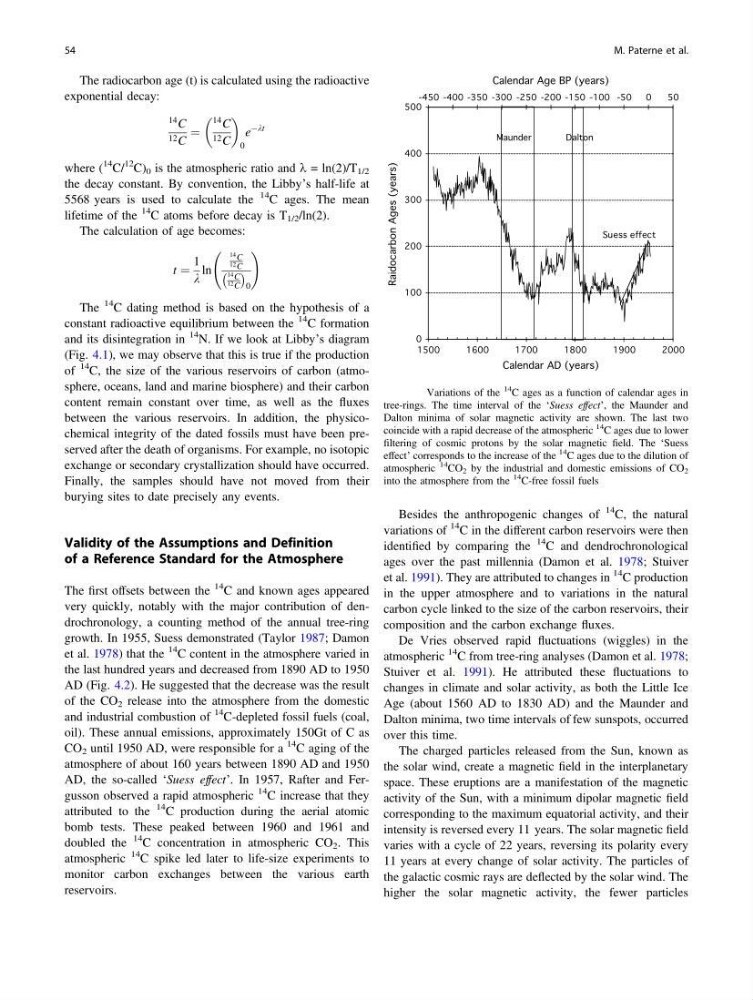
the last hundred years and decreased from 1890 AD to 1950
AD (Fig. 4.2). He suggested that the decrease was the result
of the CO 2 release into the atmosphere from the domestic
and industrial combustion of
14 C-depleted fossil fuels (coal,
oil). These annual emissions, approximately 150Gt of C as
CO 2 until 1950 AD, were responsible for a
14 C aging of the
atmosphere of about 160 years between 1890 AD and 1950
AD, the so-called ‘Suess effect’. In 1957, Rafter and Fergusson observed a rapid atmospheric
14 C increase that they
attributed to the
14 C production during the aerial atomic
bomb tests. These peaked between 1960 and 1961 and
doubled the
14 C concentration in atmospheric CO 2 . This
atmospheric
14 C spike led later to life-size experiments to
monitor carbon exchanges between the various earth
reservoirs.
Besides the anthropogenic changes of
14 C, the natural
variations of
14 C in the different carbon reservoirs were then
identified by comparing the
14 C and dendrochronological
ages over the past millennia (Damon et al. 1978; Stuiver
et al. 1991). They are attributed to changes in
14 C production
in the upper atmosphere and to variations in the natural
carbon cycle linked to the size of the carbon reservoirs, their
composition and the carbon exchange fluxes.
De Vries observed rapid fluctuations (wiggles) in the
atmospheric
14 C from tree-ring analyses (Damon et al. 1978;
Stuiver et al. 1991). He attributed these fluctuations to
changes in climate and solar activity, as both the Little Ice
Age (about 1560 AD to 1830 AD) and the Maunder and
Dalton minima, two time intervals of few sunspots, occurred
over this time.
The charged particles released from the Sun, known as
the solar wind, create a magnetic field in the interplanetary
space. These eruptions are a manifestation of the magnetic
activity of the Sun, with a minimum dipolar magnetic field
corresponding to the maximum equatorial activity, and their
intensity is reversed every 11 years. The solar magnetic field
varies with a cycle of 22 years, reversing its polarity every
11 years at every change of solar activity. The particles of
the galactic cosmic rays are deflected by the solar wind. The
higher the solar magnetic activity, the fewer particles
-450 -400 -350 -300 -250 -200 -150 -100 -50
0
50
0
100
200
300
400
500
1500
1600
1700
1800
1900
2000
Calendar Age BP (years)
Raidocarbon Ages (years)
Calendar AD (years)
Maunder
Dalton
Suess effect
Fig. 4.2 Variations of the
14
C ages as a function of calendar ages in
tree-rings. The time interval of the ‘Suess effect’, the Maunder and
Dalton minima of solar magnetic activity are shown. The last two
coincide with a rapid decrease of the atmospheric
14 C ages due to lower
filtering of cosmic protons by the solar magnetic field. The ‘Suess
effect’ corresponds to the increase of the
14
C ages due to the dilution of
atmospheric
14
CO 2 by the industrial and domestic emissions of CO 2
into the atmosphere from the
14
C-free fossil fuels
54
M. Paterne et al.
exponential decay:
14 C
12 C
¼
14 C
12 C
0
e
Àkt
where (
14 C/
12 C) 0 is the atmospheric ratio and k = ln(2)/T 1/2
the decay constant. By convention, the Libby’s half-life at
5568 years is used to calculate the
14 C ages. The mean
lifetime of the
14 C atoms before decay is T 1/2 /ln(2).
The calculation of age becomes:
t ¼
1
k
ln
14 C
12 C
14 C
12 C
À Á
0
!
The
14 C dating method is based on the hypothesis of a
constant radioactive equilibrium between the
14 C formation
and its disintegration in
14 N. If we look at Libby’s diagram
(Fig. 4.1), we may observe that this is true if the production
of
14 C, the size of the various reservoirs of carbon (atmosphere, oceans, land and marine biosphere) and their carbon
content remain constant over time, as well as the fluxes
between the various reservoirs. In addition, the physicochemical integrity of the dated fossils must have been preserved after the death of organisms. For example, no isotopic
exchange or secondary crystallization should have occurred.
Finally, the samples should have not moved from their
burying sites to date precisely any events.
Validity of the Assumptions and Definition
of a Reference Standard for the Atmosphere
The first offsets between the
14 C and known ages appeared
very quickly, notably with the major contribution of dendrochronology, a counting method of the annual tree-ring
growth. In 1955, Suess demonstrated (Taylor 1987; Damon
et al. 1978) that the
14
C content in the atmosphere varied in
the last hundred years and decreased from 1890 AD to 1950
AD (Fig. 4.2). He suggested that the decrease was the result
of the CO 2 release into the atmosphere from the domestic
and industrial combustion of
14 C-depleted fossil fuels (coal,
oil). These annual emissions, approximately 150Gt of C as
CO 2 until 1950 AD, were responsible for a
14 C aging of the
atmosphere of about 160 years between 1890 AD and 1950
AD, the so-called ‘Suess effect’. In 1957, Rafter and Fergusson observed a rapid atmospheric
14 C increase that they
attributed to the
14 C production during the aerial atomic
bomb tests. These peaked between 1960 and 1961 and
doubled the
14 C concentration in atmospheric CO 2 . This
atmospheric
14 C spike led later to life-size experiments to
monitor carbon exchanges between the various earth
reservoirs.
Besides the anthropogenic changes of
14 C, the natural
variations of
14 C in the different carbon reservoirs were then
identified by comparing the
14 C and dendrochronological
ages over the past millennia (Damon et al. 1978; Stuiver
et al. 1991). They are attributed to changes in
14 C production
in the upper atmosphere and to variations in the natural
carbon cycle linked to the size of the carbon reservoirs, their
composition and the carbon exchange fluxes.
De Vries observed rapid fluctuations (wiggles) in the
atmospheric
14 C from tree-ring analyses (Damon et al. 1978;
Stuiver et al. 1991). He attributed these fluctuations to
changes in climate and solar activity, as both the Little Ice
Age (about 1560 AD to 1830 AD) and the Maunder and
Dalton minima, two time intervals of few sunspots, occurred
over this time.
The charged particles released from the Sun, known as
the solar wind, create a magnetic field in the interplanetary
space. These eruptions are a manifestation of the magnetic
activity of the Sun, with a minimum dipolar magnetic field
corresponding to the maximum equatorial activity, and their
intensity is reversed every 11 years. The solar magnetic field
varies with a cycle of 22 years, reversing its polarity every
11 years at every change of solar activity. The particles of
the galactic cosmic rays are deflected by the solar wind. The
higher the solar magnetic activity, the fewer particles
-450 -400 -350 -300 -250 -200 -150 -100 -50
0
50
0
100
200
300
400
500
1500
1600
1700
1800
1900
2000
Calendar Age BP (years)
Raidocarbon Ages (years)
Calendar AD (years)
Maunder
Dalton
Suess effect
Fig. 4.2 Variations of the
14
C ages as a function of calendar ages in
tree-rings. The time interval of the ‘Suess effect’, the Maunder and
Dalton minima of solar magnetic activity are shown. The last two
coincide with a rapid decrease of the atmospheric
14 C ages due to lower
filtering of cosmic protons by the solar magnetic field. The ‘Suess
effect’ corresponds to the increase of the
14
C ages due to the dilution of
atmospheric
14
CO 2 by the industrial and domestic emissions of CO 2
into the atmosphere from the
14
C-free fossil fuels
54
M. Paterne et al.