

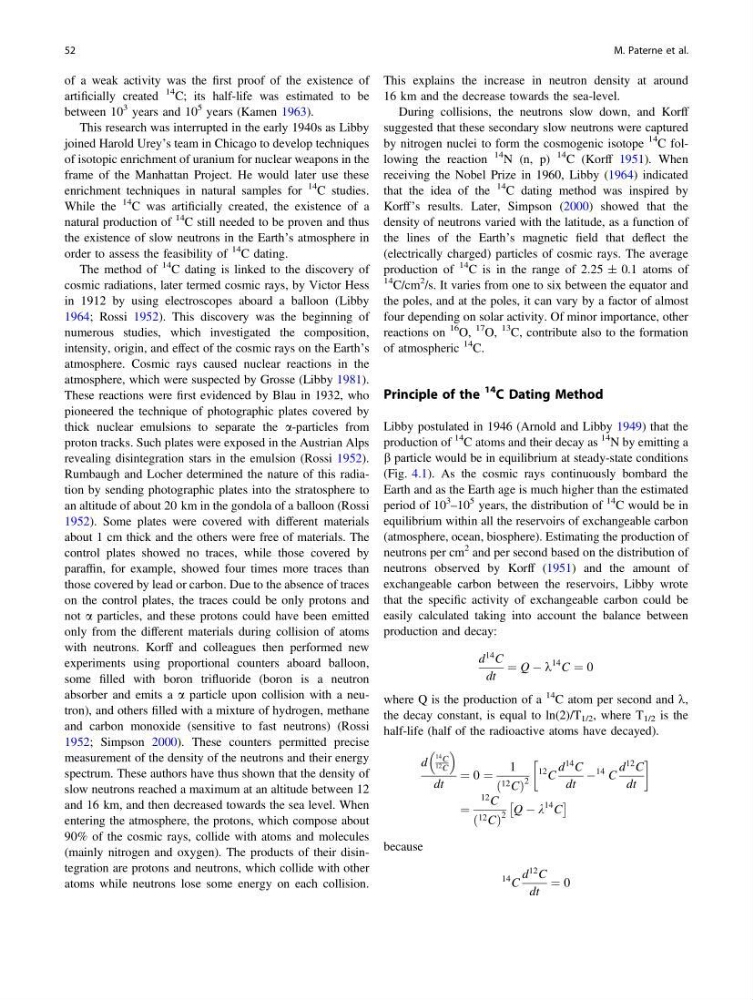
of a weak activity was the first proof of the existence of
artificially created
14 C; its half-life was estimated to be
between 10
3 years and 10
5 years (Kamen 1963).
This research was interrupted in the early 1940s as Libby
joined Harold Urey’s team in Chicago to develop techniques
of isotopic enrichment of uranium for nuclear weapons in the
frame of the Manhattan Project. He would later use these
enrichment techniques in natural samples for
14 C studies.
While the
14 C was artificially created, the existence of a
natural production of
14 C still needed to be proven and thus
the existence of slow neutrons in the Earth’s atmosphere in
order to assess the feasibility of
14 C dating.
The method of
14 C dating is linked to the discovery of
cosmic radiations, later termed cosmic rays, by Victor Hess
in 1912 by using electroscopes aboard a balloon (Libby
1964; Rossi 1952). This discovery was the beginning of
numerous studies, which investigated the composition,
intensity, origin, and effect of the cosmic rays on the Earth’s
atmosphere. Cosmic rays caused nuclear reactions in the
atmosphere, which were suspected by Grosse (Libby 1981).
These reactions were first evidenced by Blau in 1932, who
pioneered the technique of photographic plates covered by
thick nuclear emulsions to separate the a-particles from
proton tracks. Such plates were exposed in the Austrian Alps
revealing disintegration stars in the emulsion (Rossi 1952).
Rumbaugh and Locher determined the nature of this radiation by sending photographic plates into the stratosphere to
an altitude of about 20 km in the gondola of a balloon (Rossi
1952). Some plates were covered with different materials
about 1 cm thick and the others were free of materials. The
control plates showed no traces, while those covered by
paraffin, for example, showed four times more traces than
those covered by lead or carbon. Due to the absence of traces
on the control plates, the traces could be only protons and
not a particles, and these protons could have been emitted
only from the different materials during collision of atoms
with neutrons. Korff and colleagues then performed new
experiments using proportional counters aboard balloon,
some filled with boron trifluoride (boron is a neutron
absorber and emits a a particle upon collision with a neutron), and others filled with a mixture of hydrogen, methane
and carbon monoxide (sensitive to fast neutrons) (Rossi
1952; Simpson 2000). These counters permitted precise
measurement of the density of the neutrons and their energy
spectrum. These authors have thus shown that the density of
slow neutrons reached a maximum at an altitude between 12
and 16 km, and then decreased towards the sea level. When
entering the atmosphere, the protons, which compose about
90% of the cosmic rays, collide with atoms and molecules
(mainly nitrogen and oxygen). The products of their disintegration are protons and neutrons, which collide with other
atoms while neutrons lose some energy on each collision.
This explains the increase in neutron density at around
16 km and the decrease towards the sea-level.
During collisions, the neutrons slow down, and Korff
suggested that these secondary slow neutrons were captured
by nitrogen nuclei to form the cosmogenic isotope
14 C following the reaction
14 N (n, p)
14 C (Korff 1951). When
receiving the Nobel Prize in 1960, Libby (1964) indicated
that the idea of the
14 C dating method was inspired by
Korff’s results. Later, Simpson (2000) showed that the
density of neutrons varied with the latitude, as a function of
the lines of the Earth’s magnetic field that deflect the
(electrically charged) particles of cosmic rays. The average
production of
14 C is in the range of 2.25 ± 0.1 atoms of
14 C/cm
2 /s. It varies from one to six between the equator and
the poles, and at the poles, it can vary by a factor of almost
four depending on solar activity. Of minor importance, other
reactions on
16 O,
17
O,
13 C, contribute also to the formation
of atmospheric
14 C.
Principle of the
14
C Dating Method
Libby postulated in 1946 (Arnold and Libby 1949) that the
production of
14
C atoms and their decay as
14 N by emitting a
b particle would be in equilibrium at steady-state conditions
(Fig. 4.1). As the cosmic rays continuously bombard the
Earth and as the Earth age is much higher than the estimated
period of 10
3
–10
5 years, the distribution of
14 C would be in
equilibrium within all the reservoirs of exchangeable carbon
(atmosphere, ocean, biosphere). Estimating the production of
neutrons per cm
2 and per second based on the distribution of
neutrons observed by Korff (1951) and the amount of
exchangeable carbon between the reservoirs, Libby wrote
that the specific activity of exchangeable carbon could be
easily calculated taking into account the balance between
production and decay:
d
14 C
dt
¼ Q À k
14 C ¼ 0
where Q is the production of a
14 C atom per second and k,
the decay constant, is equal to ln(2)/T 1/2 , where T 1/2 is the
half-life (half of the radioactive atoms have decayed).
d
14 C
12 C
dt
¼ 0 ¼
1
12 C
ð Þ
2
12 C
d
14 C
dt
À
14 C
d
12 C
dt
!
¼
12 C
12 C
ð Þ
2
Q À k
14 C
Â
Ã
because
14 C
d
12 C
dt
¼ 0
52
M. Paterne et al.
artificially created
14 C; its half-life was estimated to be
between 10
3 years and 10
5 years (Kamen 1963).
This research was interrupted in the early 1940s as Libby
joined Harold Urey’s team in Chicago to develop techniques
of isotopic enrichment of uranium for nuclear weapons in the
frame of the Manhattan Project. He would later use these
enrichment techniques in natural samples for
14 C studies.
While the
14 C was artificially created, the existence of a
natural production of
14 C still needed to be proven and thus
the existence of slow neutrons in the Earth’s atmosphere in
order to assess the feasibility of
14 C dating.
The method of
14 C dating is linked to the discovery of
cosmic radiations, later termed cosmic rays, by Victor Hess
in 1912 by using electroscopes aboard a balloon (Libby
1964; Rossi 1952). This discovery was the beginning of
numerous studies, which investigated the composition,
intensity, origin, and effect of the cosmic rays on the Earth’s
atmosphere. Cosmic rays caused nuclear reactions in the
atmosphere, which were suspected by Grosse (Libby 1981).
These reactions were first evidenced by Blau in 1932, who
pioneered the technique of photographic plates covered by
thick nuclear emulsions to separate the a-particles from
proton tracks. Such plates were exposed in the Austrian Alps
revealing disintegration stars in the emulsion (Rossi 1952).
Rumbaugh and Locher determined the nature of this radiation by sending photographic plates into the stratosphere to
an altitude of about 20 km in the gondola of a balloon (Rossi
1952). Some plates were covered with different materials
about 1 cm thick and the others were free of materials. The
control plates showed no traces, while those covered by
paraffin, for example, showed four times more traces than
those covered by lead or carbon. Due to the absence of traces
on the control plates, the traces could be only protons and
not a particles, and these protons could have been emitted
only from the different materials during collision of atoms
with neutrons. Korff and colleagues then performed new
experiments using proportional counters aboard balloon,
some filled with boron trifluoride (boron is a neutron
absorber and emits a a particle upon collision with a neutron), and others filled with a mixture of hydrogen, methane
and carbon monoxide (sensitive to fast neutrons) (Rossi
1952; Simpson 2000). These counters permitted precise
measurement of the density of the neutrons and their energy
spectrum. These authors have thus shown that the density of
slow neutrons reached a maximum at an altitude between 12
and 16 km, and then decreased towards the sea level. When
entering the atmosphere, the protons, which compose about
90% of the cosmic rays, collide with atoms and molecules
(mainly nitrogen and oxygen). The products of their disintegration are protons and neutrons, which collide with other
atoms while neutrons lose some energy on each collision.
This explains the increase in neutron density at around
16 km and the decrease towards the sea-level.
During collisions, the neutrons slow down, and Korff
suggested that these secondary slow neutrons were captured
by nitrogen nuclei to form the cosmogenic isotope
14 C following the reaction
14 N (n, p)
14 C (Korff 1951). When
receiving the Nobel Prize in 1960, Libby (1964) indicated
that the idea of the
14 C dating method was inspired by
Korff’s results. Later, Simpson (2000) showed that the
density of neutrons varied with the latitude, as a function of
the lines of the Earth’s magnetic field that deflect the
(electrically charged) particles of cosmic rays. The average
production of
14 C is in the range of 2.25 ± 0.1 atoms of
14 C/cm
2 /s. It varies from one to six between the equator and
the poles, and at the poles, it can vary by a factor of almost
four depending on solar activity. Of minor importance, other
reactions on
16 O,
17
O,
13 C, contribute also to the formation
of atmospheric
14 C.
Principle of the
14
C Dating Method
Libby postulated in 1946 (Arnold and Libby 1949) that the
production of
14
C atoms and their decay as
14 N by emitting a
b particle would be in equilibrium at steady-state conditions
(Fig. 4.1). As the cosmic rays continuously bombard the
Earth and as the Earth age is much higher than the estimated
period of 10
3
–10
5 years, the distribution of
14 C would be in
equilibrium within all the reservoirs of exchangeable carbon
(atmosphere, ocean, biosphere). Estimating the production of
neutrons per cm
2 and per second based on the distribution of
neutrons observed by Korff (1951) and the amount of
exchangeable carbon between the reservoirs, Libby wrote
that the specific activity of exchangeable carbon could be
easily calculated taking into account the balance between
production and decay:
d
14 C
dt
¼ Q À k
14 C ¼ 0
where Q is the production of a
14 C atom per second and k,
the decay constant, is equal to ln(2)/T 1/2 , where T 1/2 is the
half-life (half of the radioactive atoms have decayed).
d
14 C
12 C
dt
¼ 0 ¼
1
12 C
ð Þ
2
12 C
d
14 C
dt
À
14 C
d
12 C
dt
!
¼
12 C
12 C
ð Þ
2
Q À k
14 C
Â
Ã
because
14 C
d
12 C
dt
¼ 0
52
M. Paterne et al.