

orogenies (Rogers and Santosh 2002; Zhao et al. 2002) and
the structuring of several large cratons (Laurentia, Baltica,
Greenland,
Siberia,
Western
Australia,
India,
Amazonia-West Africa, Congo-Sao Francisco) (Meert and
Santosh 2017). The Laurentia craton is the result of the
assembly of several terranes (Superior, Rae, Slave, Hearne,
Nain) between 1.95 and 1.8 Ga, and incorporated Wyoming
province by 1.7 Ga. The collisions of Volgo-Uralia with
Sarmatia by 2 Ga and with Fennoscandia by 1.7 Ga lead to
the formation of Baltica. Between 1.8 and 1.3 Ga, the
Columbia supercontinent experienced a period of continuous
accretion along the active margins (subduction zones). These
magmatic accretionary belts significantly increased the
emerged land surface. A reconstruction of the Columbia
supercontinent is made possible through paleomagnetic data
of some cratons at 1.5–1.4 Ga interval (Meert and Santosh
2017). The development of continental rifts towards 1.5 Ga
marked the beginning of the fragmentation of the supercontinent Columbia which lasted about 300 million years.
However, very quickly, a new assemblage commenced. The
southern coast of Laurentia (which corresponds to the current east coast of the North American continent) collided
with the Amazon mass (a constituent block of South
America), and shortly after, the north Laurentian coast collided with Australia, East Antarctica and the South China.
The unification of all existing cratons at that time ended
around 950 Ma and the new supercontinent Rodinia was
formed. These various collisions between continents brought
about the existence of several large mountain ranges, whose
geological signature is found in metamorphic belts. This is
the case in North America, where the Grenville orogeny was
dated to 1 Ga, and in South China with the Sibao orogeny.
However, there is still no consensus on the history of the
Rodinia supercontinent. The number of continents that
constituted Rodinia, the age of its formation or of its dislocation, and even its very existence for some, remain open
questions. The reason for the lack of consensus is that the
number and quality of the geological, geochronological and
paleomagnetic data does not lead to one single solution. For
a much more in-depth analysis of the paleomagnetic data
and the consequences in terms of configurations, the reader
is referred to the work of Li et al. (2008).
After having drifted north, the supercontinent Rodinia
broke apart around 780–750 Ma. The dispersion of the
continents resulted in the opening up of ocean basins oriented
approximately north-south. Due to the spherical symmetry of
the geocentric dipole magnetic field, the width of these ocean
basins is poorly constrained. At the end of the Neoproterozoic, around 600 Ma, a new supercontinent, Pannotia, could
have formed. Made up of Laurentia and Gondwana domains,
the existence of this short-lived supercontinent could only be
linked to the uncertainties that impaired the age of break-up
of Laurentia, Amazonia and Baltica and the timing of
Gondwana assembly (Li et al. 2008; Oriolo et al. 2017). This
is why the possibility of the Pannotia supercontinent has not
been retained in the reconstructions presented in this book.
The period from the late Precambrian to the early Paleozoic is marked by the gradual amalgamation of Gondwana
from a mosaic of continents separated by oceans. These
oceans constricted and closed, continents collided, causing
orogenesis. These mountains have long disappeared, but the
present-day continents still bear relicts of them, such as
metamorphic belts of high pressure, magmatism and/or
deformations. These events, that have been dated by isotopic
methods, have been extensively discussed in Cawood and
Buchan (2007).
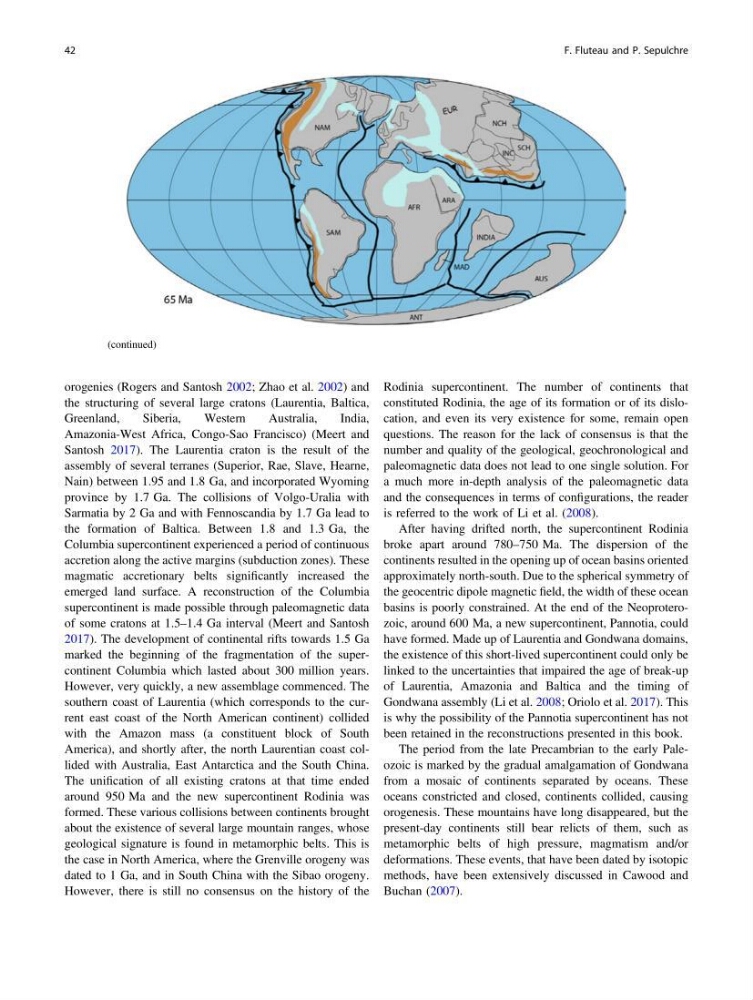
Fig. 2.6 (continued)
42
F. Fluteau and P. Sepulchre
the structuring of several large cratons (Laurentia, Baltica,
Greenland,
Siberia,
Western
Australia,
India,
Amazonia-West Africa, Congo-Sao Francisco) (Meert and
Santosh 2017). The Laurentia craton is the result of the
assembly of several terranes (Superior, Rae, Slave, Hearne,
Nain) between 1.95 and 1.8 Ga, and incorporated Wyoming
province by 1.7 Ga. The collisions of Volgo-Uralia with
Sarmatia by 2 Ga and with Fennoscandia by 1.7 Ga lead to
the formation of Baltica. Between 1.8 and 1.3 Ga, the
Columbia supercontinent experienced a period of continuous
accretion along the active margins (subduction zones). These
magmatic accretionary belts significantly increased the
emerged land surface. A reconstruction of the Columbia
supercontinent is made possible through paleomagnetic data
of some cratons at 1.5–1.4 Ga interval (Meert and Santosh
2017). The development of continental rifts towards 1.5 Ga
marked the beginning of the fragmentation of the supercontinent Columbia which lasted about 300 million years.
However, very quickly, a new assemblage commenced. The
southern coast of Laurentia (which corresponds to the current east coast of the North American continent) collided
with the Amazon mass (a constituent block of South
America), and shortly after, the north Laurentian coast collided with Australia, East Antarctica and the South China.
The unification of all existing cratons at that time ended
around 950 Ma and the new supercontinent Rodinia was
formed. These various collisions between continents brought
about the existence of several large mountain ranges, whose
geological signature is found in metamorphic belts. This is
the case in North America, where the Grenville orogeny was
dated to 1 Ga, and in South China with the Sibao orogeny.
However, there is still no consensus on the history of the
Rodinia supercontinent. The number of continents that
constituted Rodinia, the age of its formation or of its dislocation, and even its very existence for some, remain open
questions. The reason for the lack of consensus is that the
number and quality of the geological, geochronological and
paleomagnetic data does not lead to one single solution. For
a much more in-depth analysis of the paleomagnetic data
and the consequences in terms of configurations, the reader
is referred to the work of Li et al. (2008).
After having drifted north, the supercontinent Rodinia
broke apart around 780–750 Ma. The dispersion of the
continents resulted in the opening up of ocean basins oriented
approximately north-south. Due to the spherical symmetry of
the geocentric dipole magnetic field, the width of these ocean
basins is poorly constrained. At the end of the Neoproterozoic, around 600 Ma, a new supercontinent, Pannotia, could
have formed. Made up of Laurentia and Gondwana domains,
the existence of this short-lived supercontinent could only be
linked to the uncertainties that impaired the age of break-up
of Laurentia, Amazonia and Baltica and the timing of
Gondwana assembly (Li et al. 2008; Oriolo et al. 2017). This
is why the possibility of the Pannotia supercontinent has not
been retained in the reconstructions presented in this book.
The period from the late Precambrian to the early Paleozoic is marked by the gradual amalgamation of Gondwana
from a mosaic of continents separated by oceans. These
oceans constricted and closed, continents collided, causing
orogenesis. These mountains have long disappeared, but the
present-day continents still bear relicts of them, such as
metamorphic belts of high pressure, magmatism and/or
deformations. These events, that have been dated by isotopic
methods, have been extensively discussed in Cawood and
Buchan (2007).
Fig. 2.6 (continued)
42
F. Fluteau and P. Sepulchre