

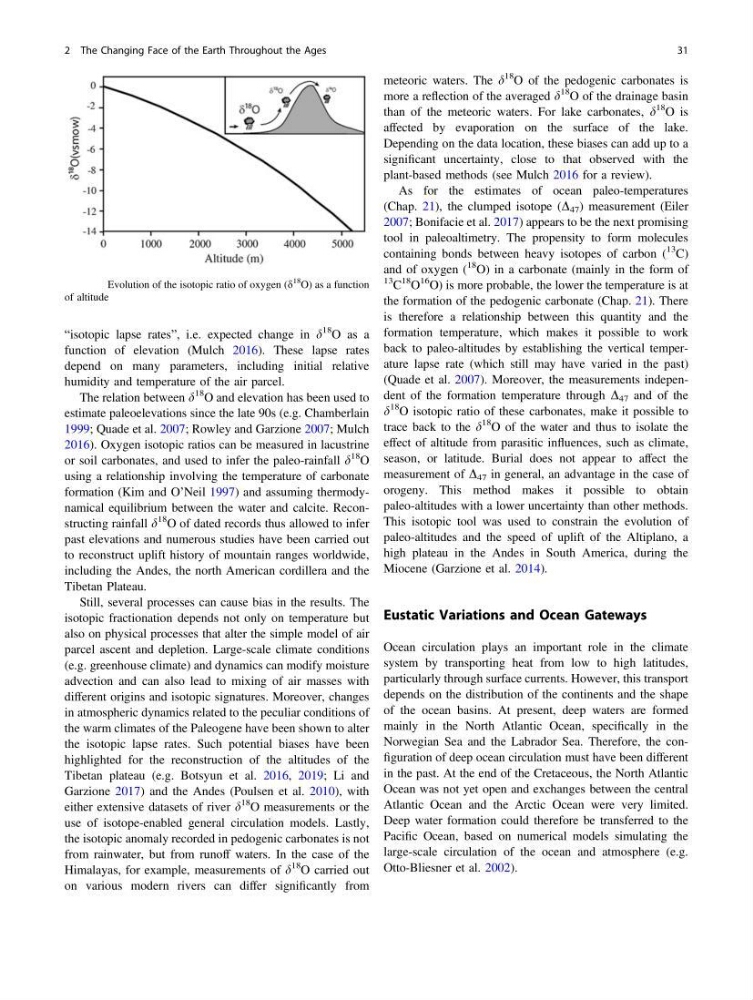
“isotopic lapse rates”, i.e. expected change in d
18 O as a
function of elevation (Mulch 2016). These lapse rates
depend on many parameters, including initial relative
humidity and temperature of the air parcel.
The relation between d
18 O and elevation has been used to
estimate paleoelevations since the late 90s (e.g. Chamberlain
1999; Quade et al. 2007; Rowley and Garzione 2007; Mulch
2016). Oxygen isotopic ratios can be measured in lacustrine
or soil carbonates, and used to infer the paleo-rainfall d
18 O
using a relationship involving the temperature of carbonate
formation (Kim and O’Neil 1997) and assuming thermodynamical equilibrium between the water and calcite. Reconstructing rainfall d
18 O of dated records thus allowed to infer
past elevations and numerous studies have been carried out
to reconstruct uplift history of mountain ranges worldwide,
including the Andes, the north American cordillera and the
Tibetan Plateau.
Still, several processes can cause bias in the results. The
isotopic fractionation depends not only on temperature but
also on physical processes that alter the simple model of air
parcel ascent and depletion. Large-scale climate conditions
(e.g. greenhouse climate) and dynamics can modify moisture
advection and can also lead to mixing of air masses with
different origins and isotopic signatures. Moreover, changes
in atmospheric dynamics related to the peculiar conditions of
the warm climates of the Paleogene have been shown to alter
the isotopic lapse rates. Such potential biases have been
highlighted for the reconstruction of the altitudes of the
Tibetan plateau (e.g. Botsyun et al. 2016, 2019; Li and
Garzione 2017) and the Andes (Poulsen et al. 2010), with
either extensive datasets of river d
18 O measurements or the
use of isotope-enabled general circulation models. Lastly,
the isotopic anomaly recorded in pedogenic carbonates is not
from rainwater, but from runoff waters. In the case of the
Himalayas, for example, measurements of d
18 O carried out
on various modern rivers can differ significantly from
meteoric waters. The d
18 O of the pedogenic carbonates is
more a reflection of the averaged d
18 O of the drainage basin
than of the meteoric waters. For lake carbonates, d
18 O is
affected by evaporation on the surface of the lake.
Depending on the data location, these biases can add up to a
significant uncertainty, close to that observed with the
plant-based methods (see Mulch 2016 for a review).
As for the estimates of ocean paleo-temperatures
(Chap. 21), the clumped isotope (D 47 ) measurement (Eiler
2007; Bonifacie et al. 2017) appears to be the next promising
tool in paleoaltimetry. The propensity to form molecules
containing bonds between heavy isotopes of carbon (
13 C)
and of oxygen (
18 O) in a carbonate (mainly in the form of
13 C
18 O
16 O) is more probable, the lower the temperature is at
the formation of the pedogenic carbonate (Chap. 21). There
is therefore a relationship between this quantity and the
formation temperature, which makes it possible to work
back to paleo-altitudes by establishing the vertical temperature lapse rate (which still may have varied in the past)
(Quade et al. 2007). Moreover, the measurements independent of the formation temperature through D 47 and of the
d
18 O isotopic ratio of these carbonates, make it possible to
trace back to the d
18 O of the water and thus to isolate the
effect of altitude from parasitic influences, such as climate,
season, or latitude. Burial does not appear to affect the
measurement of D 47 in general, an advantage in the case of
orogeny. This method makes it possible to obtain
paleo-altitudes with a lower uncertainty than other methods.
This isotopic tool was used to constrain the evolution of
paleo-altitudes and the speed of uplift of the Altiplano, a
high plateau in the Andes in South America, during the
Miocene (Garzione et al. 2014).
Eustatic Variations and Ocean Gateways
Ocean circulation plays an important role in the climate
system by transporting heat from low to high latitudes,
particularly through surface currents. However, this transport
depends on the distribution of the continents and the shape
of the ocean basins. At present, deep waters are formed
mainly in the North Atlantic Ocean, specifically in the
Norwegian Sea and the Labrador Sea. Therefore, the configuration of deep ocean circulation must have been different
in the past. At the end of the Cretaceous, the North Atlantic
Ocean was not yet open and exchanges between the central
Atlantic Ocean and the Arctic Ocean were very limited.
Deep water formation could therefore be transferred to the
Pacific Ocean, based on numerical models simulating the
large-scale circulation of the ocean and atmosphere (e.g.
Otto-Bliesner et al. 2002).
Fig. 2.3 Evolution of the isotopic ratio of oxygen (d
18
O) as a function
of altitude
2 The Changing Face of the Earth Throughout the Ages
31
18 O as a
function of elevation (Mulch 2016). These lapse rates
depend on many parameters, including initial relative
humidity and temperature of the air parcel.
The relation between d
18 O and elevation has been used to
estimate paleoelevations since the late 90s (e.g. Chamberlain
1999; Quade et al. 2007; Rowley and Garzione 2007; Mulch
2016). Oxygen isotopic ratios can be measured in lacustrine
or soil carbonates, and used to infer the paleo-rainfall d
18 O
using a relationship involving the temperature of carbonate
formation (Kim and O’Neil 1997) and assuming thermodynamical equilibrium between the water and calcite. Reconstructing rainfall d
18 O of dated records thus allowed to infer
past elevations and numerous studies have been carried out
to reconstruct uplift history of mountain ranges worldwide,
including the Andes, the north American cordillera and the
Tibetan Plateau.
Still, several processes can cause bias in the results. The
isotopic fractionation depends not only on temperature but
also on physical processes that alter the simple model of air
parcel ascent and depletion. Large-scale climate conditions
(e.g. greenhouse climate) and dynamics can modify moisture
advection and can also lead to mixing of air masses with
different origins and isotopic signatures. Moreover, changes
in atmospheric dynamics related to the peculiar conditions of
the warm climates of the Paleogene have been shown to alter
the isotopic lapse rates. Such potential biases have been
highlighted for the reconstruction of the altitudes of the
Tibetan plateau (e.g. Botsyun et al. 2016, 2019; Li and
Garzione 2017) and the Andes (Poulsen et al. 2010), with
either extensive datasets of river d
18 O measurements or the
use of isotope-enabled general circulation models. Lastly,
the isotopic anomaly recorded in pedogenic carbonates is not
from rainwater, but from runoff waters. In the case of the
Himalayas, for example, measurements of d
18 O carried out
on various modern rivers can differ significantly from
meteoric waters. The d
18 O of the pedogenic carbonates is
more a reflection of the averaged d
18 O of the drainage basin
than of the meteoric waters. For lake carbonates, d
18 O is
affected by evaporation on the surface of the lake.
Depending on the data location, these biases can add up to a
significant uncertainty, close to that observed with the
plant-based methods (see Mulch 2016 for a review).
As for the estimates of ocean paleo-temperatures
(Chap. 21), the clumped isotope (D 47 ) measurement (Eiler
2007; Bonifacie et al. 2017) appears to be the next promising
tool in paleoaltimetry. The propensity to form molecules
containing bonds between heavy isotopes of carbon (
13 C)
and of oxygen (
18 O) in a carbonate (mainly in the form of
13 C
18 O
16 O) is more probable, the lower the temperature is at
the formation of the pedogenic carbonate (Chap. 21). There
is therefore a relationship between this quantity and the
formation temperature, which makes it possible to work
back to paleo-altitudes by establishing the vertical temperature lapse rate (which still may have varied in the past)
(Quade et al. 2007). Moreover, the measurements independent of the formation temperature through D 47 and of the
d
18 O isotopic ratio of these carbonates, make it possible to
trace back to the d
18 O of the water and thus to isolate the
effect of altitude from parasitic influences, such as climate,
season, or latitude. Burial does not appear to affect the
measurement of D 47 in general, an advantage in the case of
orogeny. This method makes it possible to obtain
paleo-altitudes with a lower uncertainty than other methods.
This isotopic tool was used to constrain the evolution of
paleo-altitudes and the speed of uplift of the Altiplano, a
high plateau in the Andes in South America, during the
Miocene (Garzione et al. 2014).
Eustatic Variations and Ocean Gateways
Ocean circulation plays an important role in the climate
system by transporting heat from low to high latitudes,
particularly through surface currents. However, this transport
depends on the distribution of the continents and the shape
of the ocean basins. At present, deep waters are formed
mainly in the North Atlantic Ocean, specifically in the
Norwegian Sea and the Labrador Sea. Therefore, the configuration of deep ocean circulation must have been different
in the past. At the end of the Cretaceous, the North Atlantic
Ocean was not yet open and exchanges between the central
Atlantic Ocean and the Arctic Ocean were very limited.
Deep water formation could therefore be transferred to the
Pacific Ocean, based on numerical models simulating the
large-scale circulation of the ocean and atmosphere (e.g.
Otto-Bliesner et al. 2002).
Fig. 2.3 Evolution of the isotopic ratio of oxygen (d
18
O) as a function
of altitude
2 The Changing Face of the Earth Throughout the Ages
31