

Dansgaard-Oeschger Cycles
The Dansgaard-Oeschger cycles modify the climate on a
global scale (see Voelker (2002) for a review). Therefore,
the underlying mechanism must either have a global origin
as well, or else must modify a major element of the climate
system, which has a global impact. We will now consider
three possible mechanisms that fulfil these requirements.
One of the simplest ways to obtain a global response is a
variation in a forcing external to the climate system. It could be
a mechanism operating on long time scales (Milankovitch
forcing) or on short ones (volcanic changes, for example). It
has therefore been proposed that variations in solar forcing
may be responsible for Dansgaard-Oeschger events (Braun
et al. 2005). However, the relationship between the small
variations in the solar cycle at the relevant highlighted times
and the observed climate variations remain questionable.
The component of the climate system most likely to be
the cause of the Dansgaard-Oeschger events is undoubtedly
the ocean, and more particularly ocean circulation. It has two
main characteristics of interest here: it reacts on a global
scale, on time scales compatible with the DansgaardOeschger cycles, and it can respond to a relatively local
forcing. Studies such as Ganopolski and Rahmstorf (2001)
have shown that a semi-periodic freshwater forcing can,
under certain conditions, reproduce oscillations that resemble the cycles observed in the paleoclimate data. However,
this does not provide any indication of the origin of this
freshwater forcing and therefore gives no new explanation as
to the mechanism at work.
To compensate for this lack of a proven periodic climate
forcing, some authors propose mechanisms with oscillations
internal to the climate system. One of the most interesting
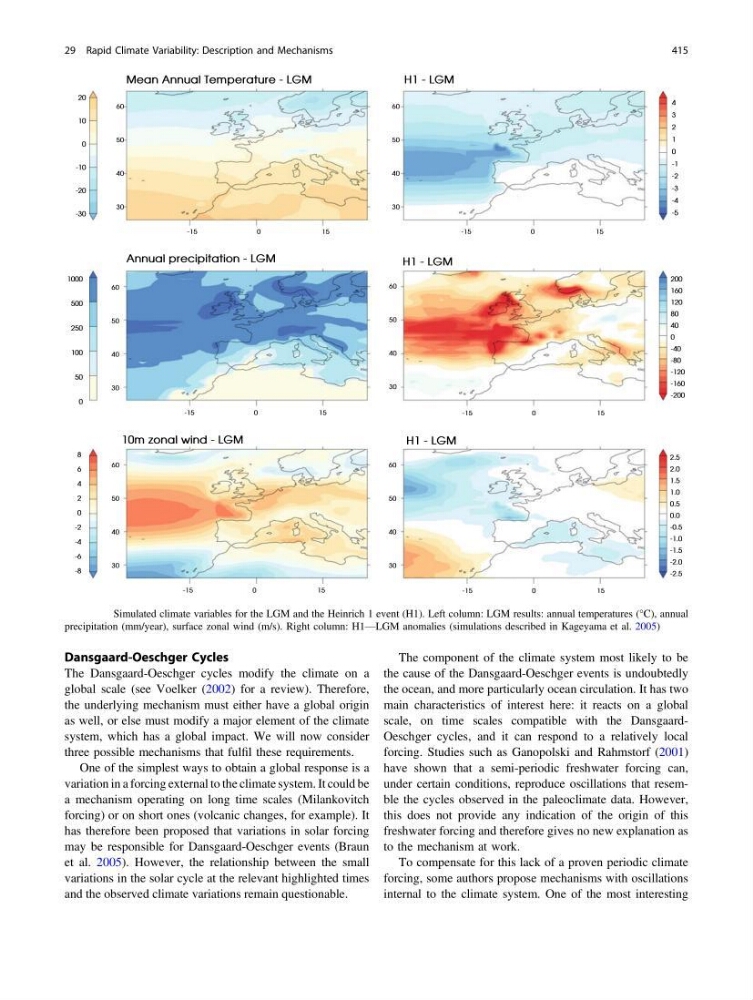
Fig. 29.5 Simulated climate variables for the LGM and the Heinrich 1 event (H1). Left column: LGM results: annual temperatures (°C), annual
precipitation (mm/year), surface zonal wind (m/s). Right column: H1—LGM anomalies (simulations described in Kageyama et al. 2005)
29 Rapid Climate Variability: Description and Mechanisms
415
The Dansgaard-Oeschger cycles modify the climate on a
global scale (see Voelker (2002) for a review). Therefore,
the underlying mechanism must either have a global origin
as well, or else must modify a major element of the climate
system, which has a global impact. We will now consider
three possible mechanisms that fulfil these requirements.
One of the simplest ways to obtain a global response is a
variation in a forcing external to the climate system. It could be
a mechanism operating on long time scales (Milankovitch
forcing) or on short ones (volcanic changes, for example). It
has therefore been proposed that variations in solar forcing
may be responsible for Dansgaard-Oeschger events (Braun
et al. 2005). However, the relationship between the small
variations in the solar cycle at the relevant highlighted times
and the observed climate variations remain questionable.
The component of the climate system most likely to be
the cause of the Dansgaard-Oeschger events is undoubtedly
the ocean, and more particularly ocean circulation. It has two
main characteristics of interest here: it reacts on a global
scale, on time scales compatible with the DansgaardOeschger cycles, and it can respond to a relatively local
forcing. Studies such as Ganopolski and Rahmstorf (2001)
have shown that a semi-periodic freshwater forcing can,
under certain conditions, reproduce oscillations that resemble the cycles observed in the paleoclimate data. However,
this does not provide any indication of the origin of this
freshwater forcing and therefore gives no new explanation as
to the mechanism at work.
To compensate for this lack of a proven periodic climate
forcing, some authors propose mechanisms with oscillations
internal to the climate system. One of the most interesting
Fig. 29.5 Simulated climate variables for the LGM and the Heinrich 1 event (H1). Left column: LGM results: annual temperatures (°C), annual
precipitation (mm/year), surface zonal wind (m/s). Right column: H1—LGM anomalies (simulations described in Kageyama et al. 2005)
29 Rapid Climate Variability: Description and Mechanisms
415