

climates provide many examples of fundamental reorganizations of the climate system.
For periods extending beyond a few thousand years,
changes in insolation due to slow changes in the Earth’s
orbit around the Sun, the formation of ice sheets, the sinking
of bedrock and changes in the composition of air also
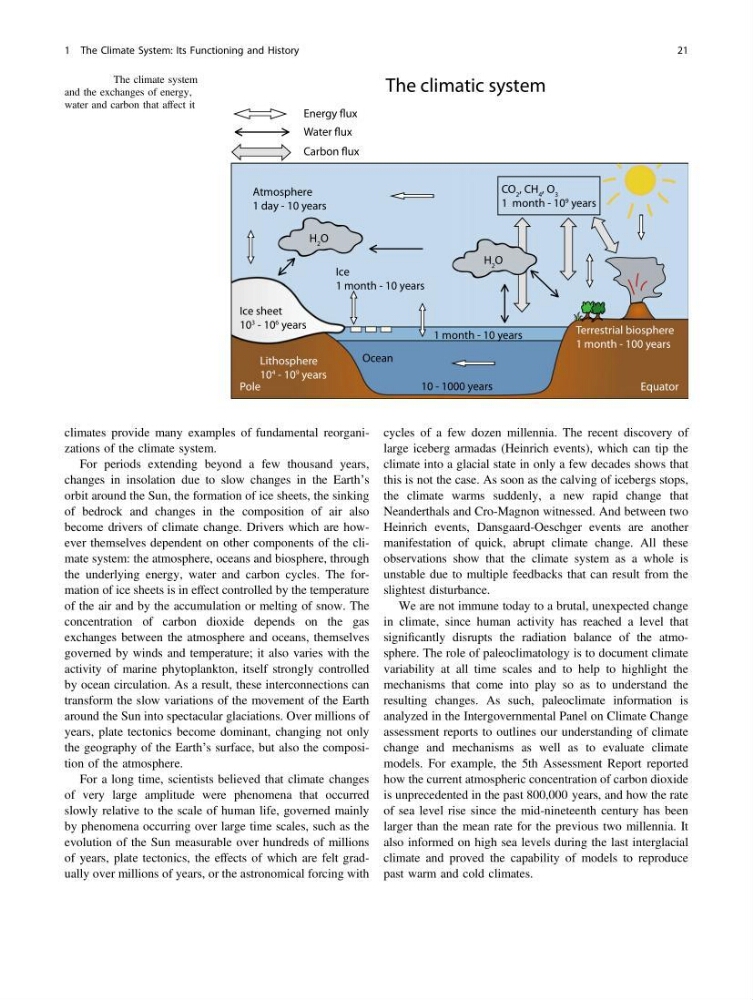
become drivers of climate change. Drivers which are however themselves dependent on other components of the climate system: the atmosphere, oceans and biosphere, through
the underlying energy, water and carbon cycles. The formation of ice sheets is in effect controlled by the temperature
of the air and by the accumulation or melting of snow. The
concentration of carbon dioxide depends on the gas
exchanges between the atmosphere and oceans, themselves
governed by winds and temperature; it also varies with the
activity of marine phytoplankton, itself strongly controlled
by ocean circulation. As a result, these interconnections can
transform the slow variations of the movement of the Earth
around the Sun into spectacular glaciations. Over millions of
years, plate tectonics become dominant, changing not only
the geography of the Earth’s surface, but also the composition of the atmosphere.
For a long time, scientists believed that climate changes
of very large amplitude were phenomena that occurred
slowly relative to the scale of human life, governed mainly
by phenomena occurring over large time scales, such as the
evolution of the Sun measurable over hundreds of millions
of years, plate tectonics, the effects of which are felt gradually over millions of years, or the astronomical forcing with
cycles of a few dozen millennia. The recent discovery of
large iceberg armadas (Heinrich events), which can tip the
climate into a glacial state in only a few decades shows that
this is not the case. As soon as the calving of icebergs stops,
the climate warms suddenly, a new rapid change that
Neanderthals and Cro-Magnon witnessed. And between two
Heinrich events, Dansgaard-Oeschger events are another
manifestation of quick, abrupt climate change. All these
observations show that the climate system as a whole is
unstable due to multiple feedbacks that can result from the
slightest disturbance.
We are not immune today to a brutal, unexpected change
in climate, since human activity has reached a level that
significantly disrupts the radiation balance of the atmosphere. The role of paleoclimatology is to document climate
variability at all time scales and to help to highlight the
mechanisms that come into play so as to understand the
resulting changes. As such, paleoclimate information is
analyzed in the Intergovernmental Panel on Climate Change
assessment reports to outlines our understanding of climate
change and mechanisms as well as to evaluate climate
models. For example, the 5th Assessment Report reported
how the current atmospheric concentration of carbon dioxide
is unprecedented in the past 800,000 years, and how the rate
of sea level rise since the mid-nineteenth century has been
larger than the mean rate for the previous two millennia. It
also informed on high sea levels during the last interglacial
climate and proved the capability of models to reproduce
past warm and cold climates.
The climatic system
Atmosphere
1 day - 10 years
H 2 O
H 2 O
CO 2 , CH 4 , O 3
1 month - 10
9 years
1 month - 10 years
Ocean
10 - 1000 years
Ice
1 month - 10 years
Ice sheet
10
3 - 10
6 years
Terrestrial biosphere
1 month - 100 years
Pole
Equator
Lithosphere
10
4 - 10
9 years
Fig. 1.10 The climate system
and the exchanges of energy,
water and carbon that affect it
1 The Climate System: Its Functioning and History
21
For periods extending beyond a few thousand years,
changes in insolation due to slow changes in the Earth’s
orbit around the Sun, the formation of ice sheets, the sinking
of bedrock and changes in the composition of air also
become drivers of climate change. Drivers which are however themselves dependent on other components of the climate system: the atmosphere, oceans and biosphere, through
the underlying energy, water and carbon cycles. The formation of ice sheets is in effect controlled by the temperature
of the air and by the accumulation or melting of snow. The
concentration of carbon dioxide depends on the gas
exchanges between the atmosphere and oceans, themselves
governed by winds and temperature; it also varies with the
activity of marine phytoplankton, itself strongly controlled
by ocean circulation. As a result, these interconnections can
transform the slow variations of the movement of the Earth
around the Sun into spectacular glaciations. Over millions of
years, plate tectonics become dominant, changing not only
the geography of the Earth’s surface, but also the composition of the atmosphere.
For a long time, scientists believed that climate changes
of very large amplitude were phenomena that occurred
slowly relative to the scale of human life, governed mainly
by phenomena occurring over large time scales, such as the
evolution of the Sun measurable over hundreds of millions
of years, plate tectonics, the effects of which are felt gradually over millions of years, or the astronomical forcing with
cycles of a few dozen millennia. The recent discovery of
large iceberg armadas (Heinrich events), which can tip the
climate into a glacial state in only a few decades shows that
this is not the case. As soon as the calving of icebergs stops,
the climate warms suddenly, a new rapid change that
Neanderthals and Cro-Magnon witnessed. And between two
Heinrich events, Dansgaard-Oeschger events are another
manifestation of quick, abrupt climate change. All these
observations show that the climate system as a whole is
unstable due to multiple feedbacks that can result from the
slightest disturbance.
We are not immune today to a brutal, unexpected change
in climate, since human activity has reached a level that
significantly disrupts the radiation balance of the atmosphere. The role of paleoclimatology is to document climate
variability at all time scales and to help to highlight the
mechanisms that come into play so as to understand the
resulting changes. As such, paleoclimate information is
analyzed in the Intergovernmental Panel on Climate Change
assessment reports to outlines our understanding of climate
change and mechanisms as well as to evaluate climate
models. For example, the 5th Assessment Report reported
how the current atmospheric concentration of carbon dioxide
is unprecedented in the past 800,000 years, and how the rate
of sea level rise since the mid-nineteenth century has been
larger than the mean rate for the previous two millennia. It
also informed on high sea levels during the last interglacial
climate and proved the capability of models to reproduce
past warm and cold climates.
The climatic system
Atmosphere
1 day - 10 years
H 2 O
H 2 O
CO 2 , CH 4 , O 3
1 month - 10
9 years
1 month - 10 years
Ocean
10 - 1000 years
Ice
1 month - 10 years
Ice sheet
10
3 - 10
6 years
Terrestrial biosphere
1 month - 100 years
Pole
Equator
Lithosphere
10
4 - 10
9 years
Fig. 1.10 The climate system
and the exchanges of energy,
water and carbon that affect it
1 The Climate System: Its Functioning and History
21