

phase, and this has allowed the reconstruction of the NAO
and its intensity over the last 350 years with, again, the
detection of multi-year and multi decadal intervals. Teleconnections associated with the NAO are also recorded in
marine sediments. Over the last ten thousand years, there has
been a tendency towards cooling of the surface waters of the
eastern North Atlantic Ocean while there has been a contrasting warming of the subtropical western Atlantic and the
eastern Mediterranean. This trend is seen as a sign of a
continued weakening of the NAO during the Holocene.
However, on these time scales, it becomes difficult to
distinguish between a change in the NAO expressed over
several millennia and a long-term climate trend, driven by
the slow fluctuations in orbital parameters. Indeed, cyclic
variations in the precession (with a cycle of 21,000 years)
were responsible for an increase in the winter incident solar
radiation in the tropics 10,000 years ago, followed by its
progressive decrease accompanied by a drop in the difference in atmospheric pressure between the tropics and the
high northern latitudes during the Holocene. This is an
example of the changes in insolation changes predicted by
astronomical theory.
The Oceans
Main Characteristics of the Oceans
The oceans cover two thirds of the surface of the planet.
With an average depth of 3900 m, they have a very high
thermal inertia, much greater than that of the atmosphere.
A layer 3 m deep of ocean surface waters has the same heat
capacity as the 10 km troposphere. This feature explains
why coastal regions have a much less contrasted climate than
regions in the interior of large landmasses. It also plays an
important role in determining the response time of the
atmosphere-ocean system to a disturbance in the radiation
balance.
The atmosphere and the oceans exchange momentum
through the friction exerted by winds at the air-sea interface.
They are thus responsible for the great marine currents,
well-known to ocean-going sailors. The atmosphere and the
oceans also exchange energy and water. Energy exchanges,
through solar radiation, the infrared flow, turbulent eddies at
the surface, and sensitive and latent heat, impact on the
temperature of surface waters of the ocean. Water exchanges, through evaporation and precipitation, have an impact
on salinity: evaporation increases the salinity of seawater
while rain, conversely, decreases salinity. These interactions,
which create variations in the temperature and salinity of
seawater, ultimately determine its density. Density is indeed
inversely proportional to temperature and directly proportional to salinity. Density differences are then the cause of
the movement of large, deep-water masses in the world’s
oceans.
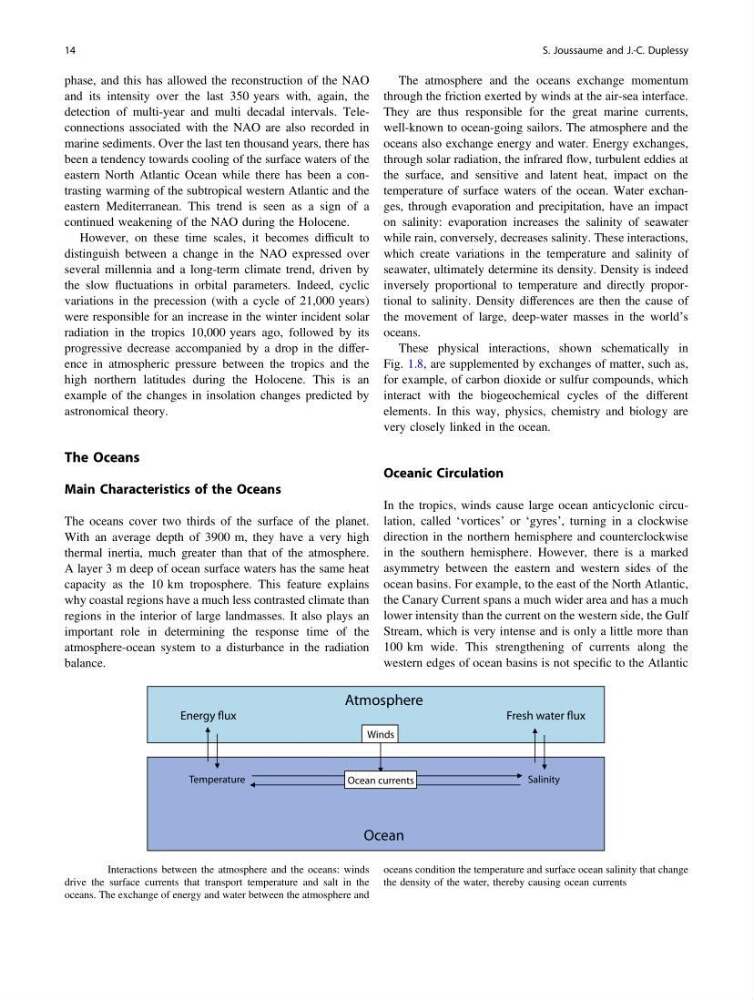
These physical interactions, shown schematically in
Fig. 1.8, are supplemented by exchanges of matter, such as,
for example, of carbon dioxide or sulfur compounds, which
interact with the biogeochemical cycles of the different
elements. In this way, physics, chemistry and biology are
very closely linked in the ocean.
Oceanic Circulation
In the tropics, winds cause large ocean anticyclonic circulation, called ‘vortices’ or ‘gyres’, turning in a clockwise
direction in the northern hemisphere and counterclockwise
in the southern hemisphere. However, there is a marked
asymmetry between the eastern and western sides of the
ocean basins. For example, to the east of the North Atlantic,
the Canary Current spans a much wider area and has a much
lower intensity than the current on the western side, the Gulf
Stream, which is very intense and is only a little more than
100 km wide. This strengthening of currents along the
western edges of ocean basins is not specific to the Atlantic
Salinity
Temperature
Winds
Ocean currents
Atmosphere
Ocean
Fig. 1.8 Interactions between the atmosphere and the oceans: winds
drive the surface currents that transport temperature and salt in the
oceans. The exchange of energy and water between the atmosphere and
oceans condition the temperature and surface ocean salinity that change
the density of the water, thereby causing ocean currents
14
S. Joussaume and J.-C. Duplessy
and its intensity over the last 350 years with, again, the
detection of multi-year and multi decadal intervals. Teleconnections associated with the NAO are also recorded in
marine sediments. Over the last ten thousand years, there has
been a tendency towards cooling of the surface waters of the
eastern North Atlantic Ocean while there has been a contrasting warming of the subtropical western Atlantic and the
eastern Mediterranean. This trend is seen as a sign of a
continued weakening of the NAO during the Holocene.
However, on these time scales, it becomes difficult to
distinguish between a change in the NAO expressed over
several millennia and a long-term climate trend, driven by
the slow fluctuations in orbital parameters. Indeed, cyclic
variations in the precession (with a cycle of 21,000 years)
were responsible for an increase in the winter incident solar
radiation in the tropics 10,000 years ago, followed by its
progressive decrease accompanied by a drop in the difference in atmospheric pressure between the tropics and the
high northern latitudes during the Holocene. This is an
example of the changes in insolation changes predicted by
astronomical theory.
The Oceans
Main Characteristics of the Oceans
The oceans cover two thirds of the surface of the planet.
With an average depth of 3900 m, they have a very high
thermal inertia, much greater than that of the atmosphere.
A layer 3 m deep of ocean surface waters has the same heat
capacity as the 10 km troposphere. This feature explains
why coastal regions have a much less contrasted climate than
regions in the interior of large landmasses. It also plays an
important role in determining the response time of the
atmosphere-ocean system to a disturbance in the radiation
balance.
The atmosphere and the oceans exchange momentum
through the friction exerted by winds at the air-sea interface.
They are thus responsible for the great marine currents,
well-known to ocean-going sailors. The atmosphere and the
oceans also exchange energy and water. Energy exchanges,
through solar radiation, the infrared flow, turbulent eddies at
the surface, and sensitive and latent heat, impact on the
temperature of surface waters of the ocean. Water exchanges, through evaporation and precipitation, have an impact
on salinity: evaporation increases the salinity of seawater
while rain, conversely, decreases salinity. These interactions,
which create variations in the temperature and salinity of
seawater, ultimately determine its density. Density is indeed
inversely proportional to temperature and directly proportional to salinity. Density differences are then the cause of
the movement of large, deep-water masses in the world’s
oceans.
These physical interactions, shown schematically in
Fig. 1.8, are supplemented by exchanges of matter, such as,
for example, of carbon dioxide or sulfur compounds, which
interact with the biogeochemical cycles of the different
elements. In this way, physics, chemistry and biology are
very closely linked in the ocean.
Oceanic Circulation
In the tropics, winds cause large ocean anticyclonic circulation, called ‘vortices’ or ‘gyres’, turning in a clockwise
direction in the northern hemisphere and counterclockwise
in the southern hemisphere. However, there is a marked
asymmetry between the eastern and western sides of the
ocean basins. For example, to the east of the North Atlantic,
the Canary Current spans a much wider area and has a much
lower intensity than the current on the western side, the Gulf
Stream, which is very intense and is only a little more than
100 km wide. This strengthening of currents along the
western edges of ocean basins is not specific to the Atlantic
Salinity
Temperature
Winds
Ocean currents
Atmosphere
Ocean
Fig. 1.8 Interactions between the atmosphere and the oceans: winds
drive the surface currents that transport temperature and salt in the
oceans. The exchange of energy and water between the atmosphere and
oceans condition the temperature and surface ocean salinity that change
the density of the water, thereby causing ocean currents
14
S. Joussaume and J.-C. Duplessy