

information on the masses of the different ice sheets in the
past. The extent of the ice sheet is generally estimated
through geomorphological data. The inversion of relative sea
level data using isostatic rebound models (including the
geoid calculation) informs us about ice cap thicknesses in the
past (Clark et al. 2002).
Finally, the ice sheets often lie on a bedrock that is below
sea level. This is true for Western Antarctica currently. When
the ice sheet melts, the sea replaces the volume of ice below
the waterline and the impact on the sea level is thereby
reduced. This volume of water is called ‘implicit ice’.
Mechanisms Involved in the Evolution
of an Ice Sheet
The evolution of an ice sheet obeys the law of conservation
of mass. If the supply of snow is greater than the loss via
melting or through the calving of icebergs, the sheet will
grow or expand. In addition to this basic principle, there are
many processes that interact with both external (atmosphere,
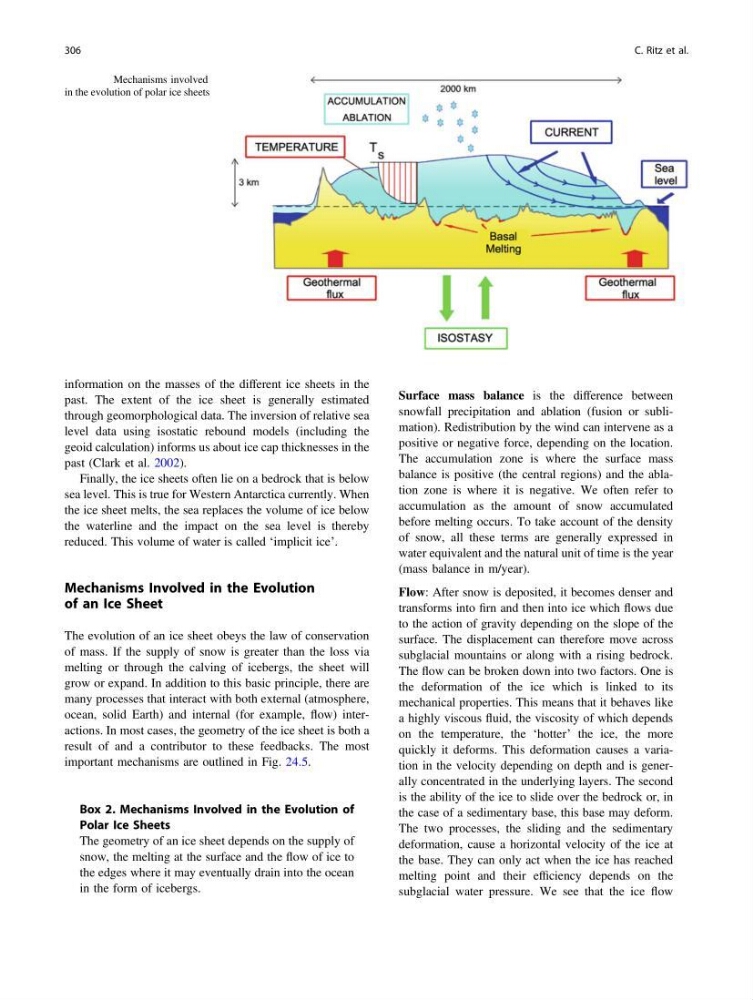
ocean, solid Earth) and internal (for example, flow) interactions. In most cases, the geometry of the ice sheet is both a
result of and a contributor to these feedbacks. The most
important mechanisms are outlined in Fig. 24.5.
Box 2. Mechanisms Involved in the Evolution of
Polar Ice Sheets
The geometry of an ice sheet depends on the supply of
snow, the melting at the surface and the flow of ice to
the edges where it may eventually drain into the ocean
in the form of icebergs.
Surface mass balance is the difference between
snowfall precipitation and ablation (fusion or sublimation). Redistribution by the wind can intervene as a
positive or negative force, depending on the location.
The accumulation zone is where the surface mass
balance is positive (the central regions) and the ablation zone is where it is negative. We often refer to
accumulation as the amount of snow accumulated
before melting occurs. To take account of the density
of snow, all these terms are generally expressed in
water equivalent and the natural unit of time is the year
(mass balance in m/year).
Flow: After snow is deposited, it becomes denser and
transforms into firn and then into ice which flows due
to the action of gravity depending on the slope of the
surface. The displacement can therefore move across
subglacial mountains or along with a rising bedrock.
The flow can be broken down into two factors. One is
the deformation of the ice which is linked to its
mechanical properties. This means that it behaves like
a highly viscous fluid, the viscosity of which depends
on the temperature, the ‘hotter’ the ice, the more
quickly it deforms. This deformation causes a variation in the velocity depending on depth and is generally concentrated in the underlying layers. The second
is the ability of the ice to slide over the bedrock or, in
the case of a sedimentary base, this base may deform.
The two processes, the sliding and the sedimentary
deformation, cause a horizontal velocity of the ice at
the base. They can only act when the ice has reached
melting point and their efficiency depends on the
subglacial water pressure. We see that the ice flow
Fig. 24.5 Mechanisms involved
in the evolution of polar ice sheets
306
C. Ritz et al.
past. The extent of the ice sheet is generally estimated
through geomorphological data. The inversion of relative sea
level data using isostatic rebound models (including the
geoid calculation) informs us about ice cap thicknesses in the
past (Clark et al. 2002).
Finally, the ice sheets often lie on a bedrock that is below
sea level. This is true for Western Antarctica currently. When
the ice sheet melts, the sea replaces the volume of ice below
the waterline and the impact on the sea level is thereby
reduced. This volume of water is called ‘implicit ice’.
Mechanisms Involved in the Evolution
of an Ice Sheet
The evolution of an ice sheet obeys the law of conservation
of mass. If the supply of snow is greater than the loss via
melting or through the calving of icebergs, the sheet will
grow or expand. In addition to this basic principle, there are
many processes that interact with both external (atmosphere,
ocean, solid Earth) and internal (for example, flow) interactions. In most cases, the geometry of the ice sheet is both a
result of and a contributor to these feedbacks. The most
important mechanisms are outlined in Fig. 24.5.
Box 2. Mechanisms Involved in the Evolution of
Polar Ice Sheets
The geometry of an ice sheet depends on the supply of
snow, the melting at the surface and the flow of ice to
the edges where it may eventually drain into the ocean
in the form of icebergs.
Surface mass balance is the difference between
snowfall precipitation and ablation (fusion or sublimation). Redistribution by the wind can intervene as a
positive or negative force, depending on the location.
The accumulation zone is where the surface mass
balance is positive (the central regions) and the ablation zone is where it is negative. We often refer to
accumulation as the amount of snow accumulated
before melting occurs. To take account of the density
of snow, all these terms are generally expressed in
water equivalent and the natural unit of time is the year
(mass balance in m/year).
Flow: After snow is deposited, it becomes denser and
transforms into firn and then into ice which flows due
to the action of gravity depending on the slope of the
surface. The displacement can therefore move across
subglacial mountains or along with a rising bedrock.
The flow can be broken down into two factors. One is
the deformation of the ice which is linked to its
mechanical properties. This means that it behaves like
a highly viscous fluid, the viscosity of which depends
on the temperature, the ‘hotter’ the ice, the more
quickly it deforms. This deformation causes a variation in the velocity depending on depth and is generally concentrated in the underlying layers. The second
is the ability of the ice to slide over the bedrock or, in
the case of a sedimentary base, this base may deform.
The two processes, the sliding and the sedimentary
deformation, cause a horizontal velocity of the ice at
the base. They can only act when the ice has reached
melting point and their efficiency depends on the
subglacial water pressure. We see that the ice flow
Fig. 24.5 Mechanisms involved
in the evolution of polar ice sheets
306
C. Ritz et al.