

significance since the forcing of the aerosol may, for
example, be much greater over heavily anthropized regions
of the northern hemisphere. Moreover, the temporal evolution of anthropogenic SO 2 emissions varies greatly from one
continent to another: emissions reached a peak in the 1980s
in Western Europe and the USA, while an acceleration of
their emissions is underway in India, for example. The sulfur
cycle in the atmosphere also involves two major natural
sources, volcanic activity and marine DMS biogenic emissions. An important dimension of the latter source is its
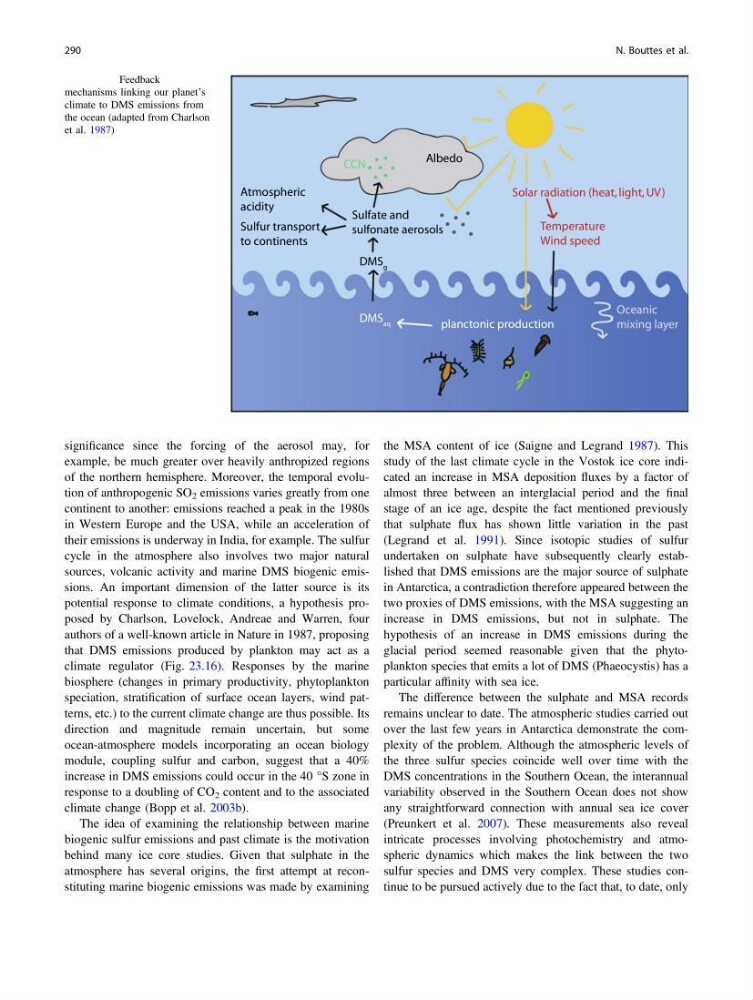
potential response to climate conditions, a hypothesis proposed by Charlson, Lovelock, Andreae and Warren, four
authors of a well-known article in Nature in 1987, proposing
that DMS emissions produced by plankton may act as a
climate regulator (Fig. 23.16). Responses by the marine
biosphere (changes in primary productivity, phytoplankton
speciation, stratification of surface ocean layers, wind patterns, etc.) to the current climate change are thus possible. Its
direction and magnitude remain uncertain, but some
ocean-atmosphere models incorporating an ocean biology
module, coupling sulfur and carbon, suggest that a 40%
increase in DMS emissions could occur in the 40 °S zone in
response to a doubling of CO 2 content and to the associated
climate change (Bopp et al. 2003b).
The idea of examining the relationship between marine
biogenic sulfur emissions and past climate is the motivation
behind many ice core studies. Given that sulphate in the
atmosphere has several origins, the first attempt at reconstituting marine biogenic emissions was made by examining
the MSA content of ice (Saigne and Legrand 1987). This
study of the last climate cycle in the Vostok ice core indicated an increase in MSA deposition fluxes by a factor of
almost three between an interglacial period and the final
stage of an ice age, despite the fact mentioned previously
that sulphate flux has shown little variation in the past
(Legrand et al. 1991). Since isotopic studies of sulfur
undertaken on sulphate have subsequently clearly established that DMS emissions are the major source of sulphate
in Antarctica, a contradiction therefore appeared between the
two proxies of DMS emissions, with the MSA suggesting an
increase in DMS emissions, but not in sulphate. The
hypothesis of an increase in DMS emissions during the
glacial period seemed reasonable given that the phytoplankton species that emits a lot of DMS (Phaeocystis) has a
particular affinity with sea ice.
The difference between the sulphate and MSA records
remains unclear to date. The atmospheric studies carried out
over the last few years in Antarctica demonstrate the complexity of the problem. Although the atmospheric levels of
the three sulfur species coincide well over time with the
DMS concentrations in the Southern Ocean, the interannual
variability observed in the Southern Ocean does not show
any straightforward connection with annual sea ice cover
(Preunkert et al. 2007). These measurements also reveal
intricate processes involving photochemistry and atmospheric dynamics which makes the link between the two
sulfur species and DMS very complex. These studies continue to be pursued actively due to the fact that, to date, only
Atmospheric
acidity
Sulfur transport
to continents
Sulfate and
sulfonate aerosols
Albedo
CCN
Solar radiation (heat, light, UV)
Temperature
Wind speed
DMS g
DMS aq
Oceanic
mixing layer
planctonic production
Fig. 23.16 Feedback
mechanisms linking our planet’s
climate to DMS emissions from
the ocean (adapted from Charlson
et al. 1987)
290
N. Bouttes et al.
example, be much greater over heavily anthropized regions
of the northern hemisphere. Moreover, the temporal evolution of anthropogenic SO 2 emissions varies greatly from one
continent to another: emissions reached a peak in the 1980s
in Western Europe and the USA, while an acceleration of
their emissions is underway in India, for example. The sulfur
cycle in the atmosphere also involves two major natural
sources, volcanic activity and marine DMS biogenic emissions. An important dimension of the latter source is its
potential response to climate conditions, a hypothesis proposed by Charlson, Lovelock, Andreae and Warren, four
authors of a well-known article in Nature in 1987, proposing
that DMS emissions produced by plankton may act as a
climate regulator (Fig. 23.16). Responses by the marine
biosphere (changes in primary productivity, phytoplankton
speciation, stratification of surface ocean layers, wind patterns, etc.) to the current climate change are thus possible. Its
direction and magnitude remain uncertain, but some
ocean-atmosphere models incorporating an ocean biology
module, coupling sulfur and carbon, suggest that a 40%
increase in DMS emissions could occur in the 40 °S zone in
response to a doubling of CO 2 content and to the associated
climate change (Bopp et al. 2003b).
The idea of examining the relationship between marine
biogenic sulfur emissions and past climate is the motivation
behind many ice core studies. Given that sulphate in the
atmosphere has several origins, the first attempt at reconstituting marine biogenic emissions was made by examining
the MSA content of ice (Saigne and Legrand 1987). This
study of the last climate cycle in the Vostok ice core indicated an increase in MSA deposition fluxes by a factor of
almost three between an interglacial period and the final
stage of an ice age, despite the fact mentioned previously
that sulphate flux has shown little variation in the past
(Legrand et al. 1991). Since isotopic studies of sulfur
undertaken on sulphate have subsequently clearly established that DMS emissions are the major source of sulphate
in Antarctica, a contradiction therefore appeared between the
two proxies of DMS emissions, with the MSA suggesting an
increase in DMS emissions, but not in sulphate. The
hypothesis of an increase in DMS emissions during the
glacial period seemed reasonable given that the phytoplankton species that emits a lot of DMS (Phaeocystis) has a
particular affinity with sea ice.
The difference between the sulphate and MSA records
remains unclear to date. The atmospheric studies carried out
over the last few years in Antarctica demonstrate the complexity of the problem. Although the atmospheric levels of
the three sulfur species coincide well over time with the
DMS concentrations in the Southern Ocean, the interannual
variability observed in the Southern Ocean does not show
any straightforward connection with annual sea ice cover
(Preunkert et al. 2007). These measurements also reveal
intricate processes involving photochemistry and atmospheric dynamics which makes the link between the two
sulfur species and DMS very complex. These studies continue to be pursued actively due to the fact that, to date, only
Atmospheric
acidity
Sulfur transport
to continents
Sulfate and
sulfonate aerosols
Albedo
CCN
Solar radiation (heat, light, UV)
Temperature
Wind speed
DMS g
DMS aq
Oceanic
mixing layer
planctonic production
Fig. 23.16 Feedback
mechanisms linking our planet’s
climate to DMS emissions from
the ocean (adapted from Charlson
et al. 1987)
290
N. Bouttes et al.