

The Last Deglaciation
Several decades ago, continental paleoclimatologists
described the warming by steps that occurred during the last
disappearance of the large northern ice caps, a period
extending from 20 to 8 ka. This ‘last deglaciation’ was also
identified by paleoceanographers in marine sediment cores
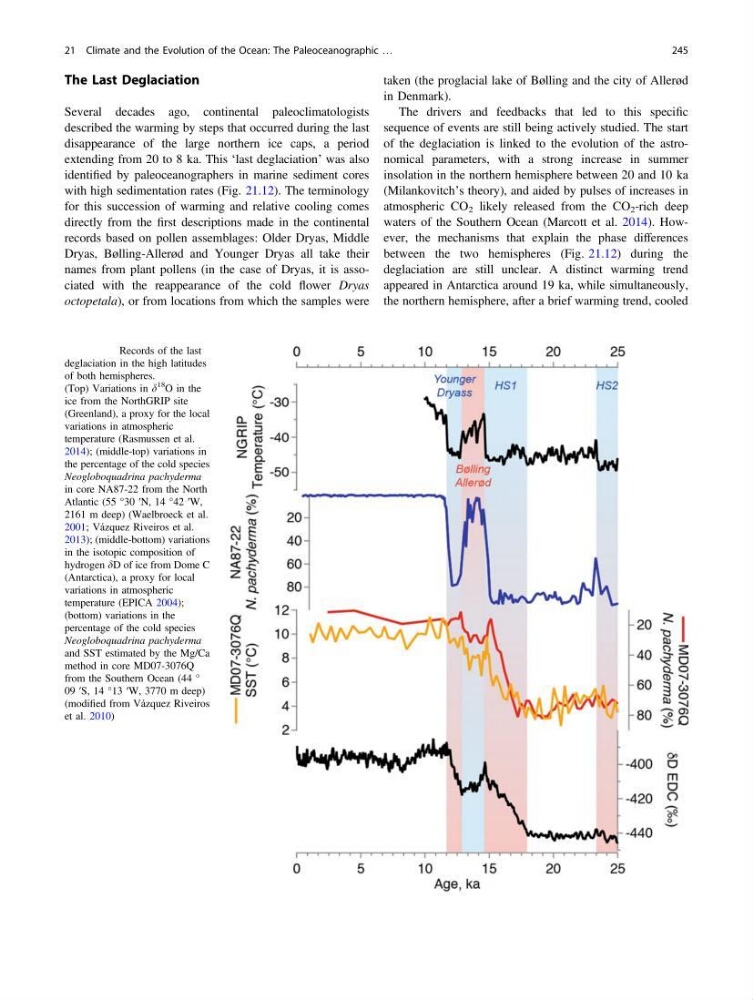
with high sedimentation rates (Fig. 21.12). The terminology
for this succession of warming and relative cooling comes
directly from the first descriptions made in the continental
records based on pollen assemblages: Older Dryas, Middle
Dryas, Bølling-Allerød and Younger Dryas all take their
names from plant pollens (in the case of Dryas, it is associated with the reappearance of the cold flower Dryas
octopetala), or from locations from which the samples were
taken (the proglacial lake of Bølling and the city of Allerød
in Denmark).
The drivers and feedbacks that led to this specific
sequence of events are still being actively studied. The start
of the deglaciation is linked to the evolution of the astronomical parameters, with a strong increase in summer
insolation in the northern hemisphere between 20 and 10 ka
(Milankovitch’s theory), and aided by pulses of increases in
atmospheric CO 2 likely released from the CO 2 -rich deep
waters of the Southern Ocean (Marcott et al. 2014). However, the mechanisms that explain the phase differences
between the two hemispheres (Fig. 21.12) during the
deglaciation are still unclear. A distinct warming trend
appeared in Antarctica around 19 ka, while simultaneously,
the northern hemisphere, after a brief warming trend, cooled
Fig. 21.12 Records of the last
deglaciation in the high latitudes
of both hemispheres.
(Top) Variations in d
18
O in the
ice from the NorthGRIP site
(Greenland), a proxy for the local
variations in atmospheric
temperature (Rasmussen et al.
2014); (middle-top) variations in
the percentage of the cold species
Neogloboquadrina pachyderma
in core NA87-22 from the North
Atlantic (55 °30 ′N, 14 °42 ′W,
2161 m deep) (Waelbroeck et al.
2001; Vázquez Riveiros et al.
2013); (middle-bottom) variations
in the isotopic composition of
hydrogen dD of ice from Dome C
(Antarctica), a proxy for local
variations in atmospheric
temperature (EPICA 2004);
(bottom) variations in the
percentage of the cold species
Neogloboquadrina pachyderma
and SST estimated by the Mg/Ca
method in core MD07-3076Q
from the Southern Ocean (44 °
09 ′S, 14 °13 ′W, 3770 m deep)
(modified from Vázquez Riveiros
et al. 2010)
21 Climate and the Evolution of the Ocean: The Paleoceanographic …
245
Several decades ago, continental paleoclimatologists
described the warming by steps that occurred during the last
disappearance of the large northern ice caps, a period
extending from 20 to 8 ka. This ‘last deglaciation’ was also
identified by paleoceanographers in marine sediment cores
with high sedimentation rates (Fig. 21.12). The terminology
for this succession of warming and relative cooling comes
directly from the first descriptions made in the continental
records based on pollen assemblages: Older Dryas, Middle
Dryas, Bølling-Allerød and Younger Dryas all take their
names from plant pollens (in the case of Dryas, it is associated with the reappearance of the cold flower Dryas
octopetala), or from locations from which the samples were
taken (the proglacial lake of Bølling and the city of Allerød
in Denmark).
The drivers and feedbacks that led to this specific
sequence of events are still being actively studied. The start
of the deglaciation is linked to the evolution of the astronomical parameters, with a strong increase in summer
insolation in the northern hemisphere between 20 and 10 ka
(Milankovitch’s theory), and aided by pulses of increases in
atmospheric CO 2 likely released from the CO 2 -rich deep
waters of the Southern Ocean (Marcott et al. 2014). However, the mechanisms that explain the phase differences
between the two hemispheres (Fig. 21.12) during the
deglaciation are still unclear. A distinct warming trend
appeared in Antarctica around 19 ka, while simultaneously,
the northern hemisphere, after a brief warming trend, cooled
Fig. 21.12 Records of the last
deglaciation in the high latitudes
of both hemispheres.
(Top) Variations in d
18
O in the
ice from the NorthGRIP site
(Greenland), a proxy for the local
variations in atmospheric
temperature (Rasmussen et al.
2014); (middle-top) variations in
the percentage of the cold species
Neogloboquadrina pachyderma
in core NA87-22 from the North
Atlantic (55 °30 ′N, 14 °42 ′W,
2161 m deep) (Waelbroeck et al.
2001; Vázquez Riveiros et al.
2013); (middle-bottom) variations
in the isotopic composition of
hydrogen dD of ice from Dome C
(Antarctica), a proxy for local
variations in atmospheric
temperature (EPICA 2004);
(bottom) variations in the
percentage of the cold species
Neogloboquadrina pachyderma
and SST estimated by the Mg/Ca
method in core MD07-3076Q
from the Southern Ocean (44 °
09 ′S, 14 °13 ′W, 3770 m deep)
(modified from Vázquez Riveiros
et al. 2010)
21 Climate and the Evolution of the Ocean: The Paleoceanographic …
245