

seawater is affected by evaporation and precipitation: the
vapor phase is depleted in the heavy
18 O isotopes relative to
the liquid phase. Conversely, when the water vapor in clouds
condenses, the precipitation is richer in
18 O than the vapor.
Thus, the transport of air masses from low to high latitudes is
accompanied by a large-scale isotopic distillation process in
the water vapor that results in the gradual decline of the
18 O/
16 O ratio in precipitation. For this reason, the
18 O/
16 O
ratio of snowfall feeding the high-latitude ice caps is
depleted by more than 30‰ compared to that of the tropical
ocean.
The growth and melting of ice caps, which involves
considerable volumes of water (several million cubic kilometers), directly affect the salinity and the average
18 O/
16 O
ratio of the ocean, and therefore that of the foraminifera that
develop there. Regional climate changes are also accompanied by local variations in evaporation and precipitation,
which induce further regional variations in the salinity of
surface seawater and its
18 O/
16
O ratio.
From the data available at the time, Emiliani (1955)
estimated that the development of large ice sheets covering
Canada (the Laurentide ice sheet) and northern Europe (the
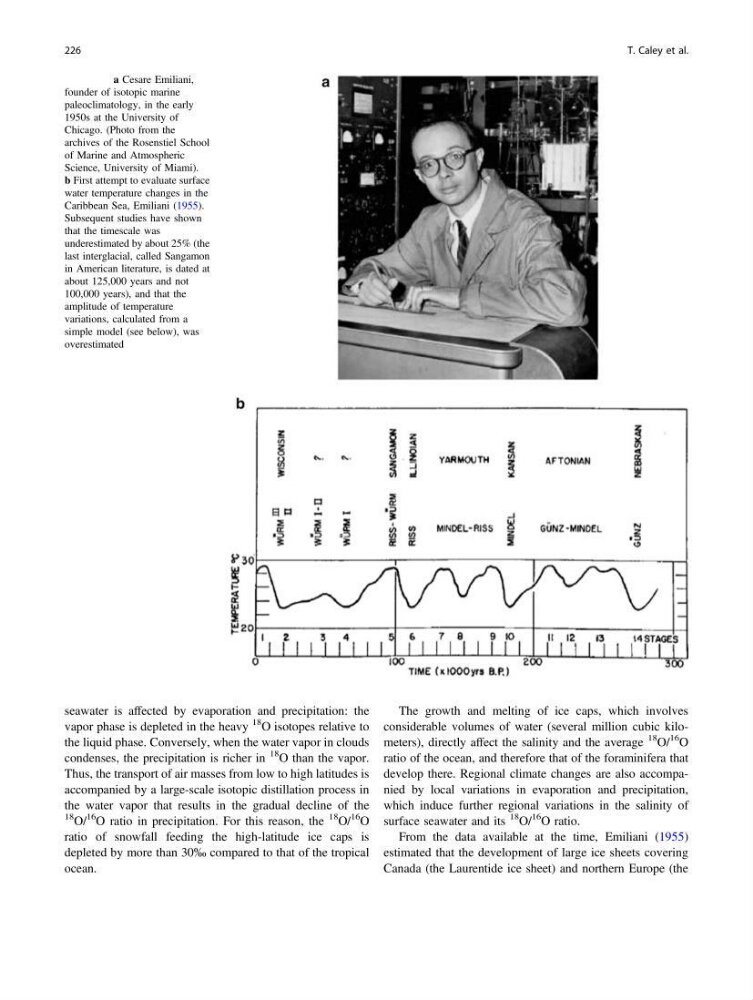
Fig. 21.1 a Cesare Emiliani,
founder of isotopic marine
paleoclimatology, in the early
1950s at the University of
Chicago. (Photo from the
archives of the Rosenstiel School
of Marine and Atmospheric
Science, University of Miami).
b First attempt to evaluate surface
water temperature changes in the
Caribbean Sea, Emiliani (1955).
Subsequent studies have shown
that the timescale was
underestimated by about 25% (the
last interglacial, called Sangamon
in American literature, is dated at
about 125,000 years and not
100,000 years), and that the
amplitude of temperature
variations, calculated from a
simple model (see below), was
overestimated
226
T. Caley et al.
vapor phase is depleted in the heavy
18 O isotopes relative to
the liquid phase. Conversely, when the water vapor in clouds
condenses, the precipitation is richer in
18 O than the vapor.
Thus, the transport of air masses from low to high latitudes is
accompanied by a large-scale isotopic distillation process in
the water vapor that results in the gradual decline of the
18 O/
16 O ratio in precipitation. For this reason, the
18 O/
16 O
ratio of snowfall feeding the high-latitude ice caps is
depleted by more than 30‰ compared to that of the tropical
ocean.
The growth and melting of ice caps, which involves
considerable volumes of water (several million cubic kilometers), directly affect the salinity and the average
18 O/
16 O
ratio of the ocean, and therefore that of the foraminifera that
develop there. Regional climate changes are also accompanied by local variations in evaporation and precipitation,
which induce further regional variations in the salinity of
surface seawater and its
18 O/
16
O ratio.
From the data available at the time, Emiliani (1955)
estimated that the development of large ice sheets covering
Canada (the Laurentide ice sheet) and northern Europe (the
Fig. 21.1 a Cesare Emiliani,
founder of isotopic marine
paleoclimatology, in the early
1950s at the University of
Chicago. (Photo from the
archives of the Rosenstiel School
of Marine and Atmospheric
Science, University of Miami).
b First attempt to evaluate surface
water temperature changes in the
Caribbean Sea, Emiliani (1955).
Subsequent studies have shown
that the timescale was
underestimated by about 25% (the
last interglacial, called Sangamon
in American literature, is dated at
about 125,000 years and not
100,000 years), and that the
amplitude of temperature
variations, calculated from a
simple model (see below), was
overestimated
226
T. Caley et al.