

On the Bolivian Altiplano, paleohydrological data
(Fig. 19.3) show that the Bolivian Altiplano experienced a
first lacustrine transgression at 18,500 BP, interrupted
between 18,100 BP and 15,800 BP by a phase of stagnation
of the lake level, followed by a subsequent phase of maximum extension up to 15,000 BP years. After this date, this
lake dried up. A second lacustrine transgression of lesser
magnitude, named ‘Coipasa’, took place between 12,500 BP
and 11,900 BP.
The reconstruction of the isotopic composition of the lake
produces a very interesting result showing a spectacular
decrease in its isotopic composition during the transgression
phases (increase of the lake level) in response to rainfall
inputs, followed by phases of isotopic enrichment during the
phases when its level stabilizes (Fig. 19.3).
Simple hydro-isotopic modeling has shown that the
increase in precipitation during the establishment of the lake
is quantitatively consistent with the decrease recorded in the
reconstruction of d
18 O lake water (Quesada et al. 2015). It also
partly explains the increase in the isotopic composition of
the lake during its stability phases. This isotopic enrichment
of lake waters is caused by interplay between lake evaporation and precipitation processes, both of which alter the
isotopic composition of the lake differently. This confirms
the establishment of the Tauca paleolake, probably caused
by a massive influx of precipitation (significant decrease in
d
18 O of the water of the paleolake) from the tropical Atlantic
in the Altiplano watershed. The abrupt disappearance of the
paleolake is contemporaneous with an isotopic excursion of
+7‰ recorded in the ice of Mount Sajama (Thompson et al.
1998). Calculation of the isotopic composition of the vapor
flux produced by evaporation of the paleolake, with its
volume and surface taken into account, shows that this
isotopic excursion could have been caused by an evaporation
of 5–60% of the total volume of the lake. If this hypothesis is
proven correct, it shows that the Tauca paleolake has certainly influenced the local, or even regional, hydrological
cycle.
In conclusion, this example shows the potential impact of
a lake on the local hydrological conditions, especially during
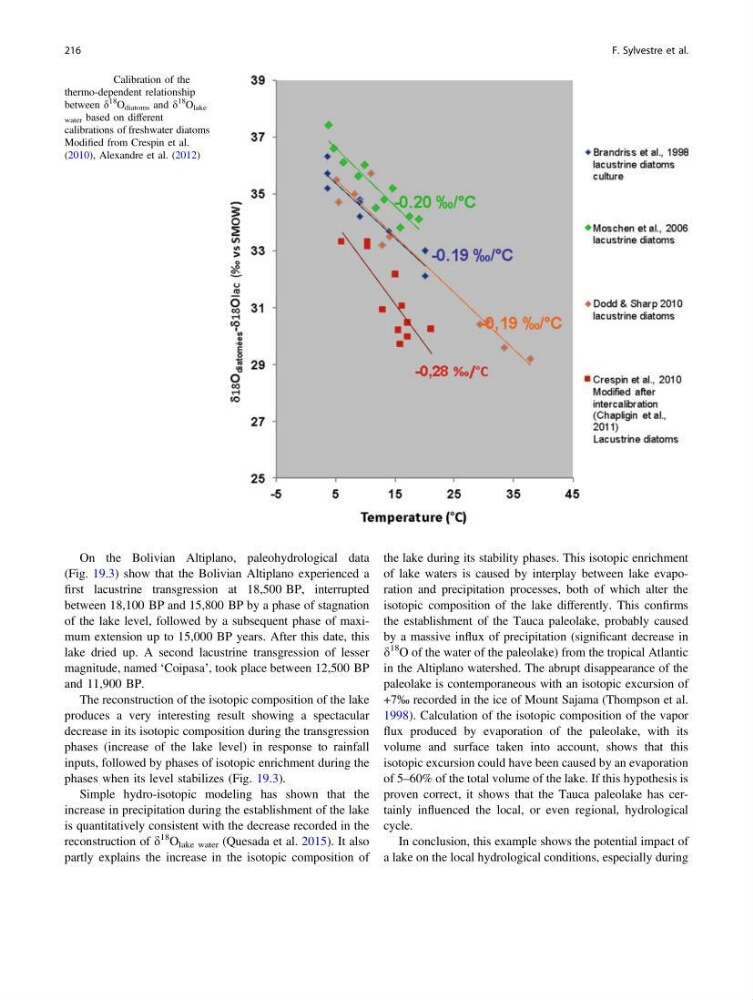
Fig. 19.2 Calibration of the
thermo-dependent relationship
between d
18
O diatoms and d
18
O lake
water based on different
calibrations of freshwater diatoms
Modified from Crespin et al.
(2010), Alexandre et al. (2012)
216
F. Sylvestre et al.
(Fig. 19.3) show that the Bolivian Altiplano experienced a
first lacustrine transgression at 18,500 BP, interrupted
between 18,100 BP and 15,800 BP by a phase of stagnation
of the lake level, followed by a subsequent phase of maximum extension up to 15,000 BP years. After this date, this
lake dried up. A second lacustrine transgression of lesser
magnitude, named ‘Coipasa’, took place between 12,500 BP
and 11,900 BP.
The reconstruction of the isotopic composition of the lake
produces a very interesting result showing a spectacular
decrease in its isotopic composition during the transgression
phases (increase of the lake level) in response to rainfall
inputs, followed by phases of isotopic enrichment during the
phases when its level stabilizes (Fig. 19.3).
Simple hydro-isotopic modeling has shown that the
increase in precipitation during the establishment of the lake
is quantitatively consistent with the decrease recorded in the
reconstruction of d
18 O lake water (Quesada et al. 2015). It also
partly explains the increase in the isotopic composition of
the lake during its stability phases. This isotopic enrichment
of lake waters is caused by interplay between lake evaporation and precipitation processes, both of which alter the
isotopic composition of the lake differently. This confirms
the establishment of the Tauca paleolake, probably caused
by a massive influx of precipitation (significant decrease in
d
18 O of the water of the paleolake) from the tropical Atlantic
in the Altiplano watershed. The abrupt disappearance of the
paleolake is contemporaneous with an isotopic excursion of
+7‰ recorded in the ice of Mount Sajama (Thompson et al.
1998). Calculation of the isotopic composition of the vapor
flux produced by evaporation of the paleolake, with its
volume and surface taken into account, shows that this
isotopic excursion could have been caused by an evaporation
of 5–60% of the total volume of the lake. If this hypothesis is
proven correct, it shows that the Tauca paleolake has certainly influenced the local, or even regional, hydrological
cycle.
In conclusion, this example shows the potential impact of
a lake on the local hydrological conditions, especially during
Fig. 19.2 Calibration of the
thermo-dependent relationship
between d
18
O diatoms and d
18
O lake
water based on different
calibrations of freshwater diatoms
Modified from Crespin et al.
(2010), Alexandre et al. (2012)
216
F. Sylvestre et al.