

11,100 years BP, strong warming encouraged the proliferation of the hazel (Corylus), the oak (Quercus) three centuries
later, and the lime tree (Tilia) five centuries later again,
replacing these pioneers. This succession over less than a
millennium is not necessarily exclusively due to climate:
species expand geographically from refuges more or less
distant from the studied area at a speed that is specific to
them. Another, less dramatic change in climate (probably a
wetter and cooler climate) around 8200 years BP enabled the
fir (Abies) and alder (Alnus) to become established. Around
6300 years BP, it was the beech (Fagus) which progressed
in the region. Around 2000 years BP, during the Roman
period, the proportion of grasses increased and trees
decreased (AP), a sign of anthropogenic deforestation.
Comparison of the different graphs in Fig. 12.1 shows that
some taxa evolve together while others are diachronous. Taxa
that are present at the same time on the same site will likely
thrive in the same climatic conditions: they will be temperate
or boreal, they will be resistant to drought or only survive in
wet conditions. If, to this, we add characteristics related to the
size of the plant (tree, shrub, grass), phenology (evergreen
plant or deciduous), type of leaf (needles or broad leaves), a
reasonable classification can be made. Prentice et al. (1996)
have proposed one for Europe. This was then applied to other
continents (Jolly 1998; Tarasov 1998). The types of plants
defined in this way, known as plant functional types (PFTs),
can be directly compared to simulations by vegetation models
based on the same typology. These PFTs are used to define the
vegetation of a site in the form of a biome: a bio-geographic
area characterized by the species of plants (and animals) that
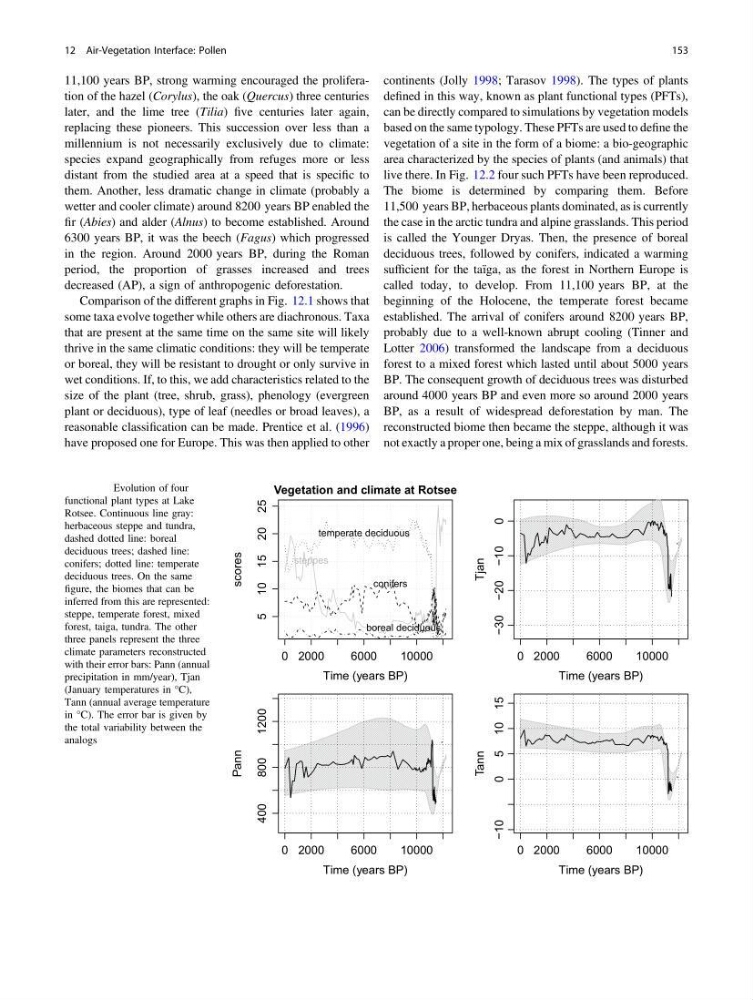
live there. In Fig. 12.2 four such PFTs have been reproduced.
The biome is determined by comparing them. Before
11,500 years BP, herbaceous plants dominated, as is currently
the case in the arctic tundra and alpine grasslands. This period
is called the Younger Dryas. Then, the presence of boreal
deciduous trees, followed by conifers, indicated a warming
sufficient for the taïga, as the forest in Northern Europe is
called today, to develop. From 11,100 years BP, at the
beginning of the Holocene, the temperate forest became
established. The arrival of conifers around 8200 years BP,
probably due to a well-known abrupt cooling (Tinner and
Lotter 2006) transformed the landscape from a deciduous
forest to a mixed forest which lasted until about 5000 years
BP. The consequent growth of deciduous trees was disturbed
around 4000 years BP and even more so around 2000 years
BP, as a result of widespread deforestation by man. The
reconstructed biome then became the steppe, although it was
not exactly a proper one, being a mix of grasslands and forests.
5
10 15 20 25
Vegetation and climate at Rotsee
Time (years BP)
scores
steppes
conifers
temperate deciduous
boreal deciduous
400
800
1200
Time (years BP)
Pann
0 2000
6000
10000
0 2000
6000
10000
−30 −20 −10
0
Time (years BP)
Tjan
0 2000
6000
10000
0 2000
6000
10000
−10
0
5 10 15
Time (years BP)
Tann
Fig. 12.2 Evolution of four
functional plant types at Lake
Rotsee. Continuous line gray:
herbaceous steppe and tundra,
dashed dotted line: boreal
deciduous trees; dashed line:
conifers; dotted line: temperate
deciduous trees. On the same
figure, the biomes that can be
inferred from this are represented:
steppe, temperate forest, mixed
forest, taiga, tundra. The other
three panels represent the three
climate parameters reconstructed
with their error bars: Pann (annual
precipitation in mm/year), Tjan
(January temperatures in °C),
Tann (annual average temperature
in °C). The error bar is given by
the total variability between the
analogs
12 Air-Vegetation Interface: Pollen
153
later, and the lime tree (Tilia) five centuries later again,
replacing these pioneers. This succession over less than a
millennium is not necessarily exclusively due to climate:
species expand geographically from refuges more or less
distant from the studied area at a speed that is specific to
them. Another, less dramatic change in climate (probably a
wetter and cooler climate) around 8200 years BP enabled the
fir (Abies) and alder (Alnus) to become established. Around
6300 years BP, it was the beech (Fagus) which progressed
in the region. Around 2000 years BP, during the Roman
period, the proportion of grasses increased and trees
decreased (AP), a sign of anthropogenic deforestation.
Comparison of the different graphs in Fig. 12.1 shows that
some taxa evolve together while others are diachronous. Taxa
that are present at the same time on the same site will likely
thrive in the same climatic conditions: they will be temperate
or boreal, they will be resistant to drought or only survive in
wet conditions. If, to this, we add characteristics related to the
size of the plant (tree, shrub, grass), phenology (evergreen
plant or deciduous), type of leaf (needles or broad leaves), a
reasonable classification can be made. Prentice et al. (1996)
have proposed one for Europe. This was then applied to other
continents (Jolly 1998; Tarasov 1998). The types of plants
defined in this way, known as plant functional types (PFTs),
can be directly compared to simulations by vegetation models
based on the same typology. These PFTs are used to define the
vegetation of a site in the form of a biome: a bio-geographic
area characterized by the species of plants (and animals) that
live there. In Fig. 12.2 four such PFTs have been reproduced.
The biome is determined by comparing them. Before
11,500 years BP, herbaceous plants dominated, as is currently
the case in the arctic tundra and alpine grasslands. This period
is called the Younger Dryas. Then, the presence of boreal
deciduous trees, followed by conifers, indicated a warming
sufficient for the taïga, as the forest in Northern Europe is
called today, to develop. From 11,100 years BP, at the
beginning of the Holocene, the temperate forest became
established. The arrival of conifers around 8200 years BP,
probably due to a well-known abrupt cooling (Tinner and
Lotter 2006) transformed the landscape from a deciduous
forest to a mixed forest which lasted until about 5000 years
BP. The consequent growth of deciduous trees was disturbed
around 4000 years BP and even more so around 2000 years
BP, as a result of widespread deforestation by man. The
reconstructed biome then became the steppe, although it was
not exactly a proper one, being a mix of grasslands and forests.
5
10 15 20 25
Vegetation and climate at Rotsee
Time (years BP)
scores
steppes
conifers
temperate deciduous
boreal deciduous
400
800
1200
Time (years BP)
Pann
0 2000
6000
10000
0 2000
6000
10000
−30 −20 −10
0
Time (years BP)
Tjan
0 2000
6000
10000
0 2000
6000
10000
−10
0
5 10 15
Time (years BP)
Tann
Fig. 12.2 Evolution of four
functional plant types at Lake
Rotsee. Continuous line gray:
herbaceous steppe and tundra,
dashed dotted line: boreal
deciduous trees; dashed line:
conifers; dotted line: temperate
deciduous trees. On the same
figure, the biomes that can be
inferred from this are represented:
steppe, temperate forest, mixed
forest, taiga, tundra. The other
three panels represent the three
climate parameters reconstructed
with their error bars: Pann (annual
precipitation in mm/year), Tjan
(January temperatures in °C),
Tann (annual average temperature
in °C). The error bar is given by
the total variability between the
analogs
12 Air-Vegetation Interface: Pollen
153