

size of magnetic grains is constant along the sedimentary
column, in other words, if the magnetic mineralogy of the
sediment is uniform. All of these characteristics must be verified by a magneto-mineralogical study of the sediment (this
verification can lead to the rejection of a significant proportion
of cores, depending on the basin being studied), in order to
obtain a reliable record of the relative variations of the field.
This is obtained by dividing, at each stratigraphic level, the
intensity of the measured natural remanent magnetization by a
standardization parameter, which will take into account the
variations in the concentration of magnetic grains. Of the three
magnetic parameters related linearly to concentration: susceptibility; isothermal remanent magnetization (IRM) and
anhysteretic remanent magnetization (ARM),
1 it is the latter
that is most often used, since it depends primarily on the same
magnetic grains as the ones carrying natural magnetization.
Three recent examples of long-distance, multi-archive
correlations are described below showing the combined use
of well-dated geomagnetic excursions and paleointensity
records in paleoclimatology studies. The first one concerns a
sediment-ice correlation. Of the other two, one is based on
the propagation time of the North Atlantic deep-water mass
from north to south, and the other on the anti-correlation
between the intensities of the North Atlantic and CircumAntarctic deep currents.
A Correlation Between Sediment and Polar Ice
The Laschamp geomagnetic excursion was the first to be
discovered and is certainly the most studied excursion of the
Brunhes period. Discovered in 1967 by Bonhommet and
Babkine (1967), in lavas of the Puy de Laschamp, then in the
Olby flow in the French Massif Central, it was originally
dated between 20 and 8 ka. A series of studies conducted by
different research groups demonstrated the difficulty of dating lavas as recent as these. Recently the combined use of
K/Ar and
40 Ar/
39 Ar methods (Chap. 5) on basalt samples
collected at Laschamp and at Olby led to the establishment
of a critical requisite for reliable dating of these recent
samples: the absence of excess argon in the initial composition of the lava, or of any other potential disruption of the
K/Ar system pre- or post eruption (Guillou et al. 2004).
Considering the uncertainty of 2.4% on the decay constant of
40 K, Guillou et al. (2004) proposed a date of
40.4 ± 2.0 ka, which was a considerable improvement, in
terms of accuracy, over previous radiometric dating. Shown
in Fig. 7.9 is a series of “snapshot data” obtained from lava
flow from the Massif Central, the Canary Islands and New
Zealand superimposed on the GLOPIS-75 curve. The
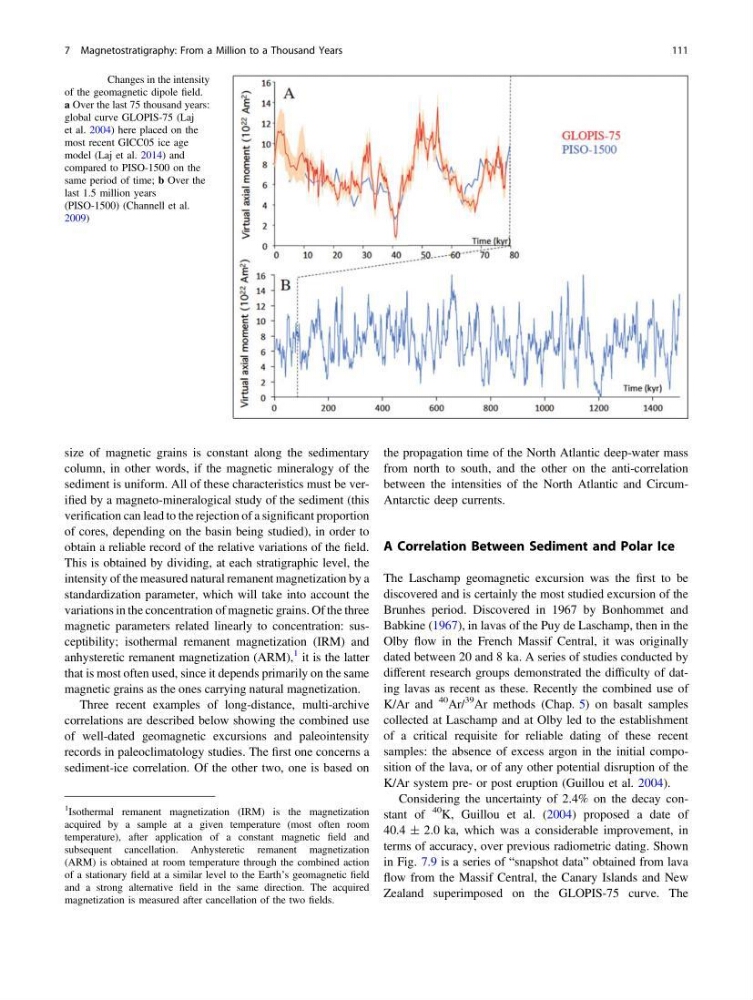
Fig. 7.8 Changes in the intensity
of the geomagnetic dipole field.
a Over the last 75 thousand years:
global curve GLOPIS-75 (Laj
et al. 2004) here placed on the
most recent GICC05 ice age
model (Laj et al. 2014) and
compared to PISO-1500 on the
same period of time; b Over the
last 1.5 million years
(PISO-1500) (Channell et al.
2009)
1
Isothermal remanent magnetization (IRM) is the magnetization
acquired by a sample at a given temperature (most often room
temperature), after application of a constant magnetic field and
subsequent cancellation. Anhysteretic remanent magnetization
(ARM) is obtained at room temperature through the combined action
of a stationary field at a similar level to the Earth’s geomagnetic field
and a strong alternative field in the same direction. The acquired
magnetization is measured after cancellation of the two fields.
7 Magnetostratigraphy: From a Million to a Thousand Years
111
column, in other words, if the magnetic mineralogy of the
sediment is uniform. All of these characteristics must be verified by a magneto-mineralogical study of the sediment (this
verification can lead to the rejection of a significant proportion
of cores, depending on the basin being studied), in order to
obtain a reliable record of the relative variations of the field.
This is obtained by dividing, at each stratigraphic level, the
intensity of the measured natural remanent magnetization by a
standardization parameter, which will take into account the
variations in the concentration of magnetic grains. Of the three
magnetic parameters related linearly to concentration: susceptibility; isothermal remanent magnetization (IRM) and
anhysteretic remanent magnetization (ARM),
1 it is the latter
that is most often used, since it depends primarily on the same
magnetic grains as the ones carrying natural magnetization.
Three recent examples of long-distance, multi-archive
correlations are described below showing the combined use
of well-dated geomagnetic excursions and paleointensity
records in paleoclimatology studies. The first one concerns a
sediment-ice correlation. Of the other two, one is based on
the propagation time of the North Atlantic deep-water mass
from north to south, and the other on the anti-correlation
between the intensities of the North Atlantic and CircumAntarctic deep currents.
A Correlation Between Sediment and Polar Ice
The Laschamp geomagnetic excursion was the first to be
discovered and is certainly the most studied excursion of the
Brunhes period. Discovered in 1967 by Bonhommet and
Babkine (1967), in lavas of the Puy de Laschamp, then in the
Olby flow in the French Massif Central, it was originally
dated between 20 and 8 ka. A series of studies conducted by
different research groups demonstrated the difficulty of dating lavas as recent as these. Recently the combined use of
K/Ar and
40 Ar/
39 Ar methods (Chap. 5) on basalt samples
collected at Laschamp and at Olby led to the establishment
of a critical requisite for reliable dating of these recent
samples: the absence of excess argon in the initial composition of the lava, or of any other potential disruption of the
K/Ar system pre- or post eruption (Guillou et al. 2004).
Considering the uncertainty of 2.4% on the decay constant of
40 K, Guillou et al. (2004) proposed a date of
40.4 ± 2.0 ka, which was a considerable improvement, in
terms of accuracy, over previous radiometric dating. Shown
in Fig. 7.9 is a series of “snapshot data” obtained from lava
flow from the Massif Central, the Canary Islands and New
Zealand superimposed on the GLOPIS-75 curve. The
Fig. 7.8 Changes in the intensity
of the geomagnetic dipole field.
a Over the last 75 thousand years:
global curve GLOPIS-75 (Laj
et al. 2004) here placed on the
most recent GICC05 ice age
model (Laj et al. 2014) and
compared to PISO-1500 on the
same period of time; b Over the
last 1.5 million years
(PISO-1500) (Channell et al.
2009)
1
Isothermal remanent magnetization (IRM) is the magnetization
acquired by a sample at a given temperature (most often room
temperature), after application of a constant magnetic field and
subsequent cancellation. Anhysteretic remanent magnetization
(ARM) is obtained at room temperature through the combined action
of a stationary field at a similar level to the Earth’s geomagnetic field
and a strong alternative field in the same direction. The acquired
magnetization is measured after cancellation of the two fields.
7 Magnetostratigraphy: From a Million to a Thousand Years
111