

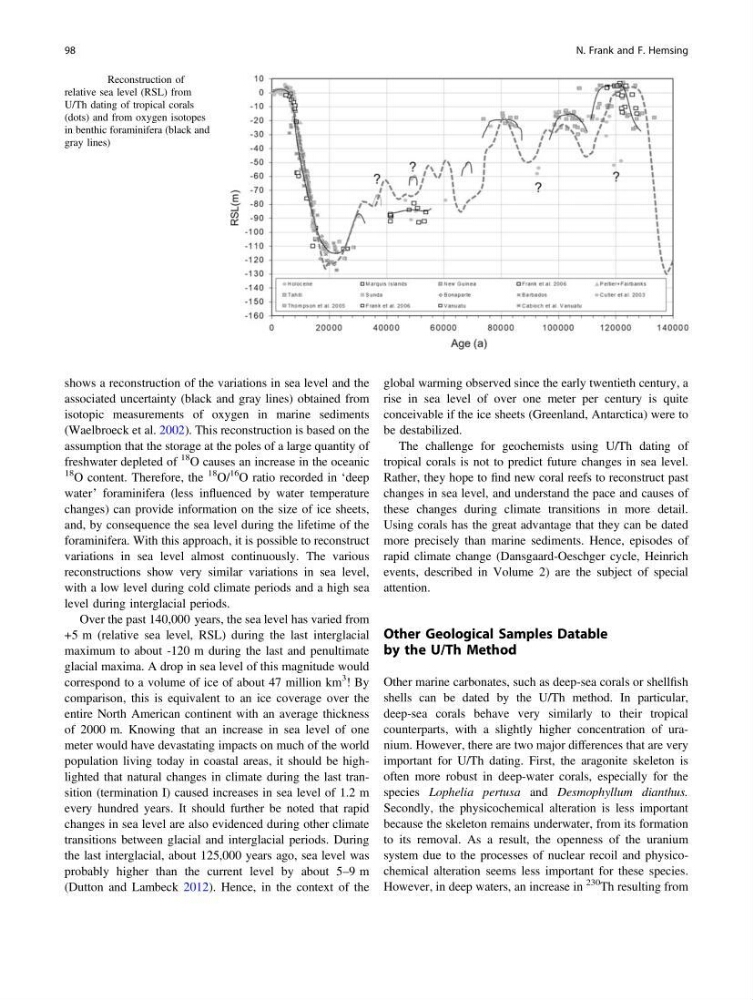
shows a reconstruction of the variations in sea level and the
associated uncertainty (black and gray lines) obtained from
isotopic measurements of oxygen in marine sediments
(Waelbroeck et al. 2002). This reconstruction is based on the
assumption that the storage at the poles of a large quantity of
freshwater depleted of
18 O causes an increase in the oceanic
18 O content. Therefore, the
18 O/
16 O ratio recorded in ‘deep
water’ foraminifera (less influenced by water temperature
changes) can provide information on the size of ice sheets,
and, by consequence the sea level during the lifetime of the
foraminifera. With this approach, it is possible to reconstruct
variations in sea level almost continuously. The various
reconstructions show very similar variations in sea level,
with a low level during cold climate periods and a high sea
level during interglacial periods.
Over the past 140,000 years, the sea level has varied from
+5 m (relative sea level, RSL) during the last interglacial
maximum to about -120 m during the last and penultimate
glacial maxima. A drop in sea level of this magnitude would
correspond to a volume of ice of about 47 million km
3 ! By
comparison, this is equivalent to an ice coverage over the
entire North American continent with an average thickness
of 2000 m. Knowing that an increase in sea level of one
meter would have devastating impacts on much of the world
population living today in coastal areas, it should be highlighted that natural changes in climate during the last transition (termination I) caused increases in sea level of 1.2 m
every hundred years. It should further be noted that rapid
changes in sea level are also evidenced during other climate
transitions between glacial and interglacial periods. During
the last interglacial, about 125,000 years ago, sea level was
probably higher than the current level by about 5–9 m
(Dutton and Lambeck 2012). Hence, in the context of the
global warming observed since the early twentieth century, a
rise in sea level of over one meter per century is quite
conceivable if the ice sheets (Greenland, Antarctica) were to
be destabilized.
The challenge for geochemists using U/Th dating of
tropical corals is not to predict future changes in sea level.
Rather, they hope to find new coral reefs to reconstruct past
changes in sea level, and understand the pace and causes of
these changes during climate transitions in more detail.
Using corals has the great advantage that they can be dated
more precisely than marine sediments. Hence, episodes of
rapid climate change (Dansgaard-Oeschger cycle, Heinrich
events, described in Volume 2) are the subject of special
attention.
Other Geological Samples Datable
by the U/Th Method
Other marine carbonates, such as deep-sea corals or shellfish
shells can be dated by the U/Th method. In particular,
deep-sea corals behave very similarly to their tropical
counterparts, with a slightly higher concentration of uranium. However, there are two major differences that are very
important for U/Th dating. First, the aragonite skeleton is
often more robust in deep-water corals, especially for the
species Lophelia pertusa and Desmophyllum dianthus.
Secondly, the physicochemical alteration is less important
because the skeleton remains underwater, from its formation
to its removal. As a result, the openness of the uranium
system due to the processes of nuclear recoil and physicochemical alteration seems less important for these species.
However, in deep waters, an increase in
230
Th resulting from
Fig. 6.7 Reconstruction of
relative sea level (RSL) from
U/Th dating of tropical corals
(dots) and from oxygen isotopes
in benthic foraminifera (black and
gray lines)
98
N. Frank and F. Hemsing
associated uncertainty (black and gray lines) obtained from
isotopic measurements of oxygen in marine sediments
(Waelbroeck et al. 2002). This reconstruction is based on the
assumption that the storage at the poles of a large quantity of
freshwater depleted of
18 O causes an increase in the oceanic
18 O content. Therefore, the
18 O/
16 O ratio recorded in ‘deep
water’ foraminifera (less influenced by water temperature
changes) can provide information on the size of ice sheets,
and, by consequence the sea level during the lifetime of the
foraminifera. With this approach, it is possible to reconstruct
variations in sea level almost continuously. The various
reconstructions show very similar variations in sea level,
with a low level during cold climate periods and a high sea
level during interglacial periods.
Over the past 140,000 years, the sea level has varied from
+5 m (relative sea level, RSL) during the last interglacial
maximum to about -120 m during the last and penultimate
glacial maxima. A drop in sea level of this magnitude would
correspond to a volume of ice of about 47 million km
3 ! By
comparison, this is equivalent to an ice coverage over the
entire North American continent with an average thickness
of 2000 m. Knowing that an increase in sea level of one
meter would have devastating impacts on much of the world
population living today in coastal areas, it should be highlighted that natural changes in climate during the last transition (termination I) caused increases in sea level of 1.2 m
every hundred years. It should further be noted that rapid
changes in sea level are also evidenced during other climate
transitions between glacial and interglacial periods. During
the last interglacial, about 125,000 years ago, sea level was
probably higher than the current level by about 5–9 m
(Dutton and Lambeck 2012). Hence, in the context of the
global warming observed since the early twentieth century, a
rise in sea level of over one meter per century is quite
conceivable if the ice sheets (Greenland, Antarctica) were to
be destabilized.
The challenge for geochemists using U/Th dating of
tropical corals is not to predict future changes in sea level.
Rather, they hope to find new coral reefs to reconstruct past
changes in sea level, and understand the pace and causes of
these changes during climate transitions in more detail.
Using corals has the great advantage that they can be dated
more precisely than marine sediments. Hence, episodes of
rapid climate change (Dansgaard-Oeschger cycle, Heinrich
events, described in Volume 2) are the subject of special
attention.
Other Geological Samples Datable
by the U/Th Method
Other marine carbonates, such as deep-sea corals or shellfish
shells can be dated by the U/Th method. In particular,
deep-sea corals behave very similarly to their tropical
counterparts, with a slightly higher concentration of uranium. However, there are two major differences that are very
important for U/Th dating. First, the aragonite skeleton is
often more robust in deep-water corals, especially for the
species Lophelia pertusa and Desmophyllum dianthus.
Secondly, the physicochemical alteration is less important
because the skeleton remains underwater, from its formation
to its removal. As a result, the openness of the uranium
system due to the processes of nuclear recoil and physicochemical alteration seems less important for these species.
However, in deep waters, an increase in
230
Th resulting from
Fig. 6.7 Reconstruction of
relative sea level (RSL) from
U/Th dating of tropical corals
(dots) and from oxygen isotopes
in benthic foraminifera (black and
gray lines)
98
N. Frank and F. Hemsing