

64
V. P. Drachev et al.
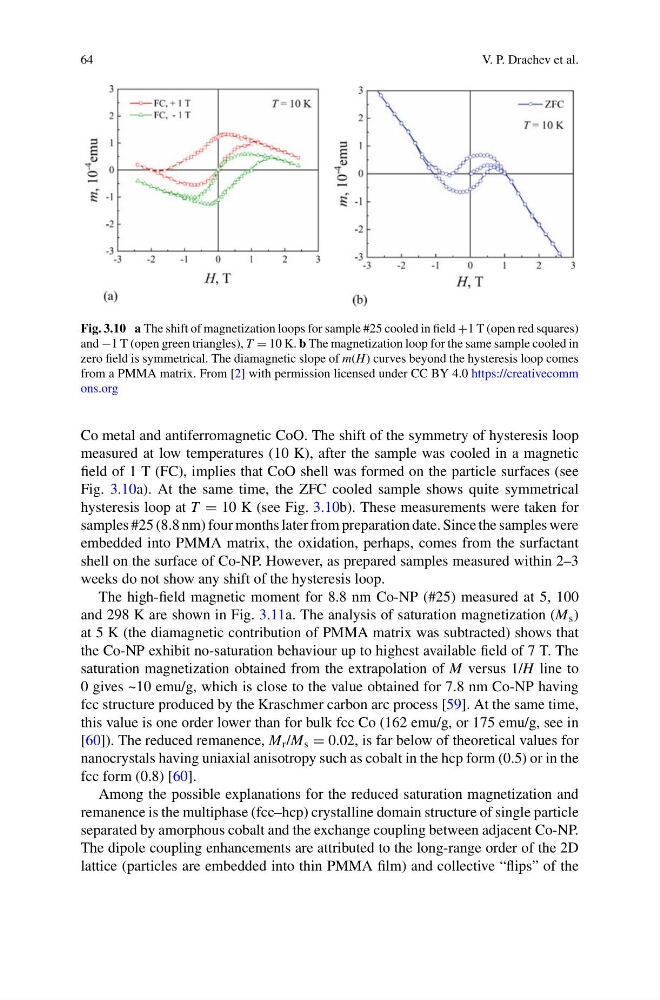
Fig. 3.10 a The shift of magnetization loops for sample #25 cooled in field +1 T (open red squares)
and −1 T (open green triangles), T = 10 K. b The magnetization loop for the same sample cooled in
zero field is symmetrical. The diamagnetic slope of m(H) curves beyond the hysteresis loop comes
from a PMMA matrix. From [2] with permission licensed under CC BY 4.0 https://creativecomm
ons.org
Co metal and antiferromagnetic CoO. The shift of the symmetry of hysteresis loop
measured at low temperatures (10 K), after the sample was cooled in a magnetic
field of 1 T (FC), implies that CoO shell was formed on the particle surfaces (see
Fig. 3.10a). At the same time, the ZFC cooled sample shows quite symmetrical
hysteresis loop at T = 10 K (see Fig. 3.10b). These measurements were taken for
samples #25 (8.8 nm) four months later from preparation date. Since the samples were
embedded into PMMA matrix, the oxidation, perhaps, comes from the surfactant
shell on the surface of Co-NP. However, as prepared samples measured within 2–3
weeks do not show any shift of the hysteresis loop.
The high-field magnetic moment for 8.8 nm Co-NP (#25) measured at 5, 100
and 298 K are shown in Fig. 3.11a. The analysis of saturation magnetization (M s )
at 5 K (the diamagnetic contribution of PMMA matrix was subtracted) shows that
the Co-NP exhibit no-saturation behaviour up to highest available field of 7 T. The
saturation magnetization obtained from the extrapolation of M versus 1/H line to
0 gives ~10 emu/g, which is close to the value obtained for 7.8 nm Co-NP having
fcc structure produced by the Kraschmer carbon arc process [59]. At the same time,
this value is one order lower than for bulk fcc Co (162 emu/g, or 175 emu/g, see in
[60]). The reduced remanence, M r /M s = 0.02, is far below of theoretical values for
nanocrystals having uniaxial anisotropy such as cobalt in the hcp form (0.5) or in the
fcc form (0.8) [60].
Among the possible explanations for the reduced saturation magnetization and
remanence is the multiphase (fcc–hcp) crystalline domain structure of single particle
separated by amorphous cobalt and the exchange coupling between adjacent Co-NP.
The dipole coupling enhancements are attributed to the long-range order of the 2D
lattice (particles are embedded into thin PMMA film) and collective “flips” of the
V. P. Drachev et al.
Fig. 3.10 a The shift of magnetization loops for sample #25 cooled in field +1 T (open red squares)
and −1 T (open green triangles), T = 10 K. b The magnetization loop for the same sample cooled in
zero field is symmetrical. The diamagnetic slope of m(H) curves beyond the hysteresis loop comes
from a PMMA matrix. From [2] with permission licensed under CC BY 4.0 https://creativecomm
ons.org
Co metal and antiferromagnetic CoO. The shift of the symmetry of hysteresis loop
measured at low temperatures (10 K), after the sample was cooled in a magnetic
field of 1 T (FC), implies that CoO shell was formed on the particle surfaces (see
Fig. 3.10a). At the same time, the ZFC cooled sample shows quite symmetrical
hysteresis loop at T = 10 K (see Fig. 3.10b). These measurements were taken for
samples #25 (8.8 nm) four months later from preparation date. Since the samples were
embedded into PMMA matrix, the oxidation, perhaps, comes from the surfactant
shell on the surface of Co-NP. However, as prepared samples measured within 2–3
weeks do not show any shift of the hysteresis loop.
The high-field magnetic moment for 8.8 nm Co-NP (#25) measured at 5, 100
and 298 K are shown in Fig. 3.11a. The analysis of saturation magnetization (M s )
at 5 K (the diamagnetic contribution of PMMA matrix was subtracted) shows that
the Co-NP exhibit no-saturation behaviour up to highest available field of 7 T. The
saturation magnetization obtained from the extrapolation of M versus 1/H line to
0 gives ~10 emu/g, which is close to the value obtained for 7.8 nm Co-NP having
fcc structure produced by the Kraschmer carbon arc process [59]. At the same time,
this value is one order lower than for bulk fcc Co (162 emu/g, or 175 emu/g, see in
[60]). The reduced remanence, M r /M s = 0.02, is far below of theoretical values for
nanocrystals having uniaxial anisotropy such as cobalt in the hcp form (0.5) or in the
fcc form (0.8) [60].
Among the possible explanations for the reduced saturation magnetization and
remanence is the multiphase (fcc–hcp) crystalline domain structure of single particle
separated by amorphous cobalt and the exchange coupling between adjacent Co-NP.
The dipole coupling enhancements are attributed to the long-range order of the 2D
lattice (particles are embedded into thin PMMA film) and collective “flips” of the