

56
V. P. Drachev et al.
that the exchange interaction of electrons splits the energy bands between spinup (majority) electrons and spin-down (minority) electrons. We suggest that a low
quality of the plasmon resonance for spin-down electrons is due to the large relaxation rate of the conduction electrons caused by high density of empty states in a
partially populated d-band. However, the majority electrons with a completely filled
d-band does not affect the relaxation rate and plasmon resonance of the conduction
spin-up electrons within magnetic nanoparticles.
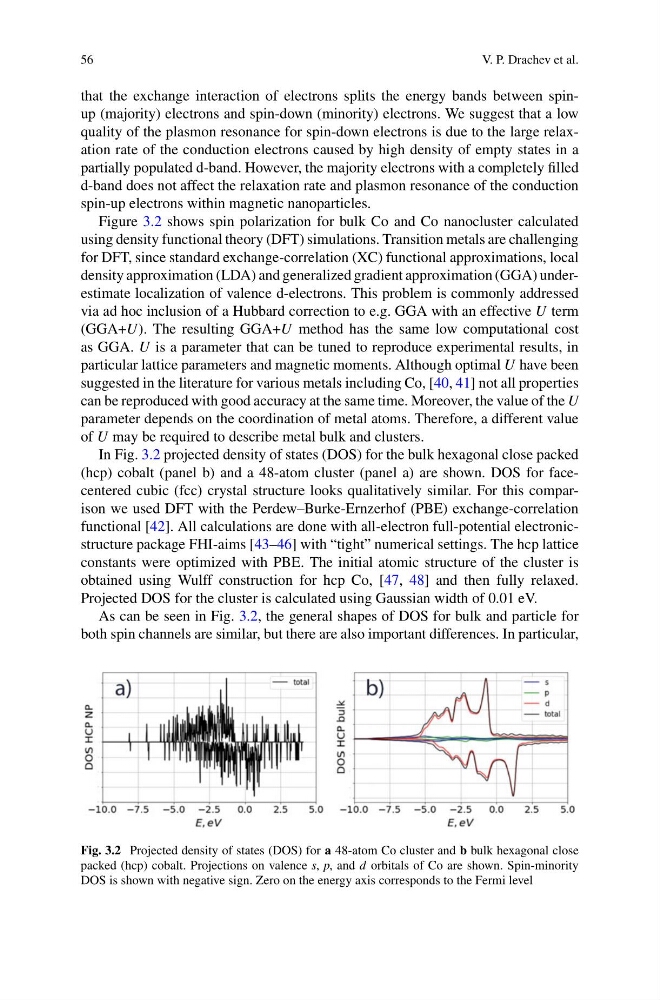
Figure 3.2 shows spin polarization for bulk Co and Co nanocluster calculated
using density functional theory (DFT) simulations. Transition metals are challenging
for DFT, since standard exchange-correlation (XC) functional approximations, local
density approximation (LDA) and generalized gradient approximation (GGA) underestimate localization of valence d-electrons. This problem is commonly addressed
via ad hoc inclusion of a Hubbard correction to e.g. GGA with an effective U term
(GGA+U). The resulting GGA+U method has the same low computational cost
as GGA. U is a parameter that can be tuned to reproduce experimental results, in
particular lattice parameters and magnetic moments. Although optimal U have been
suggested in the literature for various metals including Co, [40, 41] not all properties
can be reproduced with good accuracy at the same time. Moreover, the value of the U
parameter depends on the coordination of metal atoms. Therefore, a different value
of U may be required to describe metal bulk and clusters.
In Fig. 3.2 projected density of states (DOS) for the bulk hexagonal close packed
(hcp) cobalt (panel b) and a 48-atom cluster (panel a) are shown. DOS for facecentered cubic (fcc) crystal structure looks qualitatively similar. For this comparison we used DFT with the Perdew–Burke-Ernzerhof (PBE) exchange-correlation
functional [42]. All calculations are done with all-electron full-potential electronicstructure package FHI-aims [43–46] with “tight” numerical settings. The hcp lattice
constants were optimized with PBE. The initial atomic structure of the cluster is
obtained using Wulff construction for hcp Co, [47, 48] and then fully relaxed.
Projected DOS for the cluster is calculated using Gaussian width of 0.01 eV.
As can be seen in Fig. 3.2, the general shapes of DOS for bulk and particle for
both spin channels are similar, but there are also important differences. In particular,
Fig. 3.2 Projected density of states (DOS) for a 48-atom Co cluster and b bulk hexagonal close
packed (hcp) cobalt. Projections on valence s, p, and d orbitals of Co are shown. Spin-minority
DOS is shown with negative sign. Zero on the energy axis corresponds to the Fermi level
V. P. Drachev et al.
that the exchange interaction of electrons splits the energy bands between spinup (majority) electrons and spin-down (minority) electrons. We suggest that a low
quality of the plasmon resonance for spin-down electrons is due to the large relaxation rate of the conduction electrons caused by high density of empty states in a
partially populated d-band. However, the majority electrons with a completely filled
d-band does not affect the relaxation rate and plasmon resonance of the conduction
spin-up electrons within magnetic nanoparticles.
Figure 3.2 shows spin polarization for bulk Co and Co nanocluster calculated
using density functional theory (DFT) simulations. Transition metals are challenging
for DFT, since standard exchange-correlation (XC) functional approximations, local
density approximation (LDA) and generalized gradient approximation (GGA) underestimate localization of valence d-electrons. This problem is commonly addressed
via ad hoc inclusion of a Hubbard correction to e.g. GGA with an effective U term
(GGA+U). The resulting GGA+U method has the same low computational cost
as GGA. U is a parameter that can be tuned to reproduce experimental results, in
particular lattice parameters and magnetic moments. Although optimal U have been
suggested in the literature for various metals including Co, [40, 41] not all properties
can be reproduced with good accuracy at the same time. Moreover, the value of the U
parameter depends on the coordination of metal atoms. Therefore, a different value
of U may be required to describe metal bulk and clusters.
In Fig. 3.2 projected density of states (DOS) for the bulk hexagonal close packed
(hcp) cobalt (panel b) and a 48-atom cluster (panel a) are shown. DOS for facecentered cubic (fcc) crystal structure looks qualitatively similar. For this comparison we used DFT with the Perdew–Burke-Ernzerhof (PBE) exchange-correlation
functional [42]. All calculations are done with all-electron full-potential electronicstructure package FHI-aims [43–46] with “tight” numerical settings. The hcp lattice
constants were optimized with PBE. The initial atomic structure of the cluster is
obtained using Wulff construction for hcp Co, [47, 48] and then fully relaxed.
Projected DOS for the cluster is calculated using Gaussian width of 0.01 eV.
As can be seen in Fig. 3.2, the general shapes of DOS for bulk and particle for
both spin channels are similar, but there are also important differences. In particular,
Fig. 3.2 Projected density of states (DOS) for a 48-atom Co cluster and b bulk hexagonal close
packed (hcp) cobalt. Projections on valence s, p, and d orbitals of Co are shown. Spin-minority
DOS is shown with negative sign. Zero on the energy axis corresponds to the Fermi level