

2 Surface Plasmons for Chiral Sensing
41
and R − , which has a distinct behaviour depending on the sign and magnitude of κ.
However, as we show in Fig. 2.8, for small values of κ (κ < 10
−3 ), this angular split,
θ , becomes similarly small and its detection can be hindered by background noise
sources. Despite this, there exist alternative measurements one can consider performing in a CHISPR scheme, thanks to the ability to obtain distinct chiral-dependent
signals. In particular, we can consider measurement configurations based on differential signals which are largely immune to signal fluctuations and drifts (a direct
analogy is the case of CD measurements, which are differential type of measurements). Specifically, we consider two relevant quantities associated with the reflected
(outgoing) RCP/LCP waves: the amplitude and phase differential reflectances (DR),
namely ρ DR and φ DR , respectively. We define the DR signals as,
ρ DR =
|r + |
2
− |r − |
2
|r + | 2 + |r − | 2 , and φ DR = Arg
r +
r −
.
(2.15)
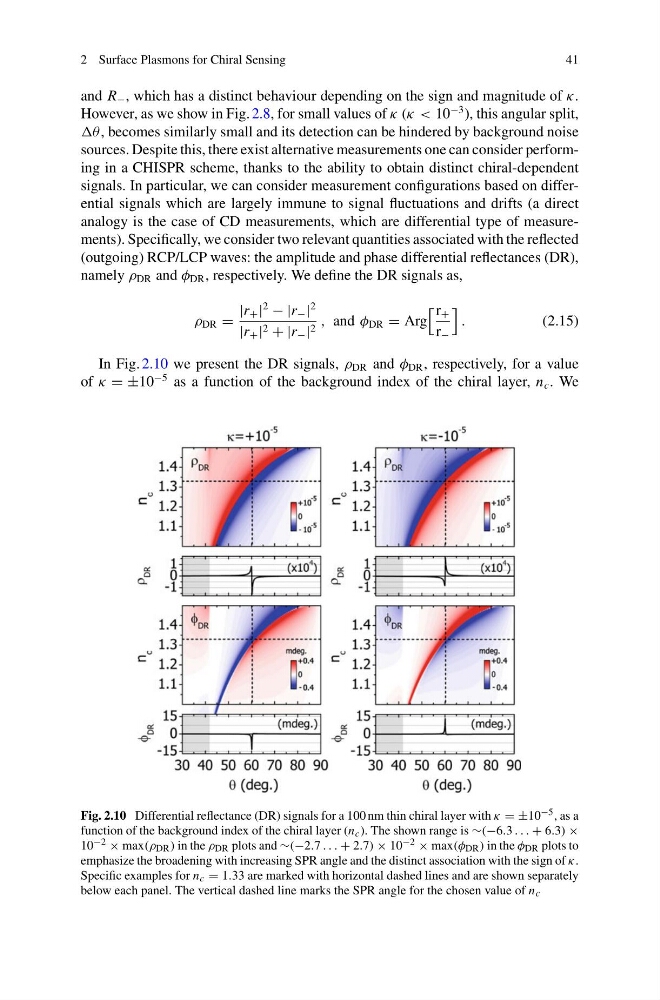
In Fig. 2.10 we present the DR signals, ρ DR and φ DR , respectively, for a value
of κ = ±10
−5 as a function of the background index of the chiral layer, n c . We
Fig. 2.10 Differential reflectance (DR) signals for a 100 nm thin chiral layer with κ = ±10 −5 , as a
function of the background index of the chiral layer (n c ). The shown range is ∼(−6.3 . . . + 6.3) ×
10 −2 × max(ρ DR ) in the ρ DR plots and ∼(−2.7 . . . + 2.7) × 10 −2 × max(φ DR ) in the φ DR plots to
emphasize the broadening with increasing SPR angle and the distinct association with the sign of κ.
Specific examples for n c = 1.33 are marked with horizontal dashed lines and are shown separately
below each panel. The vertical dashed line marks the SPR angle for the chosen value of n c
41
and R − , which has a distinct behaviour depending on the sign and magnitude of κ.
However, as we show in Fig. 2.8, for small values of κ (κ < 10
−3 ), this angular split,
θ , becomes similarly small and its detection can be hindered by background noise
sources. Despite this, there exist alternative measurements one can consider performing in a CHISPR scheme, thanks to the ability to obtain distinct chiral-dependent
signals. In particular, we can consider measurement configurations based on differential signals which are largely immune to signal fluctuations and drifts (a direct
analogy is the case of CD measurements, which are differential type of measurements). Specifically, we consider two relevant quantities associated with the reflected
(outgoing) RCP/LCP waves: the amplitude and phase differential reflectances (DR),
namely ρ DR and φ DR , respectively. We define the DR signals as,
ρ DR =
|r + |
2
− |r − |
2
|r + | 2 + |r − | 2 , and φ DR = Arg
r +
r −
.
(2.15)
In Fig. 2.10 we present the DR signals, ρ DR and φ DR , respectively, for a value
of κ = ±10
−5 as a function of the background index of the chiral layer, n c . We
Fig. 2.10 Differential reflectance (DR) signals for a 100 nm thin chiral layer with κ = ±10 −5 , as a
function of the background index of the chiral layer (n c ). The shown range is ∼(−6.3 . . . + 6.3) ×
10 −2 × max(ρ DR ) in the ρ DR plots and ∼(−2.7 . . . + 2.7) × 10 −2 × max(φ DR ) in the φ DR plots to
emphasize the broadening with increasing SPR angle and the distinct association with the sign of κ.
Specific examples for n c = 1.33 are marked with horizontal dashed lines and are shown separately
below each panel. The vertical dashed line marks the SPR angle for the chosen value of n c