

38
S. Droulias and L. Bougas
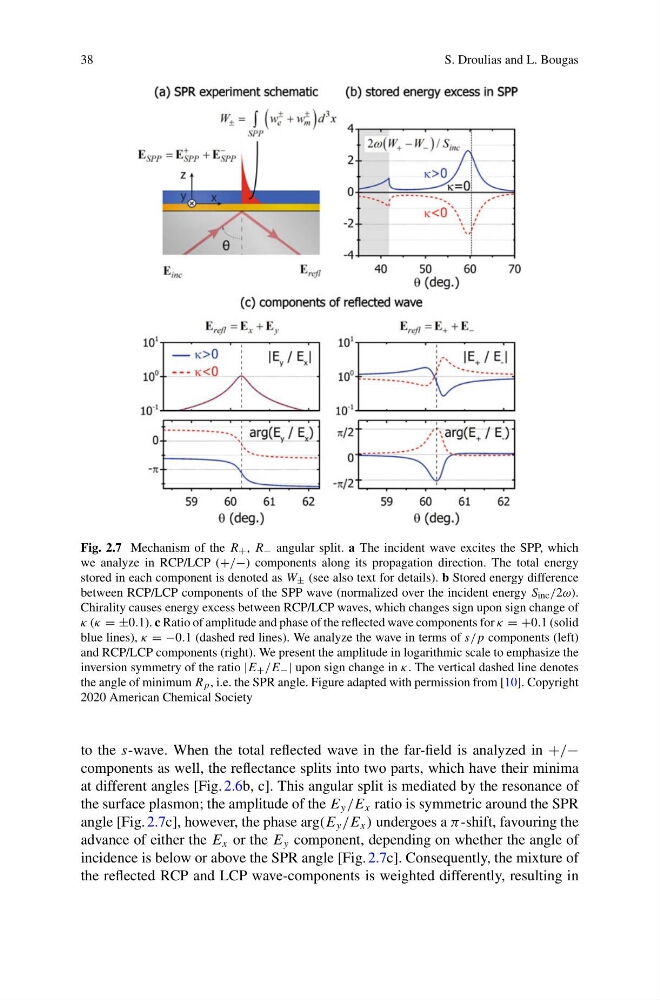
Fig. 2.7 Mechanism of the R + , R − angular split. a The incident wave excites the SPP, which
we analyze in RCP/LCP (+/−) components along its propagation direction. The total energy
stored in each component is denoted as W ± (see also text for details). b Stored energy difference
between RCP/LCP components of the SPP wave (normalized over the incident energy S inc /2ω).
Chirality causes energy excess between RCP/LCP waves, which changes sign upon sign change of
κ (κ = ±0.1). c Ratio of amplitude and phase of the reflected wave components for κ = +0.1 (solid
blue lines), κ = −0.1 (dashed red lines). We analyze the wave in terms of s/ p components (left)
and RCP/LCP components (right). We present the amplitude in logarithmic scale to emphasize the
inversion symmetry of the ratio |E + /E − | upon sign change in κ. The vertical dashed line denotes
the angle of minimum R p , i.e. the SPR angle. Figure adapted with permission from [10]. Copyright
2020 American Chemical Society
to the s-wave. When the total reflected wave in the far-field is analyzed in +/−
components as well, the reflectance splits into two parts, which have their minima
at different angles [Fig. 2.6b, c]. This angular split is mediated by the resonance of
the surface plasmon; the amplitude of the E y /E x ratio is symmetric around the SPR
angle [Fig. 2.7c], however, the phase arg(E y /E x ) undergoes a π -shift, favouring the
advance of either the E x or the E y component, depending on whether the angle of
incidence is below or above the SPR angle [Fig. 2.7c]. Consequently, the mixture of
the reflected RCP and LCP wave-components is weighted differently, resulting in
S. Droulias and L. Bougas
Fig. 2.7 Mechanism of the R + , R − angular split. a The incident wave excites the SPP, which
we analyze in RCP/LCP (+/−) components along its propagation direction. The total energy
stored in each component is denoted as W ± (see also text for details). b Stored energy difference
between RCP/LCP components of the SPP wave (normalized over the incident energy S inc /2ω).
Chirality causes energy excess between RCP/LCP waves, which changes sign upon sign change of
κ (κ = ±0.1). c Ratio of amplitude and phase of the reflected wave components for κ = +0.1 (solid
blue lines), κ = −0.1 (dashed red lines). We analyze the wave in terms of s/ p components (left)
and RCP/LCP components (right). We present the amplitude in logarithmic scale to emphasize the
inversion symmetry of the ratio |E + /E − | upon sign change in κ. The vertical dashed line denotes
the angle of minimum R p , i.e. the SPR angle. Figure adapted with permission from [10]. Copyright
2020 American Chemical Society
to the s-wave. When the total reflected wave in the far-field is analyzed in +/−
components as well, the reflectance splits into two parts, which have their minima
at different angles [Fig. 2.6b, c]. This angular split is mediated by the resonance of
the surface plasmon; the amplitude of the E y /E x ratio is symmetric around the SPR
angle [Fig. 2.7c], however, the phase arg(E y /E x ) undergoes a π -shift, favouring the
advance of either the E x or the E y component, depending on whether the angle of
incidence is below or above the SPR angle [Fig. 2.7c]. Consequently, the mixture of
the reflected RCP and LCP wave-components is weighted differently, resulting in