

548
E. Kamenetskii
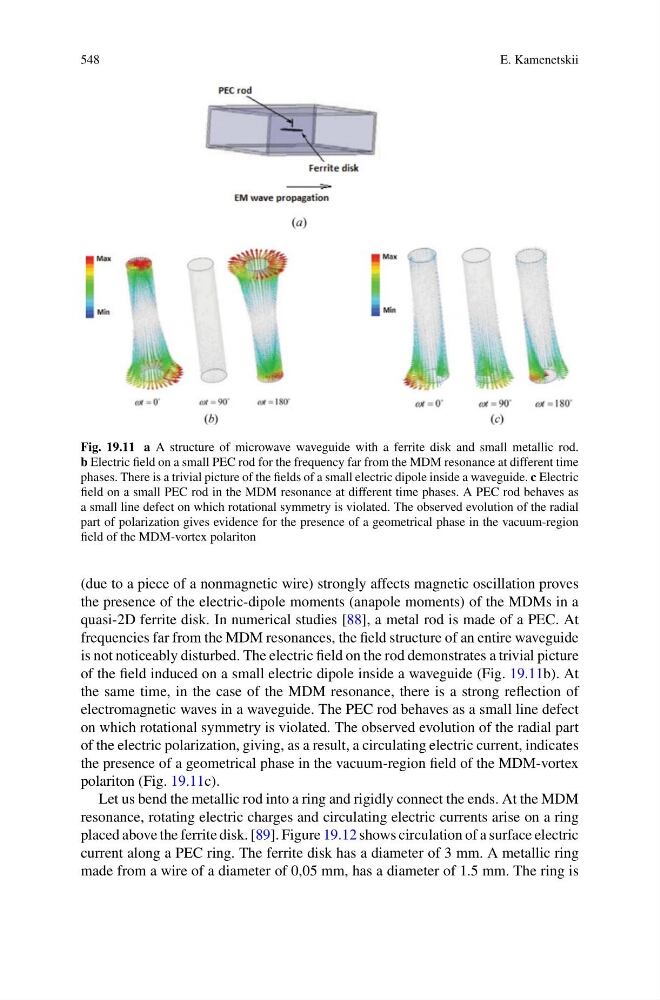
Fig. 19.11 a A structure of microwave waveguide with a ferrite disk and small metallic rod.
b Electric field on a small PEC rod for the frequency far from the MDM resonance at different time
phases. There is a trivial picture of the fields of a small electric dipole inside a waveguide. c Electric
field on a small PEC rod in the MDM resonance at different time phases. A PEC rod behaves as
a small line defect on which rotational symmetry is violated. The observed evolution of the radial
part of polarization gives evidence for the presence of a geometrical phase in the vacuum-region
field of the MDM-vortex polariton
(due to a piece of a nonmagnetic wire) strongly affects magnetic oscillation proves
the presence of the electric-dipole moments (anapole moments) of the MDMs in a
quasi-2D ferrite disk. In numerical studies [88], a metal rod is made of a PEC. At
frequencies far from the MDM resonances, the field structure of an entire waveguide
is not noticeably disturbed. The electric field on the rod demonstrates a trivial picture
of the field induced on a small electric dipole inside a waveguide (Fig. 19.11b). At
the same time, in the case of the MDM resonance, there is a strong reflection of
electromagnetic waves in a waveguide. The PEC rod behaves as a small line defect
on which rotational symmetry is violated. The observed evolution of the radial part
of the electric polarization, giving, as a result, a circulating electric current, indicates
the presence of a geometrical phase in the vacuum-region field of the MDM-vortex
polariton (Fig. 19.11c).
Let us bend the metallic rod into a ring and rigidly connect the ends. At the MDM
resonance, rotating electric charges and circulating electric currents arise on a ring
placed above the ferrite disk. [89]. Figure 19.12 shows circulation of a surface electric
current along a PEC ring. The ferrite disk has a diameter of 3 mm. A metallic ring
made from a wire of a diameter of 0,05 mm, has a diameter of 1.5 mm. The ring is
E. Kamenetskii
Fig. 19.11 a A structure of microwave waveguide with a ferrite disk and small metallic rod.
b Electric field on a small PEC rod for the frequency far from the MDM resonance at different time
phases. There is a trivial picture of the fields of a small electric dipole inside a waveguide. c Electric
field on a small PEC rod in the MDM resonance at different time phases. A PEC rod behaves as
a small line defect on which rotational symmetry is violated. The observed evolution of the radial
part of polarization gives evidence for the presence of a geometrical phase in the vacuum-region
field of the MDM-vortex polariton
(due to a piece of a nonmagnetic wire) strongly affects magnetic oscillation proves
the presence of the electric-dipole moments (anapole moments) of the MDMs in a
quasi-2D ferrite disk. In numerical studies [88], a metal rod is made of a PEC. At
frequencies far from the MDM resonances, the field structure of an entire waveguide
is not noticeably disturbed. The electric field on the rod demonstrates a trivial picture
of the field induced on a small electric dipole inside a waveguide (Fig. 19.11b). At
the same time, in the case of the MDM resonance, there is a strong reflection of
electromagnetic waves in a waveguide. The PEC rod behaves as a small line defect
on which rotational symmetry is violated. The observed evolution of the radial part
of the electric polarization, giving, as a result, a circulating electric current, indicates
the presence of a geometrical phase in the vacuum-region field of the MDM-vortex
polariton (Fig. 19.11c).
Let us bend the metallic rod into a ring and rigidly connect the ends. At the MDM
resonance, rotating electric charges and circulating electric currents arise on a ring
placed above the ferrite disk. [89]. Figure 19.12 shows circulation of a surface electric
current along a PEC ring. The ferrite disk has a diameter of 3 mm. A metallic ring
made from a wire of a diameter of 0,05 mm, has a diameter of 1.5 mm. The ring is