

19 Magnetoelectric Near Fields
531
mode amplitude can be interpreted as the probability to find a system in a certain
state n. Normalization of membrane function is expressed as
n
|a n |
2
= 1 [52–57].
The analysis of discrete-energy eigenstates of the MDM oscillations, resulting
from structural confinement in a normally magnetized ferrite disk, is based on a
continuum model. Using the principle of wave-particle duality, one can describe this
oscillating system as a collective motion of quasiparticles. There are “flat-mode”
quasiparticles at a reflexively-translational motion behavior between the lower and
upper planes of a quasi-2D disk. Such quasiparticles are called “light” magnons. In
our study we consider MS magnons in ferromagnet as quanta of collective MS spin
waves that involves the precession of many spins on the long-range dipole-dipole
interactions. It is different from the short-range magnons for exchange-interaction
spin waves with a quadratic character of dispersion. The meaning of the term “light”,
used for the condensed MDM magnons, arises from the fact that effective masses
of these quasiparticles are much less, than effective masses of “real” magnons—
the quasiparticles describing small-scale exchange-interaction effects in magnetic
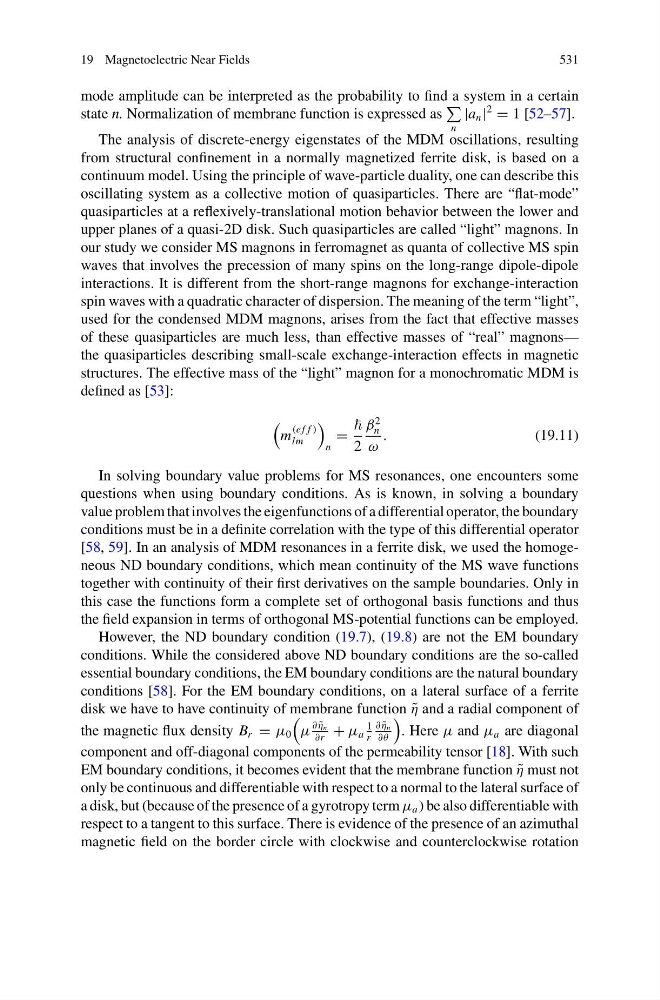
structures. The effective mass of the “light” magnon for a monochromatic MDM is
defined as [53]:
m
(e f f )
lm
n
=
2
β
2
n
ω
.
(19.11)
In solving boundary value problems for MS resonances, one encounters some
questions when using boundary conditions. As is known, in solving a boundary
value problem that involves the eigenfunctions of a differential operator, the boundary
conditions must be in a definite correlation with the type of this differential operator
[58, 59]. In an analysis of MDM resonances in a ferrite disk, we used the homogeneous ND boundary conditions, which mean continuity of the MS wave functions
together with continuity of their first derivatives on the sample boundaries. Only in
this case the functions form a complete set of orthogonal basis functions and thus
the field expansion in terms of orthogonal MS-potential functions can be employed.
However, the ND boundary condition (19.7), (19.8) are not the EM boundary
conditions. While the considered above ND boundary conditions are the so-called
essential boundary conditions, the EM boundary conditions are the natural boundary
conditions [58]. For the EM boundary conditions, on a lateral surface of a ferrite
disk we have to have continuity of membrane function ˜
η and a radial component of
the magnetic flux density B r = μ 0
μ
∂ ˜
η n
∂r
+ μ a
1
r
∂ ˜
η n
∂θ
. Here μ and μ a are diagonal
component and off-diagonal components of the permeability tensor [18]. With such
EM boundary conditions, it becomes evident that the membrane function ˜
η must not
only be continuous and differentiable with respect to a normal to the lateral surface of
a disk, but (because of the presence of a gyrotropy term μ a ) be also differentiable with
respect to a tangent to this surface. There is evidence of the presence of an azimuthal
magnetic field on the border circle with clockwise and counterclockwise rotation
531
mode amplitude can be interpreted as the probability to find a system in a certain
state n. Normalization of membrane function is expressed as
n
|a n |
2
= 1 [52–57].
The analysis of discrete-energy eigenstates of the MDM oscillations, resulting
from structural confinement in a normally magnetized ferrite disk, is based on a
continuum model. Using the principle of wave-particle duality, one can describe this
oscillating system as a collective motion of quasiparticles. There are “flat-mode”
quasiparticles at a reflexively-translational motion behavior between the lower and
upper planes of a quasi-2D disk. Such quasiparticles are called “light” magnons. In
our study we consider MS magnons in ferromagnet as quanta of collective MS spin
waves that involves the precession of many spins on the long-range dipole-dipole
interactions. It is different from the short-range magnons for exchange-interaction
spin waves with a quadratic character of dispersion. The meaning of the term “light”,
used for the condensed MDM magnons, arises from the fact that effective masses
of these quasiparticles are much less, than effective masses of “real” magnons—
the quasiparticles describing small-scale exchange-interaction effects in magnetic
structures. The effective mass of the “light” magnon for a monochromatic MDM is
defined as [53]:
m
(e f f )
lm
n
=
2
β
2
n
ω
.
(19.11)
In solving boundary value problems for MS resonances, one encounters some
questions when using boundary conditions. As is known, in solving a boundary
value problem that involves the eigenfunctions of a differential operator, the boundary
conditions must be in a definite correlation with the type of this differential operator
[58, 59]. In an analysis of MDM resonances in a ferrite disk, we used the homogeneous ND boundary conditions, which mean continuity of the MS wave functions
together with continuity of their first derivatives on the sample boundaries. Only in
this case the functions form a complete set of orthogonal basis functions and thus
the field expansion in terms of orthogonal MS-potential functions can be employed.
However, the ND boundary condition (19.7), (19.8) are not the EM boundary
conditions. While the considered above ND boundary conditions are the so-called
essential boundary conditions, the EM boundary conditions are the natural boundary
conditions [58]. For the EM boundary conditions, on a lateral surface of a ferrite
disk we have to have continuity of membrane function ˜
η and a radial component of
the magnetic flux density B r = μ 0
μ
∂ ˜
η n
∂r
+ μ a
1
r
∂ ˜
η n
∂θ
. Here μ and μ a are diagonal
component and off-diagonal components of the permeability tensor [18]. With such
EM boundary conditions, it becomes evident that the membrane function ˜
η must not
only be continuous and differentiable with respect to a normal to the lateral surface of
a disk, but (because of the presence of a gyrotropy term μ a ) be also differentiable with
respect to a tangent to this surface. There is evidence of the presence of an azimuthal
magnetic field on the border circle with clockwise and counterclockwise rotation