

486
A. Martín-Ruiz et al.
by a magnetic dipole of strength m = −(q//)(1 + 2 // 1 ) located at the image point
−z
, thus confirming the qualitative expectation that a magnetic dipole is induced.
17.6.2 Experimental Proposals
Now we discuss two specific fingerprints of the induced magnetic field which could,
in principle, be measured.
Angle-resolved measurement
In the static case considered above, the WSM attracts the charge toward the surface in
the direction perpendicular to it with a force F e = qE z>0 (r
), where r
= z
ˆ
e z is the
position of the charge. However, interesting phenomena appear when we consider
the dynamics of the external charge. Let us consider, for instance, a steady electron
beam drifting at a distance z
above the surface of the WSM. To make our solution
still valid, we have to consider the electrons slow enough with respect to the Fermi
velocity in the solid, in such a way that the induced polarization and magnetization
of the material rearranges infinitely fast. So, besides the electrostatic force F e , if the
charge q moves with a uniform velocity v above the surface of the WSM, a magnetic
force of the form F m = q
v
c
× B z>0 (r
) will also act on the charge due to the induced
magnetic field. For an electron beam moving along the x-direction (with velocity
v = v x ˆ
e x ) we find
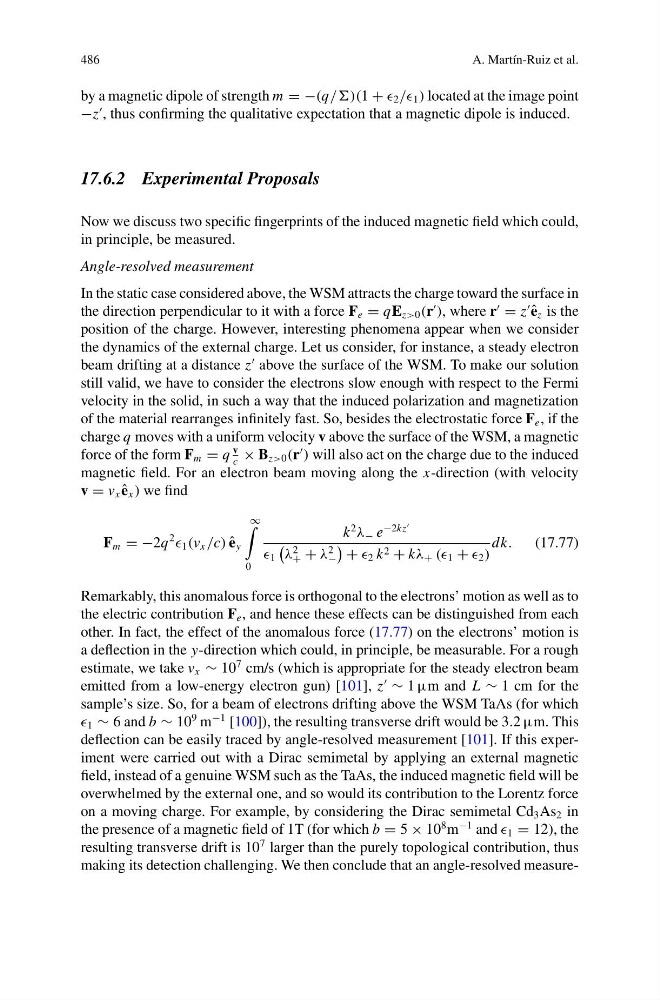
F m = −2q
2
1 (v x /c) ˆ
e y
∞
0
k
2
λ − e
−2kz
1
λ
2
+ + λ
2
−
+ 2 k 2 + kλ + ( 1 + 2 )
dk.
(17.77)
Remarkably, this anomalous force is orthogonal to the electrons’ motion as well as to
the electric contribution F e , and hence these effects can be distinguished from each
other. In fact, the effect of the anomalous force (17.77) on the electrons’ motion is
a deflection in the y-direction which could, in principle, be measurable. For a rough
estimate, we take v x ∼ 10
7 cm/s (which is appropriate for the steady electron beam
emitted from a low-energy electron gun) [101], z
∼ 1 µm and L ∼ 1 cm for the
sample’s size. So, for a beam of electrons drifting above the WSM TaAs (for which
1 ∼ 6 and b ∼ 10
9 m
−1 [100]), the resulting transverse drift would be 3.2 µm. This
deflection can be easily traced by angle-resolved measurement [101]. If this experiment were carried out with a Dirac semimetal by applying an external magnetic
field, instead of a genuine WSM such as the TaAs, the induced magnetic field will be
overwhelmed by the external one, and so would its contribution to the Lorentz force
on a moving charge. For example, by considering the Dirac semimetal Cd 3 As 2 in
the presence of a magnetic field of 1T (for which b = 5 × 10
8 m
−1 and 1 = 12), the
resulting transverse drift is 10
7 larger than the purely topological contribution, thus
making its detection challenging. We then conclude that an angle-resolved measure-
A. Martín-Ruiz et al.
by a magnetic dipole of strength m = −(q//)(1 + 2 // 1 ) located at the image point
−z
, thus confirming the qualitative expectation that a magnetic dipole is induced.
17.6.2 Experimental Proposals
Now we discuss two specific fingerprints of the induced magnetic field which could,
in principle, be measured.
Angle-resolved measurement
In the static case considered above, the WSM attracts the charge toward the surface in
the direction perpendicular to it with a force F e = qE z>0 (r
), where r
= z
ˆ
e z is the
position of the charge. However, interesting phenomena appear when we consider
the dynamics of the external charge. Let us consider, for instance, a steady electron
beam drifting at a distance z
above the surface of the WSM. To make our solution
still valid, we have to consider the electrons slow enough with respect to the Fermi
velocity in the solid, in such a way that the induced polarization and magnetization
of the material rearranges infinitely fast. So, besides the electrostatic force F e , if the
charge q moves with a uniform velocity v above the surface of the WSM, a magnetic
force of the form F m = q
v
c
× B z>0 (r
) will also act on the charge due to the induced
magnetic field. For an electron beam moving along the x-direction (with velocity
v = v x ˆ
e x ) we find
F m = −2q
2
1 (v x /c) ˆ
e y
∞
0
k
2
λ − e
−2kz
1
λ
2
+ + λ
2
−
+ 2 k 2 + kλ + ( 1 + 2 )
dk.
(17.77)
Remarkably, this anomalous force is orthogonal to the electrons’ motion as well as to
the electric contribution F e , and hence these effects can be distinguished from each
other. In fact, the effect of the anomalous force (17.77) on the electrons’ motion is
a deflection in the y-direction which could, in principle, be measurable. For a rough
estimate, we take v x ∼ 10
7 cm/s (which is appropriate for the steady electron beam
emitted from a low-energy electron gun) [101], z
∼ 1 µm and L ∼ 1 cm for the
sample’s size. So, for a beam of electrons drifting above the WSM TaAs (for which
1 ∼ 6 and b ∼ 10
9 m
−1 [100]), the resulting transverse drift would be 3.2 µm. This
deflection can be easily traced by angle-resolved measurement [101]. If this experiment were carried out with a Dirac semimetal by applying an external magnetic
field, instead of a genuine WSM such as the TaAs, the induced magnetic field will be
overwhelmed by the external one, and so would its contribution to the Lorentz force
on a moving charge. For example, by considering the Dirac semimetal Cd 3 As 2 in
the presence of a magnetic field of 1T (for which b = 5 × 10
8 m
−1 and 1 = 12), the
resulting transverse drift is 10
7 larger than the purely topological contribution, thus
making its detection challenging. We then conclude that an angle-resolved measure-