

17 Axion Electrodynamics in Magnetoelectric Media
463
describing the electromagnetic response in the case of linear, isotropic and homogeneous magnetoelectrics. Let us start from the general formulation of electrodynamics
in a material medium according to the Maxwell equations
∇ · D = 4πρ, ∇ · B = 0, ∇ × E +
1
c
∂B
∂t
= 0, ∇ × H −
1
c
∂D
∂t
=
4π
c
J,
(17.1)
together with the Lorentz force
F L = q
E +
v
c
× B
.
(17.2)
The characterization of a specific media is given by the constitutive relations which
define the displacement D and the magnetic field H in terms of the electric field
E and the magnetic induction B, which are the fundamental fields that define the
electromagnetic potentials according to the homogeneous equations in (17.1) [25].
The constitutive relations depend on the nature of the material and usually have
the form D = D(E, B) and H = H(E, B). For example, in linear nonmagnetoelectric
media they are D i = ε i j E j y B i = μ i j H j , where ε i j is the permittivity and μ i j is
the permeability tensors, respectively, which can depend on the position and time.
For isotropic and homogeneous materials ε i j = εδ i j and μ i j = μδ i j , with ε and μ
constants. In the case of magnetoelectrics we will consider media described by the
following constitutive relations
D = εE −
θα
π
B,
H =
1
μ
B +
θα
π
E,
(17.3)
where α = e
2
/c 1/137 is the fine-structure constant and the MEP θ is an additional parameter of the medium. The extension of these constitutive relations to the
anisotropic case, for the optical properties of the material (ε and μ) is direct and for
the MEP θ is also possible.
Substituting them in (17.1), we obtain the following modified non-homogeneous
Maxwell equations
∇ · (εE) = 4πρ +
α
π
∇θ · B, ∇ × (B/μ) −
1
c
∂(εE)
∂t
=
4π
c
J −
α
π
∇θ × E −
1
c
α
π
∂θ
∂t
B.
(17.4)
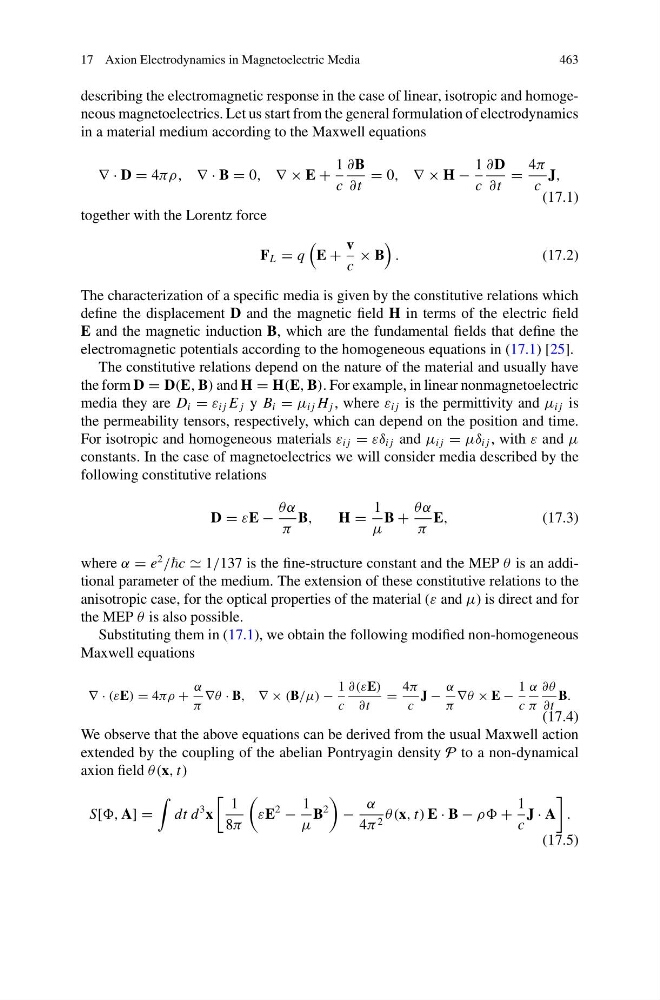
We observe that the above equations can be derived from the usual Maxwell action
extended by the coupling of the abelian Pontryagin density P to a non-dynamical
axion field θ(x, t)
S[, A] =
dt d
3 x
1
8π
εE
2
−
1
μ
B
2
−
α
4π 2 θ(x, t) E · B − ρρ +
1
c
J · A
.
(17.5)
463
describing the electromagnetic response in the case of linear, isotropic and homogeneous magnetoelectrics. Let us start from the general formulation of electrodynamics
in a material medium according to the Maxwell equations
∇ · D = 4πρ, ∇ · B = 0, ∇ × E +
1
c
∂B
∂t
= 0, ∇ × H −
1
c
∂D
∂t
=
4π
c
J,
(17.1)
together with the Lorentz force
F L = q
E +
v
c
× B
.
(17.2)
The characterization of a specific media is given by the constitutive relations which
define the displacement D and the magnetic field H in terms of the electric field
E and the magnetic induction B, which are the fundamental fields that define the
electromagnetic potentials according to the homogeneous equations in (17.1) [25].
The constitutive relations depend on the nature of the material and usually have
the form D = D(E, B) and H = H(E, B). For example, in linear nonmagnetoelectric
media they are D i = ε i j E j y B i = μ i j H j , where ε i j is the permittivity and μ i j is
the permeability tensors, respectively, which can depend on the position and time.
For isotropic and homogeneous materials ε i j = εδ i j and μ i j = μδ i j , with ε and μ
constants. In the case of magnetoelectrics we will consider media described by the
following constitutive relations
D = εE −
θα
π
B,
H =
1
μ
B +
θα
π
E,
(17.3)
where α = e
2
/c 1/137 is the fine-structure constant and the MEP θ is an additional parameter of the medium. The extension of these constitutive relations to the
anisotropic case, for the optical properties of the material (ε and μ) is direct and for
the MEP θ is also possible.
Substituting them in (17.1), we obtain the following modified non-homogeneous
Maxwell equations
∇ · (εE) = 4πρ +
α
π
∇θ · B, ∇ × (B/μ) −
1
c
∂(εE)
∂t
=
4π
c
J −
α
π
∇θ × E −
1
c
α
π
∂θ
∂t
B.
(17.4)
We observe that the above equations can be derived from the usual Maxwell action
extended by the coupling of the abelian Pontryagin density P to a non-dynamical
axion field θ(x, t)
S[, A] =
dt d
3 x
1
8π
εE
2
−
1
μ
B
2
−
α
4π 2 θ(x, t) E · B − ρρ +
1
c
J · A
.
(17.5)