

452
L. Shen et al.
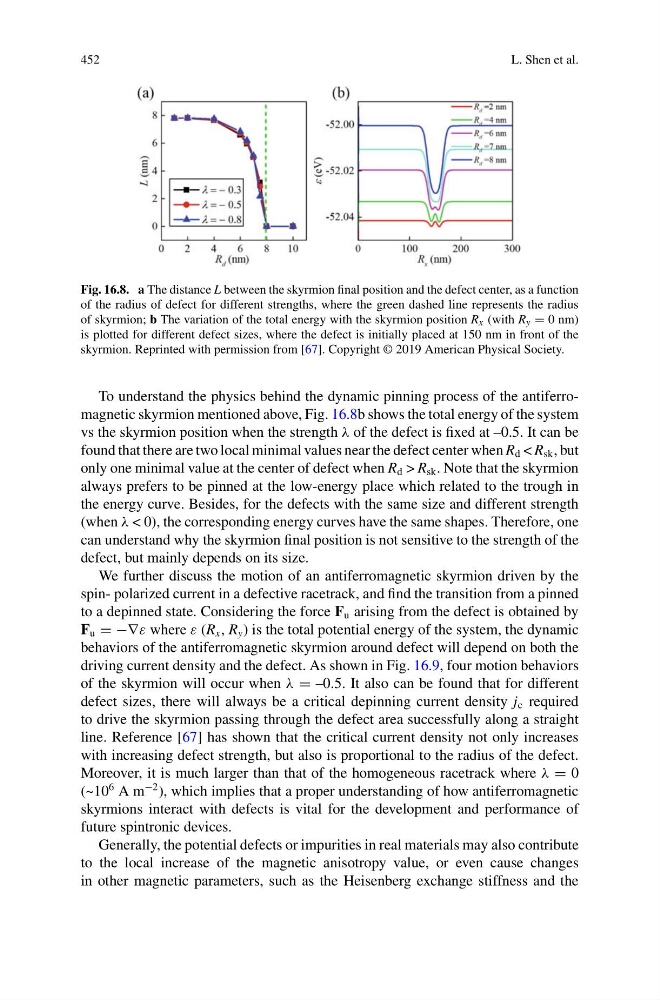
Fig. 16.8. a The distance L between the skyrmion final position and the defect center, as a function
of the radius of defect for different strengths, where the green dashed line represents the radius
of skyrmion; b The variation of the total energy with the skyrmion position R x (with R y = 0 nm)
is plotted for different defect sizes, where the defect is initially placed at 150 nm in front of the
skyrmion. Reprinted with permission from [67]. Copyright © 2019 American Physical Society.
To understand the physics behind the dynamic pinning process of the antiferromagnetic skyrmion mentioned above, Fig. 16.8b shows the total energy of the system
vs the skyrmion position when the strength λ of the defect is fixed at –0.5. It can be
found that there are two local minimal values near the defect center when R d < R sk , but
only one minimal value at the center of defect when R d > R sk . Note that the skyrmion
always prefers to be pinned at the low-energy place which related to the trough in
the energy curve. Besides, for the defects with the same size and different strength
(when λ < 0), the corresponding energy curves have the same shapes. Therefore, one
can understand why the skyrmion final position is not sensitive to the strength of the
defect, but mainly depends on its size.
We further discuss the motion of an antiferromagnetic skyrmion driven by the
spin- polarized current in a defective racetrack, and find the transition from a pinned
to a depinned state. Considering the force F u arising from the defect is obtained by
F u = −∇ε where ε (R x , R y ) is the total potential energy of the system, the dynamic
behaviors of the antiferromagnetic skyrmion around defect will depend on both the
driving current density and the defect. As shown in Fig. 16.9, four motion behaviors
of the skyrmion will occur when λ = –0.5. It also can be found that for different
defect sizes, there will always be a critical depinning current density j c required
to drive the skyrmion passing through the defect area successfully along a straight
line. Reference [67] has shown that the critical current density not only increases
with increasing defect strength, but also is proportional to the radius of the defect.
Moreover, it is much larger than that of the homogeneous racetrack where λ = 0
(~10
6 A m
−2 ), which implies that a proper understanding of how antiferromagnetic
skyrmions interact with defects is vital for the development and performance of
future spintronic devices.
Generally, the potential defects or impurities in real materials may also contribute
to the local increase of the magnetic anisotropy value, or even cause changes
in other magnetic parameters, such as the Heisenberg exchange stiffness and the
L. Shen et al.
Fig. 16.8. a The distance L between the skyrmion final position and the defect center, as a function
of the radius of defect for different strengths, where the green dashed line represents the radius
of skyrmion; b The variation of the total energy with the skyrmion position R x (with R y = 0 nm)
is plotted for different defect sizes, where the defect is initially placed at 150 nm in front of the
skyrmion. Reprinted with permission from [67]. Copyright © 2019 American Physical Society.
To understand the physics behind the dynamic pinning process of the antiferromagnetic skyrmion mentioned above, Fig. 16.8b shows the total energy of the system
vs the skyrmion position when the strength λ of the defect is fixed at –0.5. It can be
found that there are two local minimal values near the defect center when R d < R sk , but
only one minimal value at the center of defect when R d > R sk . Note that the skyrmion
always prefers to be pinned at the low-energy place which related to the trough in
the energy curve. Besides, for the defects with the same size and different strength
(when λ < 0), the corresponding energy curves have the same shapes. Therefore, one
can understand why the skyrmion final position is not sensitive to the strength of the
defect, but mainly depends on its size.
We further discuss the motion of an antiferromagnetic skyrmion driven by the
spin- polarized current in a defective racetrack, and find the transition from a pinned
to a depinned state. Considering the force F u arising from the defect is obtained by
F u = −∇ε where ε (R x , R y ) is the total potential energy of the system, the dynamic
behaviors of the antiferromagnetic skyrmion around defect will depend on both the
driving current density and the defect. As shown in Fig. 16.9, four motion behaviors
of the skyrmion will occur when λ = –0.5. It also can be found that for different
defect sizes, there will always be a critical depinning current density j c required
to drive the skyrmion passing through the defect area successfully along a straight
line. Reference [67] has shown that the critical current density not only increases
with increasing defect strength, but also is proportional to the radius of the defect.
Moreover, it is much larger than that of the homogeneous racetrack where λ = 0
(~10
6 A m
−2 ), which implies that a proper understanding of how antiferromagnetic
skyrmions interact with defects is vital for the development and performance of
future spintronic devices.
Generally, the potential defects or impurities in real materials may also contribute
to the local increase of the magnetic anisotropy value, or even cause changes
in other magnetic parameters, such as the Heisenberg exchange stiffness and the