

2 Surface Plasmons for Chiral Sensing
27
material parameters of the constitutive relations. In particular, these, along with
Maxwell’s equations, can be written as (according to Condon [12, 13], in the e
−iωt
convention):
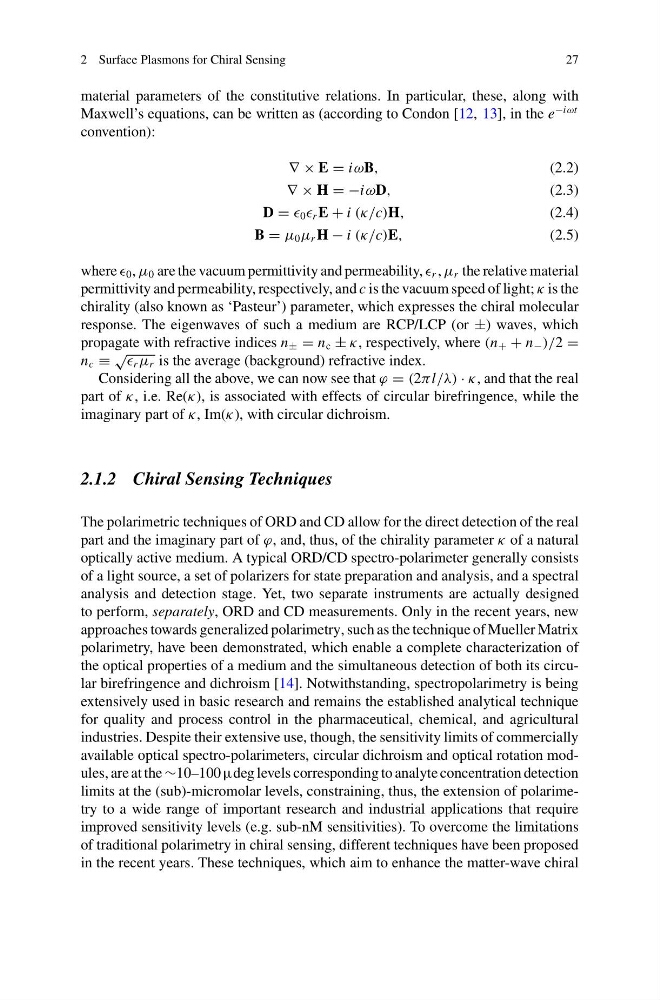
∇ × E = iωB,
(2.2)
∇ × H = −iωD,
(2.3)
D = 0 r E + i (κ/c)H,
(2.4)
B = μ 0 μ r H − i (κ/c)E,
(2.5)
where 0 , μ 0 are the vacuum permittivity and permeability, r , μ r the relative material
permittivity and permeability, respectively, and c is the vacuum speed of light; κ is the
chirality (also known as ‘Pasteur’) parameter, which expresses the chiral molecular
response. The eigenwaves of such a medium are RCP/LCP (or ±) waves, which
propagate with refractive indices n ± = n c ± κ, respectively, where (n + + n − )/2 =
n c ≡
√ r μ r is the average (background) refractive index.
Considering all the above, we can now see that ϕ = (2πl/λ) · κ, and that the real
part of κ, i.e. Re(κ), is associated with effects of circular birefringence, while the
imaginary part of κ, Im(κ), with circular dichroism.
2.1.2 Chiral Sensing Techniques
The polarimetric techniques of ORD and CD allow for the direct detection of the real
part and the imaginary part of ϕ, and, thus, of the chirality parameter κ of a natural
optically active medium. A typical ORD/CD spectro-polarimeter generally consists
of a light source, a set of polarizers for state preparation and analysis, and a spectral
analysis and detection stage. Yet, two separate instruments are actually designed
to perform, separately, ORD and CD measurements. Only in the recent years, new
approaches towards generalized polarimetry, such as the technique of Mueller Matrix
polarimetry, have been demonstrated, which enable a complete characterization of
the optical properties of a medium and the simultaneous detection of both its circular birefringence and dichroism [14]. Notwithstanding, spectropolarimetry is being
extensively used in basic research and remains the established analytical technique
for quality and process control in the pharmaceutical, chemical, and agricultural
industries. Despite their extensive use, though, the sensitivity limits of commercially
available optical spectro-polarimeters, circular dichroism and optical rotation modules, are at the ∼10–100 µdeg levels corresponding to analyte concentration detection
limits at the (sub)-micromolar levels, constraining, thus, the extension of polarimetry to a wide range of important research and industrial applications that require
improved sensitivity levels (e.g. sub-nM sensitivities). To overcome the limitations
of traditional polarimetry in chiral sensing, different techniques have been proposed
in the recent years. These techniques, which aim to enhance the matter-wave chiral
27
material parameters of the constitutive relations. In particular, these, along with
Maxwell’s equations, can be written as (according to Condon [12, 13], in the e
−iωt
convention):
∇ × E = iωB,
(2.2)
∇ × H = −iωD,
(2.3)
D = 0 r E + i (κ/c)H,
(2.4)
B = μ 0 μ r H − i (κ/c)E,
(2.5)
where 0 , μ 0 are the vacuum permittivity and permeability, r , μ r the relative material
permittivity and permeability, respectively, and c is the vacuum speed of light; κ is the
chirality (also known as ‘Pasteur’) parameter, which expresses the chiral molecular
response. The eigenwaves of such a medium are RCP/LCP (or ±) waves, which
propagate with refractive indices n ± = n c ± κ, respectively, where (n + + n − )/2 =
n c ≡
√ r μ r is the average (background) refractive index.
Considering all the above, we can now see that ϕ = (2πl/λ) · κ, and that the real
part of κ, i.e. Re(κ), is associated with effects of circular birefringence, while the
imaginary part of κ, Im(κ), with circular dichroism.
2.1.2 Chiral Sensing Techniques
The polarimetric techniques of ORD and CD allow for the direct detection of the real
part and the imaginary part of ϕ, and, thus, of the chirality parameter κ of a natural
optically active medium. A typical ORD/CD spectro-polarimeter generally consists
of a light source, a set of polarizers for state preparation and analysis, and a spectral
analysis and detection stage. Yet, two separate instruments are actually designed
to perform, separately, ORD and CD measurements. Only in the recent years, new
approaches towards generalized polarimetry, such as the technique of Mueller Matrix
polarimetry, have been demonstrated, which enable a complete characterization of
the optical properties of a medium and the simultaneous detection of both its circular birefringence and dichroism [14]. Notwithstanding, spectropolarimetry is being
extensively used in basic research and remains the established analytical technique
for quality and process control in the pharmaceutical, chemical, and agricultural
industries. Despite their extensive use, though, the sensitivity limits of commercially
available optical spectro-polarimeters, circular dichroism and optical rotation modules, are at the ∼10–100 µdeg levels corresponding to analyte concentration detection
limits at the (sub)-micromolar levels, constraining, thus, the extension of polarimetry to a wide range of important research and industrial applications that require
improved sensitivity levels (e.g. sub-nM sensitivities). To overcome the limitations
of traditional polarimetry in chiral sensing, different techniques have been proposed
in the recent years. These techniques, which aim to enhance the matter-wave chiral