

442
L. Shen et al.
dynamic behavior of antiferromagnets should be similar to that described by the classical Newton’s kinetic equation, and antiferromagnets may have richer dynamics than
ferromagnets. On the other hand, intrinsic resonance frequency of the ferromagnet is
typically on the order of gigahertz, while for the antiferromagnet it has high resonance
frequency (generally, terahertz) thanks to the presence of strong antiferromagnetic
exchange fields [6]. Therefore, the antiferromagnet can be used as an oscillator to
generate terahertz oscillation signal [7]. Additionally, the magnetic moments of antiferromagnetic sublattices are compensated, which leads to nearly zero stray fields
and insensitivity to the perturbation due to magnetic fields. These advantages make
antiferromagnets active in condensed matter physics.
Magnetic textures, such as domain wall [8–10], skyrmion [11–16], bimeron [17–
21] and skyrmionium [22–25] have attracted a great deal of attention due to their rich
physics and important applications in information storage and computing devices.
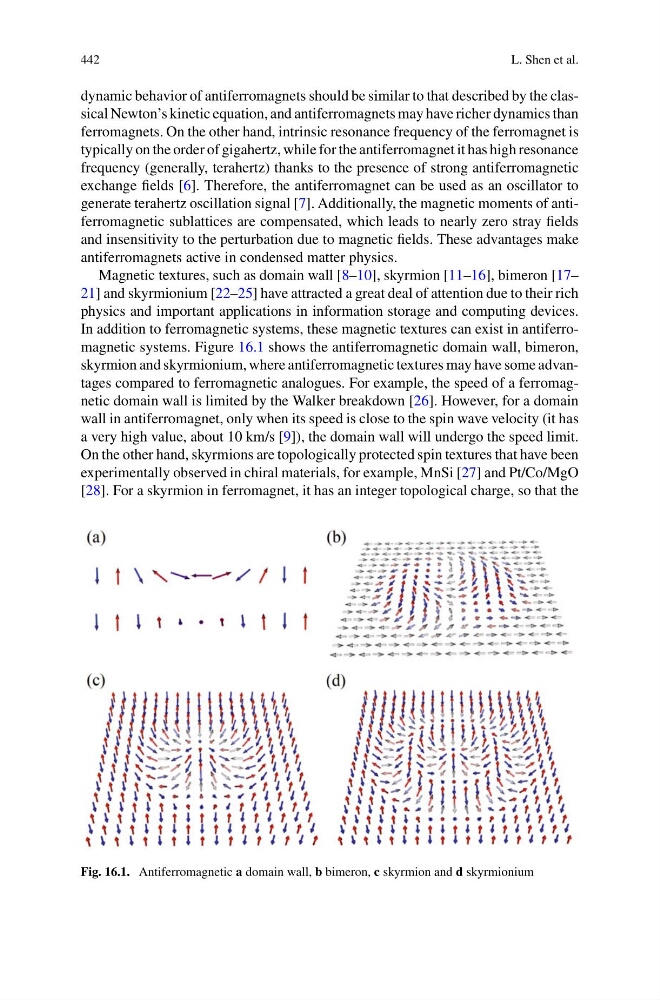
In addition to ferromagnetic systems, these magnetic textures can exist in antiferromagnetic systems. Figure 16.1 shows the antiferromagnetic domain wall, bimeron,
skyrmion and skyrmionium, where antiferromagnetic textures may have some advantages compared to ferromagnetic analogues. For example, the speed of a ferromagnetic domain wall is limited by the Walker breakdown [26]. However, for a domain
wall in antiferromagnet, only when its speed is close to the spin wave velocity (it has
a very high value, about 10 km/s [9]), the domain wall will undergo the speed limit.
On the other hand, skyrmions are topologically protected spin textures that have been
experimentally observed in chiral materials, for example, MnSi [27] and Pt/Co/MgO
[28]. For a skyrmion in ferromagnet, it has an integer topological charge, so that the
Fig. 16.1. Antiferromagnetic a domain wall, b bimeron, c skyrmion and d skyrmionium
L. Shen et al.
dynamic behavior of antiferromagnets should be similar to that described by the classical Newton’s kinetic equation, and antiferromagnets may have richer dynamics than
ferromagnets. On the other hand, intrinsic resonance frequency of the ferromagnet is
typically on the order of gigahertz, while for the antiferromagnet it has high resonance
frequency (generally, terahertz) thanks to the presence of strong antiferromagnetic
exchange fields [6]. Therefore, the antiferromagnet can be used as an oscillator to
generate terahertz oscillation signal [7]. Additionally, the magnetic moments of antiferromagnetic sublattices are compensated, which leads to nearly zero stray fields
and insensitivity to the perturbation due to magnetic fields. These advantages make
antiferromagnets active in condensed matter physics.
Magnetic textures, such as domain wall [8–10], skyrmion [11–16], bimeron [17–
21] and skyrmionium [22–25] have attracted a great deal of attention due to their rich
physics and important applications in information storage and computing devices.
In addition to ferromagnetic systems, these magnetic textures can exist in antiferromagnetic systems. Figure 16.1 shows the antiferromagnetic domain wall, bimeron,
skyrmion and skyrmionium, where antiferromagnetic textures may have some advantages compared to ferromagnetic analogues. For example, the speed of a ferromagnetic domain wall is limited by the Walker breakdown [26]. However, for a domain
wall in antiferromagnet, only when its speed is close to the spin wave velocity (it has
a very high value, about 10 km/s [9]), the domain wall will undergo the speed limit.
On the other hand, skyrmions are topologically protected spin textures that have been
experimentally observed in chiral materials, for example, MnSi [27] and Pt/Co/MgO
[28]. For a skyrmion in ferromagnet, it has an integer topological charge, so that the
Fig. 16.1. Antiferromagnetic a domain wall, b bimeron, c skyrmion and d skyrmionium