

15 Topological Dynamics of Spin Texture Based Metamaterials
417
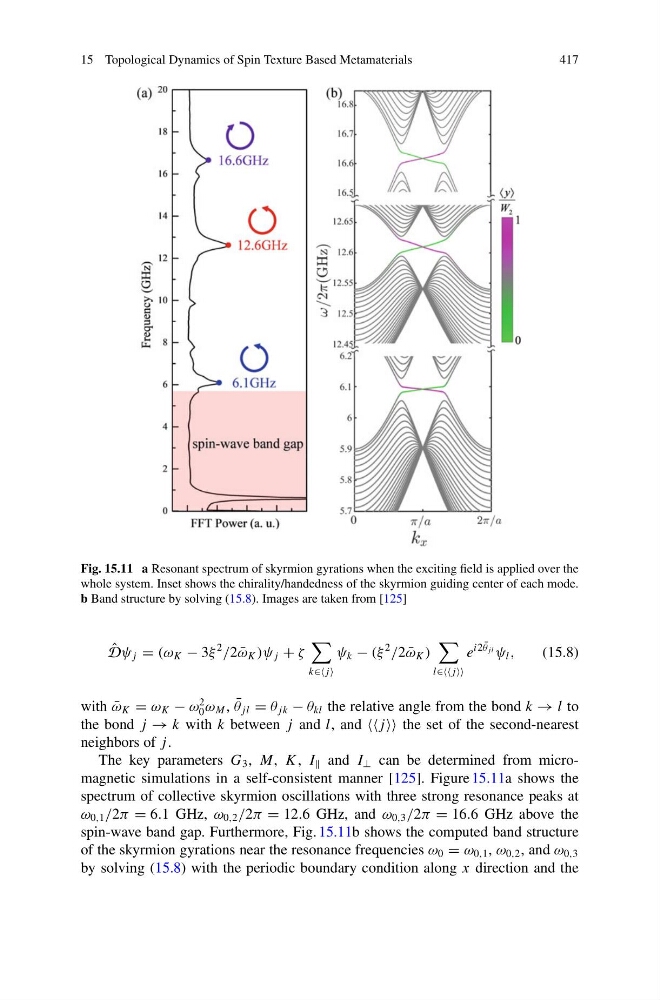
Fig. 15.11 a Resonant spectrum of skyrmion gyrations when the exciting field is applied over the
whole system. Inset shows the chirality/handedness of the skyrmion guiding center of each mode.
b Band structure by solving (15.8). Images are taken from [125]
ˆ
Dψ j = (ω K − 3ξ
2
/2 ¯
ω K )ψ j + ζ
k∈∈ j
ψ k − (ξ
2
/2 ¯
ω K )
l∈∈∈ j
e
i2 ¯
θ jl ψ l ,
(15.8)
with ¯
ω K = ω K − ω
2
0 ω M , ¯
θ jl = θ jk − θ kl the relative angle from the bond k → l to
the bond j → k with k between j and l, and j the set of the second-nearest
neighbors of j.
The key parameters G 3 , M, K , I and I ⊥ can be determined from micromagnetic simulations in a self-consistent manner [125]. Figure 15.11a shows the
spectrum of collective skyrmion oscillations with three strong resonance peaks at
ω 0,1 /2π = 6.1 GHz, ω 0,2 /2π = 12.6 GHz, and ω 0,3 /2π = 16.6 GHz above the
spin-wave band gap. Furthermore, Fig. 15.11b shows the computed band structure
of the skyrmion gyrations near the resonance frequencies ω 0 = ω 0,1 , ω 0,2 , and ω 0,3
by solving (15.8) with the periodic boundary condition along x direction and the
417
Fig. 15.11 a Resonant spectrum of skyrmion gyrations when the exciting field is applied over the
whole system. Inset shows the chirality/handedness of the skyrmion guiding center of each mode.
b Band structure by solving (15.8). Images are taken from [125]
ˆ
Dψ j = (ω K − 3ξ
2
/2 ¯
ω K )ψ j + ζ
k∈∈ j
ψ k − (ξ
2
/2 ¯
ω K )
l∈∈∈ j
e
i2 ¯
θ jl ψ l ,
(15.8)
with ¯
ω K = ω K − ω
2
0 ω M , ¯
θ jl = θ jk − θ kl the relative angle from the bond k → l to
the bond j → k with k between j and l, and j the set of the second-nearest
neighbors of j.
The key parameters G 3 , M, K , I and I ⊥ can be determined from micromagnetic simulations in a self-consistent manner [125]. Figure 15.11a shows the
spectrum of collective skyrmion oscillations with three strong resonance peaks at
ω 0,1 /2π = 6.1 GHz, ω 0,2 /2π = 12.6 GHz, and ω 0,3 /2π = 16.6 GHz above the
spin-wave band gap. Furthermore, Fig. 15.11b shows the computed band structure
of the skyrmion gyrations near the resonance frequencies ω 0 = ω 0,1 , ω 0,2 , and ω 0,3
by solving (15.8) with the periodic boundary condition along x direction and the