

15 Topological Dynamics of Spin Texture Based Metamaterials
407
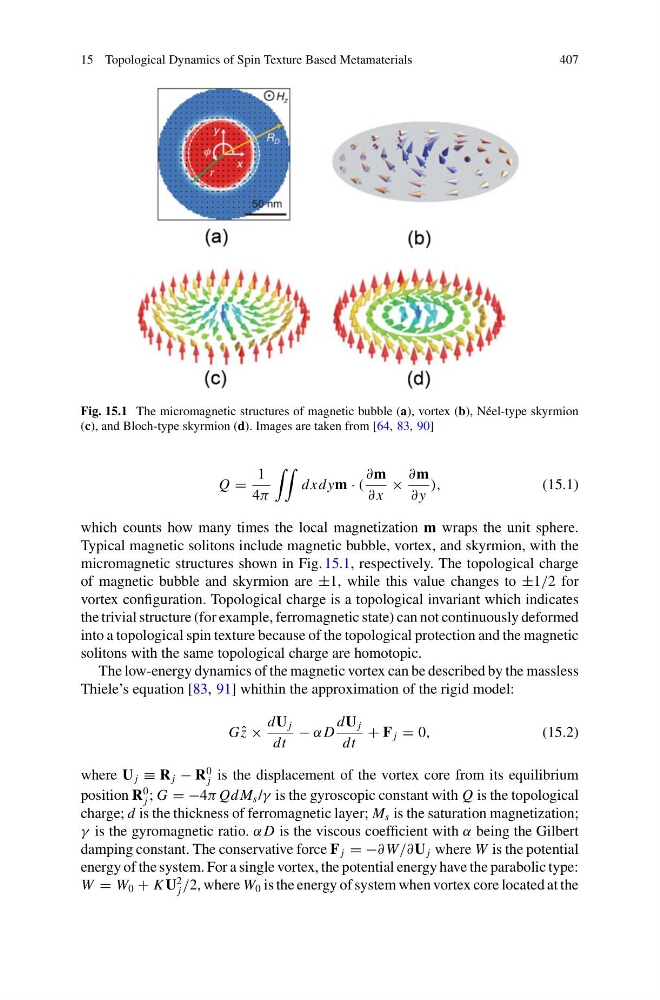
Fig. 15.1 The micromagnetic structures of magnetic bubble (a), vortex (b), Néel-type skyrmion
(c), and Bloch-type skyrmion (d). Images are taken from [64, 83, 90]
Q =
1
4π
dxdym · (
∂m
∂ x
×
∂m
∂ y
),
(15.1)
which counts how many times the local magnetization m wraps the unit sphere.
Typical magnetic solitons include magnetic bubble, vortex, and skyrmion, with the
micromagnetic structures shown in Fig. 15.1, respectively. The topological charge
of magnetic bubble and skyrmion are ±1, while this value changes to ±1/2 for
vortex configuration. Topological charge is a topological invariant which indicates
the trivial structure (for example, ferromagnetic state) can not continuously deformed
into a topological spin texture because of the topological protection and the magnetic
solitons with the same topological charge are homotopic.
The low-energy dynamics of the magnetic vortex can be described by the massless
Thiele’s equation [83, 91] whithin the approximation of the rigid model:
G ˆ
z ×
dU j
dt
− α D
dU j
dt
+ F j = 0,
(15.2)
where U j ≡ R j − R
0
j is the displacement of the vortex core from its equilibrium
position R
0
j ; G = −4π Qd M s /γ is the gyroscopic constant with Q is the topological
charge; d is the thickness of ferromagnetic layer; M s is the saturation magnetization;
γ is the gyromagnetic ratio. α D is the viscous coefficient with α being the Gilbert
damping constant. The conservative force F j = −∂ W/∂U j where W is the potential
energy of the system. For a single vortex, the potential energy have the parabolic type:
W = W 0 + K U
2
j /2, where W 0 is the energy of system when vortex core located at the
407
Fig. 15.1 The micromagnetic structures of magnetic bubble (a), vortex (b), Néel-type skyrmion
(c), and Bloch-type skyrmion (d). Images are taken from [64, 83, 90]
Q =
1
4π
dxdym · (
∂m
∂ x
×
∂m
∂ y
),
(15.1)
which counts how many times the local magnetization m wraps the unit sphere.
Typical magnetic solitons include magnetic bubble, vortex, and skyrmion, with the
micromagnetic structures shown in Fig. 15.1, respectively. The topological charge
of magnetic bubble and skyrmion are ±1, while this value changes to ±1/2 for
vortex configuration. Topological charge is a topological invariant which indicates
the trivial structure (for example, ferromagnetic state) can not continuously deformed
into a topological spin texture because of the topological protection and the magnetic
solitons with the same topological charge are homotopic.
The low-energy dynamics of the magnetic vortex can be described by the massless
Thiele’s equation [83, 91] whithin the approximation of the rigid model:
G ˆ
z ×
dU j
dt
− α D
dU j
dt
+ F j = 0,
(15.2)
where U j ≡ R j − R
0
j is the displacement of the vortex core from its equilibrium
position R
0
j ; G = −4π Qd M s /γ is the gyroscopic constant with Q is the topological
charge; d is the thickness of ferromagnetic layer; M s is the saturation magnetization;
γ is the gyromagnetic ratio. α D is the viscous coefficient with α being the Gilbert
damping constant. The conservative force F j = −∂ W/∂U j where W is the potential
energy of the system. For a single vortex, the potential energy have the parabolic type:
W = W 0 + K U
2
j /2, where W 0 is the energy of system when vortex core located at the