

14 Topology in Magnetism
395
–4 /3√3
3
6
9
ε
(a)
4 /3√3
0
0
–
kx
kz
–
–
–
ε
(b)
–4 /3√3
3
6
9
4 /3√3
– 0
0
–
kx
kz
(c)
–
0
–4 /3√3
–
4 /3√3
–
0
kx
kz
5
6
7
(f)
ε
Z
Z
Γ
–
–
–
kz
high
low
(e)
5
6
7
ε
Z
Z
Γ
–
–
–
kz
high
low
(d)
–
0
–4 /3√3
–
4 /3√3
–
0
kx
kz
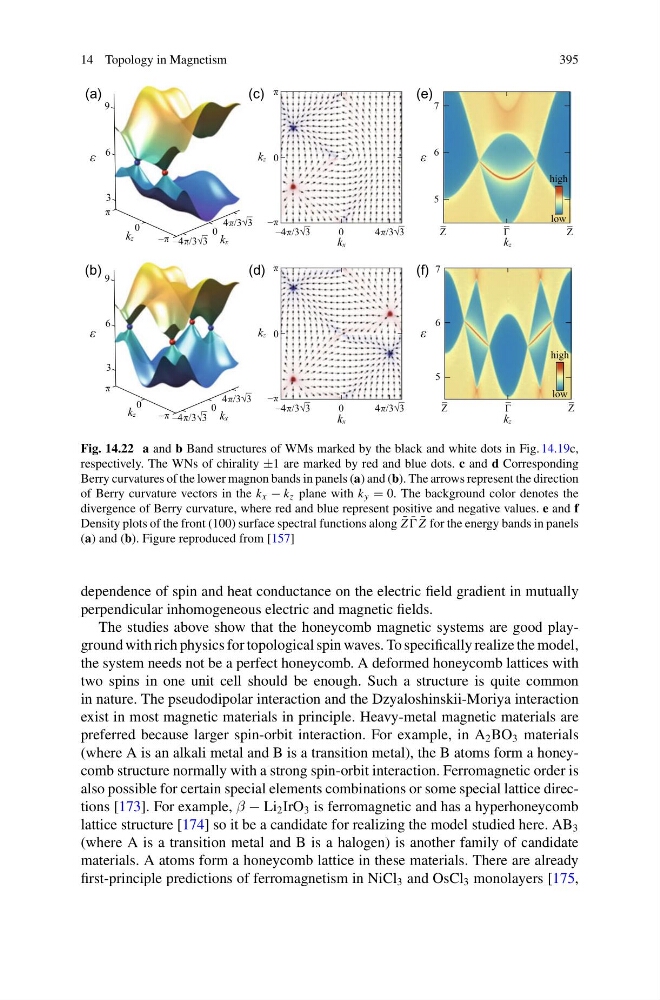
Fig. 14.22 a and b Band structures of WMs marked by the black and white dots in Fig. 14.19c,
respectively. The WNs of chirality ±1 are marked by red and blue dots. c and d Corresponding
Berry curvatures of the lower magnon bands in panels (a) and (b). The arrows represent the direction
of Berry curvature vectors in the k x − k z plane with k y = 0. The background color denotes the
divergence of Berry curvature, where red and blue represent positive and negative values. e and f
Density plots of the front (100) surface spectral functions along ¯
Z ¯
¯
Z for the energy bands in panels
(a) and (b). Figure reproduced from [157]
dependence of spin and heat conductance on the electric field gradient in mutually
perpendicular inhomogeneous electric and magnetic fields.
The studies above show that the honeycomb magnetic systems are good playground with rich physics for topological spin waves. To specifically realize the model,
the system needs not be a perfect honeycomb. A deformed honeycomb lattices with
two spins in one unit cell should be enough. Such a structure is quite common
in nature. The pseudodipolar interaction and the Dzyaloshinskii-Moriya interaction
exist in most magnetic materials in principle. Heavy-metal magnetic materials are
preferred because larger spin-orbit interaction. For example, in A 2 BO 3 materials
(where A is an alkali metal and B is a transition metal), the B atoms form a honeycomb structure normally with a strong spin-orbit interaction. Ferromagnetic order is
also possible for certain special elements combinations or some special lattice directions [173]. For example, β − Li 2 IrO 3 is ferromagnetic and has a hyperhoneycomb
lattice structure [174] so it be a candidate for realizing the model studied here. AB 3
(where A is a transition metal and B is a halogen) is another family of candidate
materials. A atoms form a honeycomb lattice in these materials. There are already
first-principle predictions of ferromagnetism in NiCl 3 and OsCl 3 monolayers [175,
395
–4 /3√3
3
6
9
ε
(a)
4 /3√3
0
0
–
kx
kz
–
–
–
ε
(b)
–4 /3√3
3
6
9
4 /3√3
– 0
0
–
kx
kz
(c)
–
0
–4 /3√3
–
4 /3√3
–
0
kx
kz
5
6
7
(f)
ε
Z
Z
Γ
–
–
–
kz
high
low
(e)
5
6
7
ε
Z
Z
Γ
–
–
–
kz
high
low
(d)
–
0
–4 /3√3
–
4 /3√3
–
0
kx
kz
Fig. 14.22 a and b Band structures of WMs marked by the black and white dots in Fig. 14.19c,
respectively. The WNs of chirality ±1 are marked by red and blue dots. c and d Corresponding
Berry curvatures of the lower magnon bands in panels (a) and (b). The arrows represent the direction
of Berry curvature vectors in the k x − k z plane with k y = 0. The background color denotes the
divergence of Berry curvature, where red and blue represent positive and negative values. e and f
Density plots of the front (100) surface spectral functions along ¯
Z ¯
¯
Z for the energy bands in panels
(a) and (b). Figure reproduced from [157]
dependence of spin and heat conductance on the electric field gradient in mutually
perpendicular inhomogeneous electric and magnetic fields.
The studies above show that the honeycomb magnetic systems are good playground with rich physics for topological spin waves. To specifically realize the model,
the system needs not be a perfect honeycomb. A deformed honeycomb lattices with
two spins in one unit cell should be enough. Such a structure is quite common
in nature. The pseudodipolar interaction and the Dzyaloshinskii-Moriya interaction
exist in most magnetic materials in principle. Heavy-metal magnetic materials are
preferred because larger spin-orbit interaction. For example, in A 2 BO 3 materials
(where A is an alkali metal and B is a transition metal), the B atoms form a honeycomb structure normally with a strong spin-orbit interaction. Ferromagnetic order is
also possible for certain special elements combinations or some special lattice directions [173]. For example, β − Li 2 IrO 3 is ferromagnetic and has a hyperhoneycomb
lattice structure [174] so it be a candidate for realizing the model studied here. AB 3
(where A is a transition metal and B is a halogen) is another family of candidate
materials. A atoms form a honeycomb lattice in these materials. There are already
first-principle predictions of ferromagnetism in NiCl 3 and OsCl 3 monolayers [175,