

14 Topology in Magnetism
361
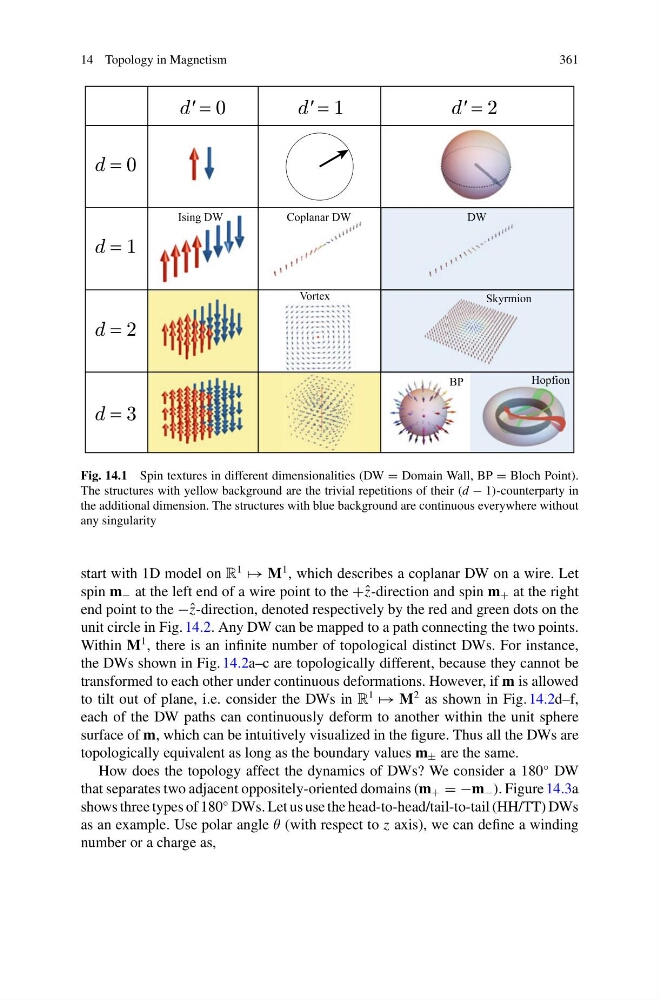
Fig. 14.1 Spin textures in different dimensionalities (DW = Domain Wall, BP = Bloch Point).
The structures with yellow background are the trivial repetitions of their (d − 1)-counterparty in
the additional dimension. The structures with blue background are continuous everywhere without
any singularity
start with 1D model on R
1
→ M
1 , which describes a coplanar DW on a wire. Let
spin m − at the left end of a wire point to the +ˆ z-direction and spin m + at the right
end point to the −ˆ z-direction, denoted respectively by the red and green dots on the
unit circle in Fig. 14.2. Any DW can be mapped to a path connecting the two points.
Within M
1 , there is an infinite number of topological distinct DWs. For instance,
the DWs shown in Fig. 14.2a–c are topologically different, because they cannot be
transformed to each other under continuous deformations. However, if m is allowed
to tilt out of plane, i.e. consider the DWs in R
1
→ M
2 as shown in Fig.14.2d–f,
each of the DW paths can continuously deform to another within the unit sphere
surface of m, which can be intuitively visualized in the figure. Thus all the DWs are
topologically equivalent as long as the boundary values m ± are the same.
How does the topology affect the dynamics of DWs? We consider a 180
◦ DW
that separates two adjacent oppositely-oriented domains (m + = −m − ). Figure 14.3a
shows three types of 180
◦ DWs. Let us use the head-to-head/tail-to-tail (HH/TT) DWs
as an example. Use polar angle θ (with respect to z axis), we can define a winding
number or a charge as,
361
Fig. 14.1 Spin textures in different dimensionalities (DW = Domain Wall, BP = Bloch Point).
The structures with yellow background are the trivial repetitions of their (d − 1)-counterparty in
the additional dimension. The structures with blue background are continuous everywhere without
any singularity
start with 1D model on R
1
→ M
1 , which describes a coplanar DW on a wire. Let
spin m − at the left end of a wire point to the +ˆ z-direction and spin m + at the right
end point to the −ˆ z-direction, denoted respectively by the red and green dots on the
unit circle in Fig. 14.2. Any DW can be mapped to a path connecting the two points.
Within M
1 , there is an infinite number of topological distinct DWs. For instance,
the DWs shown in Fig. 14.2a–c are topologically different, because they cannot be
transformed to each other under continuous deformations. However, if m is allowed
to tilt out of plane, i.e. consider the DWs in R
1
→ M
2 as shown in Fig.14.2d–f,
each of the DW paths can continuously deform to another within the unit sphere
surface of m, which can be intuitively visualized in the figure. Thus all the DWs are
topologically equivalent as long as the boundary values m ± are the same.
How does the topology affect the dynamics of DWs? We consider a 180
◦ DW
that separates two adjacent oppositely-oriented domains (m + = −m − ). Figure 14.3a
shows three types of 180
◦ DWs. Let us use the head-to-head/tail-to-tail (HH/TT) DWs
as an example. Use polar angle θ (with respect to z axis), we can define a winding
number or a charge as,