

358
X. S. Wang and X. R. Wang
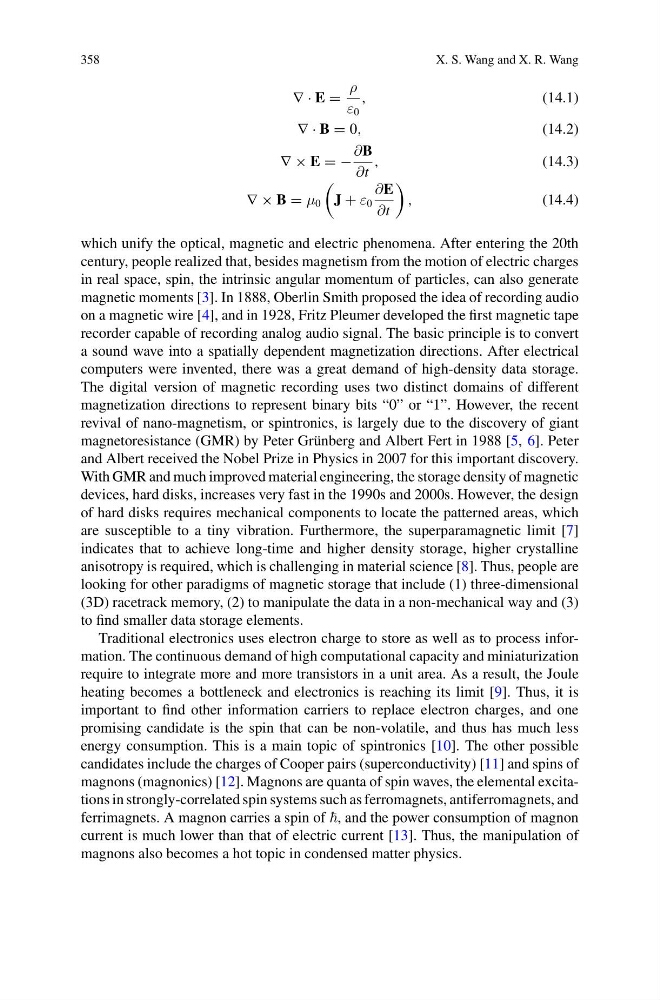
∇ · E =
ρ
ε 0
,
(14.1)
∇ · B = 0,
(14.2)
∇ × E = −
∂B
∂t
,
(14.3)
∇ × B = μ 0
J + ε 0
∂E
∂t
,
(14.4)
which unify the optical, magnetic and electric phenomena. After entering the 20th
century, people realized that, besides magnetism from the motion of electric charges
in real space, spin, the intrinsic angular momentum of particles, can also generate
magnetic moments [3]. In 1888, Oberlin Smith proposed the idea of recording audio
on a magnetic wire [4], and in 1928, Fritz Pleumer developed the first magnetic tape
recorder capable of recording analog audio signal. The basic principle is to convert
a sound wave into a spatially dependent magnetization directions. After electrical
computers were invented, there was a great demand of high-density data storage.
The digital version of magnetic recording uses two distinct domains of different
magnetization directions to represent binary bits “0” or “1”. However, the recent
revival of nano-magnetism, or spintronics, is largely due to the discovery of giant
magnetoresistance (GMR) by Peter Grünberg and Albert Fert in 1988 [5, 6]. Peter
and Albert received the Nobel Prize in Physics in 2007 for this important discovery.
With GMR and much improved material engineering, the storage density of magnetic
devices, hard disks, increases very fast in the 1990s and 2000s. However, the design
of hard disks requires mechanical components to locate the patterned areas, which
are susceptible to a tiny vibration. Furthermore, the superparamagnetic limit [7]
indicates that to achieve long-time and higher density storage, higher crystalline
anisotropy is required, which is challenging in material science [8]. Thus, people are
looking for other paradigms of magnetic storage that include (1) three-dimensional
(3D) racetrack memory, (2) to manipulate the data in a non-mechanical way and (3)
to find smaller data storage elements.
Traditional electronics uses electron charge to store as well as to process information. The continuous demand of high computational capacity and miniaturization
require to integrate more and more transistors in a unit area. As a result, the Joule
heating becomes a bottleneck and electronics is reaching its limit [9]. Thus, it is
important to find other information carriers to replace electron charges, and one
promising candidate is the spin that can be non-volatile, and thus has much less
energy consumption. This is a main topic of spintronics [10]. The other possible
candidates include the charges of Cooper pairs (superconductivity) [11] and spins of
magnons (magnonics) [12]. Magnons are quanta of spin waves, the elemental excitations in strongly-correlated spin systems such as ferromagnets, antiferromagnets, and
ferrimagnets. A magnon carries a spin of , and the power consumption of magnon
current is much lower than that of electric current [13]. Thus, the manipulation of
magnons also becomes a hot topic in condensed matter physics.
X. S. Wang and X. R. Wang
∇ · E =
ρ
ε 0
,
(14.1)
∇ · B = 0,
(14.2)
∇ × E = −
∂B
∂t
,
(14.3)
∇ × B = μ 0
J + ε 0
∂E
∂t
,
(14.4)
which unify the optical, magnetic and electric phenomena. After entering the 20th
century, people realized that, besides magnetism from the motion of electric charges
in real space, spin, the intrinsic angular momentum of particles, can also generate
magnetic moments [3]. In 1888, Oberlin Smith proposed the idea of recording audio
on a magnetic wire [4], and in 1928, Fritz Pleumer developed the first magnetic tape
recorder capable of recording analog audio signal. The basic principle is to convert
a sound wave into a spatially dependent magnetization directions. After electrical
computers were invented, there was a great demand of high-density data storage.
The digital version of magnetic recording uses two distinct domains of different
magnetization directions to represent binary bits “0” or “1”. However, the recent
revival of nano-magnetism, or spintronics, is largely due to the discovery of giant
magnetoresistance (GMR) by Peter Grünberg and Albert Fert in 1988 [5, 6]. Peter
and Albert received the Nobel Prize in Physics in 2007 for this important discovery.
With GMR and much improved material engineering, the storage density of magnetic
devices, hard disks, increases very fast in the 1990s and 2000s. However, the design
of hard disks requires mechanical components to locate the patterned areas, which
are susceptible to a tiny vibration. Furthermore, the superparamagnetic limit [7]
indicates that to achieve long-time and higher density storage, higher crystalline
anisotropy is required, which is challenging in material science [8]. Thus, people are
looking for other paradigms of magnetic storage that include (1) three-dimensional
(3D) racetrack memory, (2) to manipulate the data in a non-mechanical way and (3)
to find smaller data storage elements.
Traditional electronics uses electron charge to store as well as to process information. The continuous demand of high computational capacity and miniaturization
require to integrate more and more transistors in a unit area. As a result, the Joule
heating becomes a bottleneck and electronics is reaching its limit [9]. Thus, it is
important to find other information carriers to replace electron charges, and one
promising candidate is the spin that can be non-volatile, and thus has much less
energy consumption. This is a main topic of spintronics [10]. The other possible
candidates include the charges of Cooper pairs (superconductivity) [11] and spins of
magnons (magnonics) [12]. Magnons are quanta of spin waves, the elemental excitations in strongly-correlated spin systems such as ferromagnets, antiferromagnets, and
ferrimagnets. A magnon carries a spin of , and the power consumption of magnon
current is much lower than that of electric current [13]. Thus, the manipulation of
magnons also becomes a hot topic in condensed matter physics.