

348
J. E. Vázquez-Lozano and A. Martínez
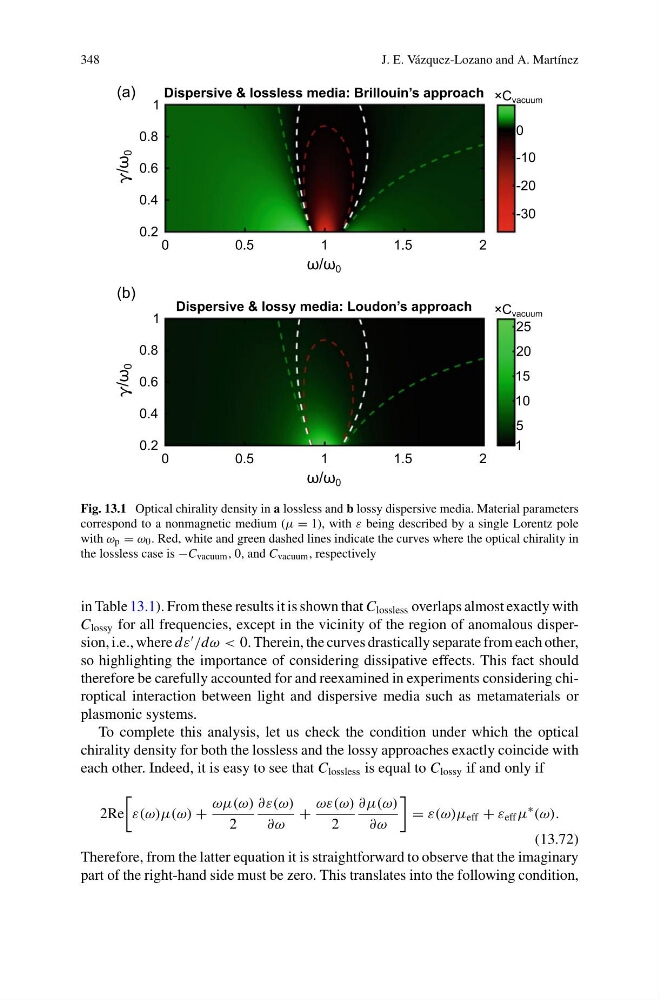
Fig. 13.1 Optical chirality density in a lossless and b lossy dispersive media. Material parameters
correspond to a nonmagnetic medium (μ = 1), with ε being described by a single Lorentz pole
with ω p = ω 0 . Red, white and green dashed lines indicate the curves where the optical chirality in
the lossless case is −C vacuum , 0, and C vacuum , respectively
in Table 13.1). From these results it is shown that C lossless overlaps almost exactly with
C lossy for all frequencies, except in the vicinity of the region of anomalous dispersion, i.e., where dε
/dω < 0. Therein, the curves drastically separate from each other,
so highlighting the importance of considering dissipative effects. This fact should
therefore be carefully accounted for and reexamined in experiments considering chiroptical interaction between light and dispersive media such as metamaterials or
plasmonic systems.
To complete this analysis, let us check the condition under which the optical
chirality density for both the lossless and the lossy approaches exactly coincide with
each other. Indeed, it is easy to see that C lossless is equal to C lossy if and only if
2Re
ε(ω)μ(ω) +
ωμ(ω)
2
∂ε(ω)
∂ω
+
ωε(ω)
2
∂μ(ω)
∂ω
= ε(ω)μ eff + ε eff μ
∗
(ω).
(13.72)
Therefore, from the latter equation it is straightforward to observe that the imaginary
part of the right-hand side must be zero. This translates into the following condition,
J. E. Vázquez-Lozano and A. Martínez
Fig. 13.1 Optical chirality density in a lossless and b lossy dispersive media. Material parameters
correspond to a nonmagnetic medium (μ = 1), with ε being described by a single Lorentz pole
with ω p = ω 0 . Red, white and green dashed lines indicate the curves where the optical chirality in
the lossless case is −C vacuum , 0, and C vacuum , respectively
in Table 13.1). From these results it is shown that C lossless overlaps almost exactly with
C lossy for all frequencies, except in the vicinity of the region of anomalous dispersion, i.e., where dε
/dω < 0. Therein, the curves drastically separate from each other,
so highlighting the importance of considering dissipative effects. This fact should
therefore be carefully accounted for and reexamined in experiments considering chiroptical interaction between light and dispersive media such as metamaterials or
plasmonic systems.
To complete this analysis, let us check the condition under which the optical
chirality density for both the lossless and the lossy approaches exactly coincide with
each other. Indeed, it is easy to see that C lossless is equal to C lossy if and only if
2Re
ε(ω)μ(ω) +
ωμ(ω)
2
∂ε(ω)
∂ω
+
ωε(ω)
2
∂μ(ω)
∂ω
= ε(ω)μ eff + ε eff μ
∗
(ω).
(13.72)
Therefore, from the latter equation it is straightforward to observe that the imaginary
part of the right-hand side must be zero. This translates into the following condition,