

340
J. E. Vázquez-Lozano and A. Martínez
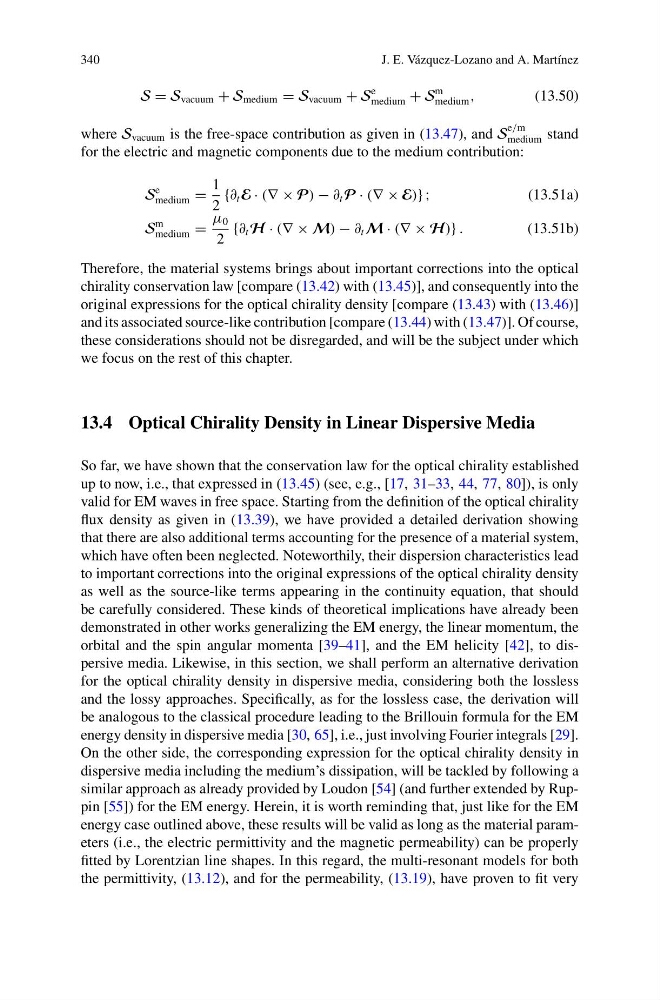
S = S vacuum + S medium = S vacuum + S
e
medium + S
m
medium ,
(13.50)
where S vacuum is the free-space contribution as given in (13.47), and S
e/m
medium stand
for the electric and magnetic components due to the medium contribution:
S
e
medium =
1
2
{∂ t E · (∇ × P) − ∂ t P · (∇ × E)} ;
(13.51a)
S
m
medium =
μ 0
2
{∂ t H · (∇ × M) − ∂ t M · (∇ × H)} .
(13.51b)
Therefore, the material systems brings about important corrections into the optical
chirality conservation law [compare (13.42) with (13.45)], and consequently into the
original expressions for the optical chirality density [compare (13.43) with (13.46)]
and its associated source-like contribution [compare (13.44) with (13.47)]. Of course,
these considerations should not be disregarded, and will be the subject under which
we focus on the rest of this chapter.
13.4 Optical Chirality Density in Linear Dispersive Media
So far, we have shown that the conservation law for the optical chirality established
up to now, i.e., that expressed in (13.45) (see, e.g., [17, 31–33, 44, 77, 80]), is only
valid for EM waves in free space. Starting from the definition of the optical chirality
flux density as given in (13.39), we have provided a detailed derivation showing
that there are also additional terms accounting for the presence of a material system,
which have often been neglected. Noteworthily, their dispersion characteristics lead
to important corrections into the original expressions of the optical chirality density
as well as the source-like terms appearing in the continuity equation, that should
be carefully considered. These kinds of theoretical implications have already been
demonstrated in other works generalizing the EM energy, the linear momentum, the
orbital and the spin angular momenta [39–41], and the EM helicity [42], to dispersive media. Likewise, in this section, we shall perform an alternative derivation
for the optical chirality density in dispersive media, considering both the lossless
and the lossy approaches. Specifically, as for the lossless case, the derivation will
be analogous to the classical procedure leading to the Brillouin formula for the EM
energy density in dispersive media [30, 65], i.e., just involving Fourier integrals [29].
On the other side, the corresponding expression for the optical chirality density in
dispersive media including the medium’s dissipation, will be tackled by following a
similar approach as already provided by Loudon [54] (and further extended by Ruppin [55]) for the EM energy. Herein, it is worth reminding that, just like for the EM
energy case outlined above, these results will be valid as long as the material parameters (i.e., the electric permittivity and the magnetic permeability) can be properly
fitted by Lorentzian line shapes. In this regard, the multi-resonant models for both
the permittivity, (13.12), and for the permeability, (13.19), have proven to fit very
J. E. Vázquez-Lozano and A. Martínez
S = S vacuum + S medium = S vacuum + S
e
medium + S
m
medium ,
(13.50)
where S vacuum is the free-space contribution as given in (13.47), and S
e/m
medium stand
for the electric and magnetic components due to the medium contribution:
S
e
medium =
1
2
{∂ t E · (∇ × P) − ∂ t P · (∇ × E)} ;
(13.51a)
S
m
medium =
μ 0
2
{∂ t H · (∇ × M) − ∂ t M · (∇ × H)} .
(13.51b)
Therefore, the material systems brings about important corrections into the optical
chirality conservation law [compare (13.42) with (13.45)], and consequently into the
original expressions for the optical chirality density [compare (13.43) with (13.46)]
and its associated source-like contribution [compare (13.44) with (13.47)]. Of course,
these considerations should not be disregarded, and will be the subject under which
we focus on the rest of this chapter.
13.4 Optical Chirality Density in Linear Dispersive Media
So far, we have shown that the conservation law for the optical chirality established
up to now, i.e., that expressed in (13.45) (see, e.g., [17, 31–33, 44, 77, 80]), is only
valid for EM waves in free space. Starting from the definition of the optical chirality
flux density as given in (13.39), we have provided a detailed derivation showing
that there are also additional terms accounting for the presence of a material system,
which have often been neglected. Noteworthily, their dispersion characteristics lead
to important corrections into the original expressions of the optical chirality density
as well as the source-like terms appearing in the continuity equation, that should
be carefully considered. These kinds of theoretical implications have already been
demonstrated in other works generalizing the EM energy, the linear momentum, the
orbital and the spin angular momenta [39–41], and the EM helicity [42], to dispersive media. Likewise, in this section, we shall perform an alternative derivation
for the optical chirality density in dispersive media, considering both the lossless
and the lossy approaches. Specifically, as for the lossless case, the derivation will
be analogous to the classical procedure leading to the Brillouin formula for the EM
energy density in dispersive media [30, 65], i.e., just involving Fourier integrals [29].
On the other side, the corresponding expression for the optical chirality density in
dispersive media including the medium’s dissipation, will be tackled by following a
similar approach as already provided by Loudon [54] (and further extended by Ruppin [55]) for the EM energy. Herein, it is worth reminding that, just like for the EM
energy case outlined above, these results will be valid as long as the material parameters (i.e., the electric permittivity and the magnetic permeability) can be properly
fitted by Lorentzian line shapes. In this regard, the multi-resonant models for both
the permittivity, (13.12), and for the permeability, (13.19), have proven to fit very