

12 Magnetoelastic Waves in Thin Films
317
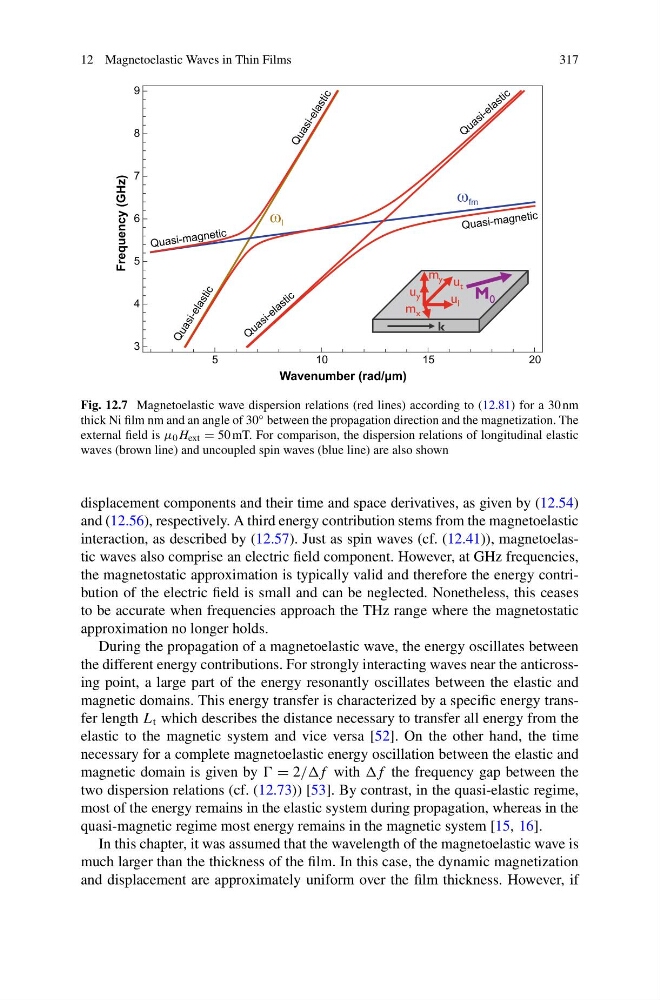
Fig. 12.7 Magnetoelastic wave dispersion relations (red lines) according to (12.81) for a 30nm
thick Ni film nm and an angle of 30 ◦ between the propagation direction and the magnetization. The
external field is μ 0 H ext = 50 mT. For comparison, the dispersion relations of longitudinal elastic
waves (brown line) and uncoupled spin waves (blue line) are also shown
displacement components and their time and space derivatives, as given by (12.54)
and (12.56), respectively. A third energy contribution stems from the magnetoelastic
interaction, as described by (12.57). Just as spin waves (cf. (12.41)), magnetoelastic waves also comprise an electric field component. However, at GHz frequencies,
the magnetostatic approximation is typically valid and therefore the energy contribution of the electric field is small and can be neglected. Nonetheless, this ceases
to be accurate when frequencies approach the THz range where the magnetostatic
approximation no longer holds.
During the propagation of a magnetoelastic wave, the energy oscillates between
the different energy contributions. For strongly interacting waves near the anticrossing point, a large part of the energy resonantly oscillates between the elastic and
magnetic domains. This energy transfer is characterized by a specific energy transfer length L t which describes the distance necessary to transfer all energy from the
elastic to the magnetic system and vice versa [52]. On the other hand, the time
necessary for a complete magnetoelastic energy oscillation between the elastic and
magnetic domain is given by = 2// f with f the frequency gap between the
two dispersion relations (cf. (12.73)) [53]. By contrast, in the quasi-elastic regime,
most of the energy remains in the elastic system during propagation, whereas in the
quasi-magnetic regime most energy remains in the magnetic system [15, 16].
In this chapter, it was assumed that the wavelength of the magnetoelastic wave is
much larger than the thickness of the film. In this case, the dynamic magnetization
and displacement are approximately uniform over the film thickness. However, if
317
Fig. 12.7 Magnetoelastic wave dispersion relations (red lines) according to (12.81) for a 30nm
thick Ni film nm and an angle of 30 ◦ between the propagation direction and the magnetization. The
external field is μ 0 H ext = 50 mT. For comparison, the dispersion relations of longitudinal elastic
waves (brown line) and uncoupled spin waves (blue line) are also shown
displacement components and their time and space derivatives, as given by (12.54)
and (12.56), respectively. A third energy contribution stems from the magnetoelastic
interaction, as described by (12.57). Just as spin waves (cf. (12.41)), magnetoelastic waves also comprise an electric field component. However, at GHz frequencies,
the magnetostatic approximation is typically valid and therefore the energy contribution of the electric field is small and can be neglected. Nonetheless, this ceases
to be accurate when frequencies approach the THz range where the magnetostatic
approximation no longer holds.
During the propagation of a magnetoelastic wave, the energy oscillates between
the different energy contributions. For strongly interacting waves near the anticrossing point, a large part of the energy resonantly oscillates between the elastic and
magnetic domains. This energy transfer is characterized by a specific energy transfer length L t which describes the distance necessary to transfer all energy from the
elastic to the magnetic system and vice versa [52]. On the other hand, the time
necessary for a complete magnetoelastic energy oscillation between the elastic and
magnetic domain is given by = 2// f with f the frequency gap between the
two dispersion relations (cf. (12.73)) [53]. By contrast, in the quasi-elastic regime,
most of the energy remains in the elastic system during propagation, whereas in the
quasi-magnetic regime most energy remains in the magnetic system [15, 16].
In this chapter, it was assumed that the wavelength of the magnetoelastic wave is
much larger than the thickness of the film. In this case, the dynamic magnetization
and displacement are approximately uniform over the film thickness. However, if