

274
M. Sato
number q = q 0 ∝ ω/G which is the best truncation order of the Floquet-Magnus
expansion. Here, G is the typical local energy scale of the system including the
coupling between the system and AC field. (ii) ˆ
H q of application of AC field. (iii) During a short time τ 2 τ 1 , the time evolution
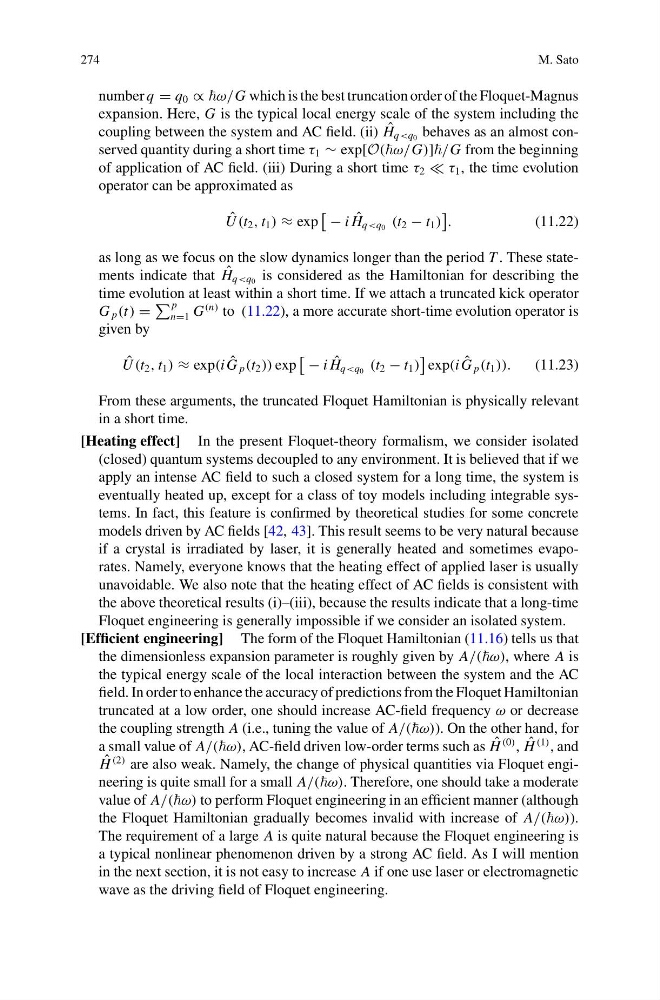
operator can be approximated as
ˆ
U (t 2 , t 1 ) ≈ exp
− i ˆ
H q .
(11.22)
as long as we focus on the slow dynamics longer than the period T . These statements indicate that ˆ
H q time evolution at least within a short time. If we attach a truncated kick operator
G p (t) =
p
n=1 G
(n) to (11.22), a more accurate short-time evolution operator is
given by
ˆ
U (t 2 , t 1 ) ≈ exp(i ˆ
G p (t 2 )) exp
− i ˆ
H q exp(i ˆ
G p (t 1 )).
(11.23)
From these arguments, the truncated Floquet Hamiltonian is physically relevant
in a short time.
[Heating effect] In the present Floquet-theory formalism, we consider isolated
(closed) quantum systems decoupled to any environment. It is believed that if we
apply an intense AC field to such a closed system for a long time, the system is
eventually heated up, except for a class of toy models including integrable systems. In fact, this feature is confirmed by theoretical studies for some concrete
models driven by AC fields [42, 43]. This result seems to be very natural because
if a crystal is irradiated by laser, it is generally heated and sometimes evaporates. Namely, everyone knows that the heating effect of applied laser is usually
unavoidable. We also note that the heating effect of AC fields is consistent with
the above theoretical results (i)–(iii), because the results indicate that a long-time
Floquet engineering is generally impossible if we consider an isolated system.
[Efficient engineering] The form of the Floquet Hamiltonian (11.16) tells us that
the dimensionless expansion parameter is roughly given by A/(ω), where A is
the typical energy scale of the local interaction between the system and the AC
field. In order to enhance the accuracy of predictions from the Floquet Hamiltonian
truncated at a low order, one should increase AC-field frequency ω or decrease
the coupling strength A (i.e., tuning the value of A/(ω)). On the other hand, for
a small value of A/(ω), AC-field driven low-order terms such as ˆ
H
(0) , ˆ
H
(1) , and
ˆ
H
(2) are also weak. Namely, the change of physical quantities via Floquet engineering is quite small for a small A/(ω). Therefore, one should take a moderate
value of A/(ω) to perform Floquet engineering in an efficient manner (although
the Floquet Hamiltonian gradually becomes invalid with increase of A/(ω)).
The requirement of a large A is quite natural because the Floquet engineering is
a typical nonlinear phenomenon driven by a strong AC field. As I will mention
in the next section, it is not easy to increase A if one use laser or electromagnetic
wave as the driving field of Floquet engineering.
M. Sato
number q = q 0 ∝ ω/G which is the best truncation order of the Floquet-Magnus
expansion. Here, G is the typical local energy scale of the system including the
coupling between the system and AC field. (ii) ˆ
H q of application of AC field. (iii) During a short time τ 2 τ 1 , the time evolution
operator can be approximated as
ˆ
U (t 2 , t 1 ) ≈ exp
− i ˆ
H q .
(11.22)
as long as we focus on the slow dynamics longer than the period T . These statements indicate that ˆ
H q time evolution at least within a short time. If we attach a truncated kick operator
G p (t) =
p
n=1 G
(n) to (11.22), a more accurate short-time evolution operator is
given by
ˆ
U (t 2 , t 1 ) ≈ exp(i ˆ
G p (t 2 )) exp
− i ˆ
H q exp(i ˆ
G p (t 1 )).
(11.23)
From these arguments, the truncated Floquet Hamiltonian is physically relevant
in a short time.
[Heating effect] In the present Floquet-theory formalism, we consider isolated
(closed) quantum systems decoupled to any environment. It is believed that if we
apply an intense AC field to such a closed system for a long time, the system is
eventually heated up, except for a class of toy models including integrable systems. In fact, this feature is confirmed by theoretical studies for some concrete
models driven by AC fields [42, 43]. This result seems to be very natural because
if a crystal is irradiated by laser, it is generally heated and sometimes evaporates. Namely, everyone knows that the heating effect of applied laser is usually
unavoidable. We also note that the heating effect of AC fields is consistent with
the above theoretical results (i)–(iii), because the results indicate that a long-time
Floquet engineering is generally impossible if we consider an isolated system.
[Efficient engineering] The form of the Floquet Hamiltonian (11.16) tells us that
the dimensionless expansion parameter is roughly given by A/(ω), where A is
the typical energy scale of the local interaction between the system and the AC
field. In order to enhance the accuracy of predictions from the Floquet Hamiltonian
truncated at a low order, one should increase AC-field frequency ω or decrease
the coupling strength A (i.e., tuning the value of A/(ω)). On the other hand, for
a small value of A/(ω), AC-field driven low-order terms such as ˆ
H
(0) , ˆ
H
(1) , and
ˆ
H
(2) are also weak. Namely, the change of physical quantities via Floquet engineering is quite small for a small A/(ω). Therefore, one should take a moderate
value of A/(ω) to perform Floquet engineering in an efficient manner (although
the Floquet Hamiltonian gradually becomes invalid with increase of A/(ω)).
The requirement of a large A is quite natural because the Floquet engineering is
a typical nonlinear phenomenon driven by a strong AC field. As I will mention
in the next section, it is not easy to increase A if one use laser or electromagnetic
wave as the driving field of Floquet engineering.