

8
T. Yu and G. E. W. Bauer
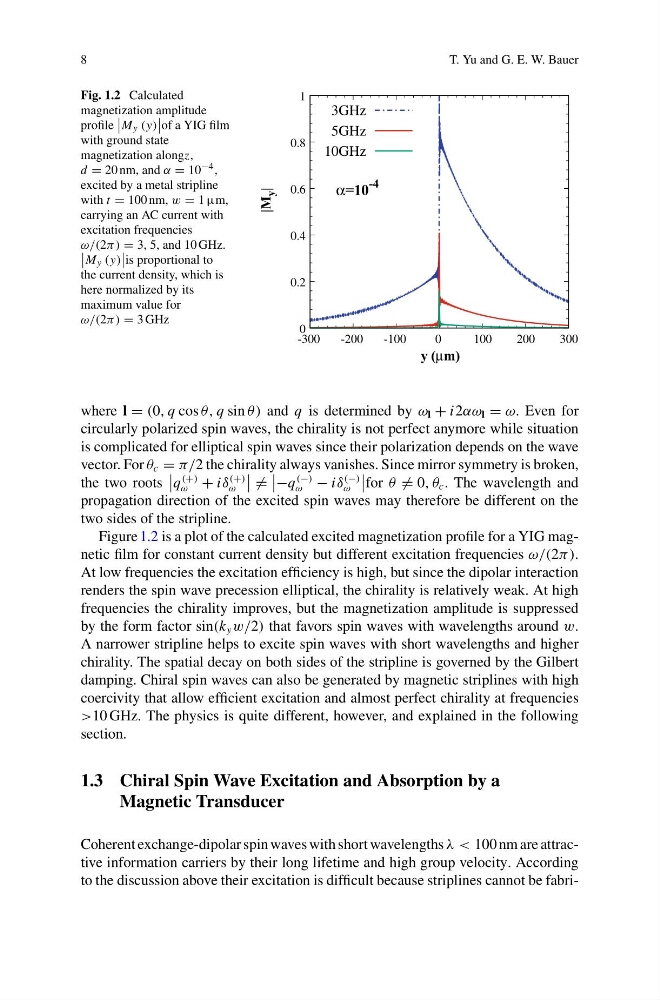
Fig. 1.2 Calculated
magnetization amplitude
profile
M y (y)
of a YIG film
with ground state
magnetization alongz,
d = 20 nm, and α = 10 −4 ,
excited by a metal stripline
with t = 100 nm, w = 1 µm,
carrying an AC current with
excitation frequencies
ω/(2π) = 3, 5, and 10 GHz.
M y (y)
is proportional to
the current density, which is
here normalized by its
maximum value for
ω/(2π) = 3 GHz
0
0.2
0.4
0.6
0.8
1
-300
-200
-100
0
100
200
300
|M
y |
y (μm)
α=10
-4
3GHz
5GHz
10GHz
where l = (0, q cos θ, q sin θ) and q is determined by ω l + i2αω l = ω. Even for
circularly polarized spin waves, the chirality is not perfect anymore while situation
is complicated for elliptical spin waves since their polarization depends on the wave
vector. For θ c = π/2 the chirality always vanishes. Since mirror symmetry is broken,
the two roots
q
(+)
ω + iδ
(+)
ω
=
−q
(−)
ω − iδ
(−)
ω
for θ = 0, θ c . The wavelength and
propagation direction of the excited spin waves may therefore be different on the
two sides of the stripline.
Figure 1.2 is a plot of the calculated excited magnetization profile for a YIG magnetic film for constant current density but different excitation frequencies ω/(2π).
At low frequencies the excitation efficiency is high, but since the dipolar interaction
renders the spin wave precession elliptical, the chirality is relatively weak. At high
frequencies the chirality improves, but the magnetization amplitude is suppressed
by the form factor sin(k y w/2) that favors spin waves with wavelengths around w.
A narrower stripline helps to excite spin waves with short wavelengths and higher
chirality. The spatial decay on both sides of the stripline is governed by the Gilbert
damping. Chiral spin waves can also be generated by magnetic striplines with high
coercivity that allow efficient excitation and almost perfect chirality at frequencies
>10 GHz. The physics is quite different, however, and explained in the following
section.
1.3 Chiral Spin Wave Excitation and Absorption by a
Magnetic Transducer
Coherent exchange-dipolar spin waves with short wavelengths λ < 100 nm are attractive information carriers by their long lifetime and high group velocity. According
to the discussion above their excitation is difficult because striplines cannot be fabri-
T. Yu and G. E. W. Bauer
Fig. 1.2 Calculated
magnetization amplitude
profile
M y (y)
of a YIG film
with ground state
magnetization alongz,
d = 20 nm, and α = 10 −4 ,
excited by a metal stripline
with t = 100 nm, w = 1 µm,
carrying an AC current with
excitation frequencies
ω/(2π) = 3, 5, and 10 GHz.
M y (y)
is proportional to
the current density, which is
here normalized by its
maximum value for
ω/(2π) = 3 GHz
0
0.2
0.4
0.6
0.8
1
-300
-200
-100
0
100
200
300
|M
y |
y (μm)
α=10
-4
3GHz
5GHz
10GHz
where l = (0, q cos θ, q sin θ) and q is determined by ω l + i2αω l = ω. Even for
circularly polarized spin waves, the chirality is not perfect anymore while situation
is complicated for elliptical spin waves since their polarization depends on the wave
vector. For θ c = π/2 the chirality always vanishes. Since mirror symmetry is broken,
the two roots
q
(+)
ω + iδ
(+)
ω
=
−q
(−)
ω − iδ
(−)
ω
for θ = 0, θ c . The wavelength and
propagation direction of the excited spin waves may therefore be different on the
two sides of the stripline.
Figure 1.2 is a plot of the calculated excited magnetization profile for a YIG magnetic film for constant current density but different excitation frequencies ω/(2π).
At low frequencies the excitation efficiency is high, but since the dipolar interaction
renders the spin wave precession elliptical, the chirality is relatively weak. At high
frequencies the chirality improves, but the magnetization amplitude is suppressed
by the form factor sin(k y w/2) that favors spin waves with wavelengths around w.
A narrower stripline helps to excite spin waves with short wavelengths and higher
chirality. The spatial decay on both sides of the stripline is governed by the Gilbert
damping. Chiral spin waves can also be generated by magnetic striplines with high
coercivity that allow efficient excitation and almost perfect chirality at frequencies
>10 GHz. The physics is quite different, however, and explained in the following
section.
1.3 Chiral Spin Wave Excitation and Absorption by a
Magnetic Transducer
Coherent exchange-dipolar spin waves with short wavelengths λ < 100 nm are attractive information carriers by their long lifetime and high group velocity. According
to the discussion above their excitation is difficult because striplines cannot be fabri-