

10 Realization of Artificial Chirality in Micro-/Nano-Scale …
259
the number of blocks and the shape of the polymer. Segments of BCP aggregate to
reach thermal equilibrium, and this process leads to spontaneous assembly of BCPs.
For example, a chiral gyroid structure can be synthesized by controlling the volume
fraction of each block [78]. Even though the BCPs are composed of the same species
of monomer units, the final morphology of the assembled BCP after order-to-disorder
transition differs depending on the interaction between segments, the volume fraction
of the blocks, the polymer structures and the solution-processing routes.
Pure BCPs do not readily yield a plasmonic surface effect, so inorganic materials
must be combined with them. Two synthesis strategies have been used: templating
and coassembly.
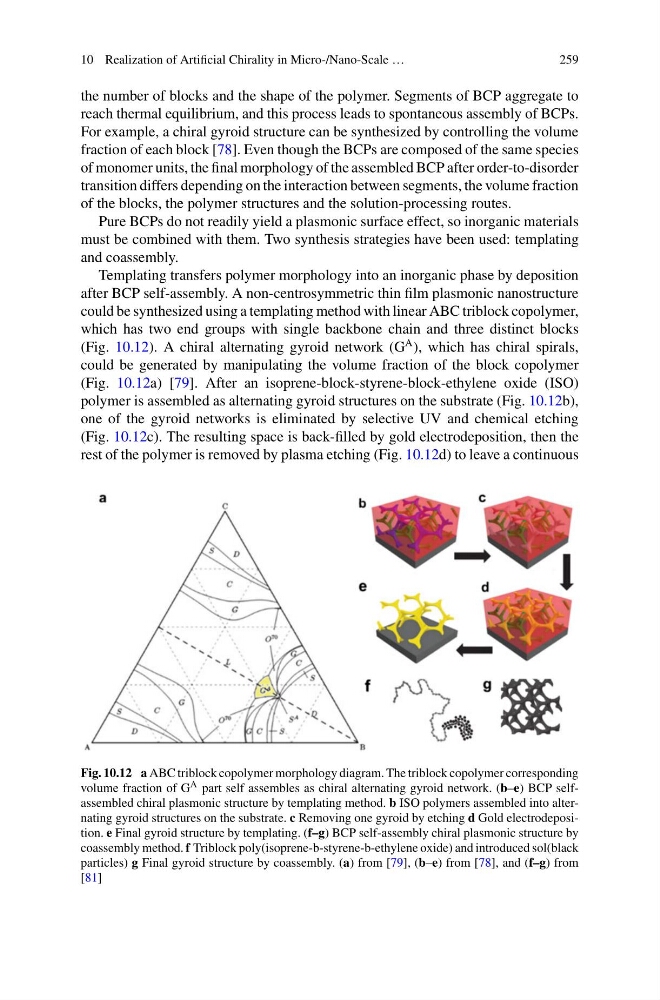
Templating transfers polymer morphology into an inorganic phase by deposition
after BCP self-assembly. A non-centrosymmetric thin film plasmonic nanostructure
could be synthesized using a templating method with linear ABC triblock copolymer,
which has two end groups with single backbone chain and three distinct blocks
(Fig. 10.12). A chiral alternating gyroid network (G
A ), which has chiral spirals,
could be generated by manipulating the volume fraction of the block copolymer
(Fig. 10.12a) [79]. After an isoprene-block-styrene-block-ethylene oxide (ISO)
polymer is assembled as alternating gyroid structures on the substrate (Fig. 10.12b),
one of the gyroid networks is eliminated by selective UV and chemical etching
(Fig. 10.12c). The resulting space is back-filled by gold electrodeposition, then the
rest of the polymer is removed by plasma etching (Fig. 10.12d) to leave a continuous
Fig. 10.12 a ABC triblock copolymer morphology diagram. The triblock copolymer corresponding
volume fraction of G A part self assembles as chiral alternating gyroid network. (b–e) BCP selfassembled chiral plasmonic structure by templating method. b ISO polymers assembled into alternating gyroid structures on the substrate. c Removing one gyroid by etching d Gold electrodeposition. e Final gyroid structure by templating. (f–g) BCP self-assembly chiral plasmonic structure by
coassembly method. f Triblock poly(isoprene-b-styrene-b-ethylene oxide) and introduced sol(black
particles) g Final gyroid structure by coassembly. (a) from [79], (b–e) from [78], and (f–g) from
[81]
259
the number of blocks and the shape of the polymer. Segments of BCP aggregate to
reach thermal equilibrium, and this process leads to spontaneous assembly of BCPs.
For example, a chiral gyroid structure can be synthesized by controlling the volume
fraction of each block [78]. Even though the BCPs are composed of the same species
of monomer units, the final morphology of the assembled BCP after order-to-disorder
transition differs depending on the interaction between segments, the volume fraction
of the blocks, the polymer structures and the solution-processing routes.
Pure BCPs do not readily yield a plasmonic surface effect, so inorganic materials
must be combined with them. Two synthesis strategies have been used: templating
and coassembly.
Templating transfers polymer morphology into an inorganic phase by deposition
after BCP self-assembly. A non-centrosymmetric thin film plasmonic nanostructure
could be synthesized using a templating method with linear ABC triblock copolymer,
which has two end groups with single backbone chain and three distinct blocks
(Fig. 10.12). A chiral alternating gyroid network (G
A ), which has chiral spirals,
could be generated by manipulating the volume fraction of the block copolymer
(Fig. 10.12a) [79]. After an isoprene-block-styrene-block-ethylene oxide (ISO)
polymer is assembled as alternating gyroid structures on the substrate (Fig. 10.12b),
one of the gyroid networks is eliminated by selective UV and chemical etching
(Fig. 10.12c). The resulting space is back-filled by gold electrodeposition, then the
rest of the polymer is removed by plasma etching (Fig. 10.12d) to leave a continuous
Fig. 10.12 a ABC triblock copolymer morphology diagram. The triblock copolymer corresponding
volume fraction of G A part self assembles as chiral alternating gyroid network. (b–e) BCP selfassembled chiral plasmonic structure by templating method. b ISO polymers assembled into alternating gyroid structures on the substrate. c Removing one gyroid by etching d Gold electrodeposition. e Final gyroid structure by templating. (f–g) BCP self-assembly chiral plasmonic structure by
coassembly method. f Triblock poly(isoprene-b-styrene-b-ethylene oxide) and introduced sol(black
particles) g Final gyroid structure by coassembly. (a) from [79], (b–e) from [78], and (f–g) from
[81]