

9 Symmetry Approach to Chiral Optomagnonics in Antiferromagnetic Insulators
227
Since s
μ
(t, r) is T odd and P even, the spin current density j
μ
(t, r) has opposite
transformation properties. As we have seen in Sect. 9.2, the electromagnetic field can
be characterized by optical chirality ρ χ (t, r) with the same transformations properties
as j
μ
(t, r). Therefore, we may expect that by exposing an antiferromagnetic insulator
to a circularly polarized electromagnetic field, we can excite a spin photocurrent,
which direction should be determined by the helicity of light.
In this section, we will consider these arguments in detail, and show that this
photo-excitation process requires the frequency of the electromagnetic field to be in
the region of the antiferromagnetic resonance. We begin with a semiclassical theory.
Nonlinear response and geometric effects in low dimensional materials are discussed
at the end of this section. First we consider an interesting phenomenon analogous to
the Zitterbewegung effect for magnons.
9.4.1 Magnon Spin Currents in Antiferromagnets
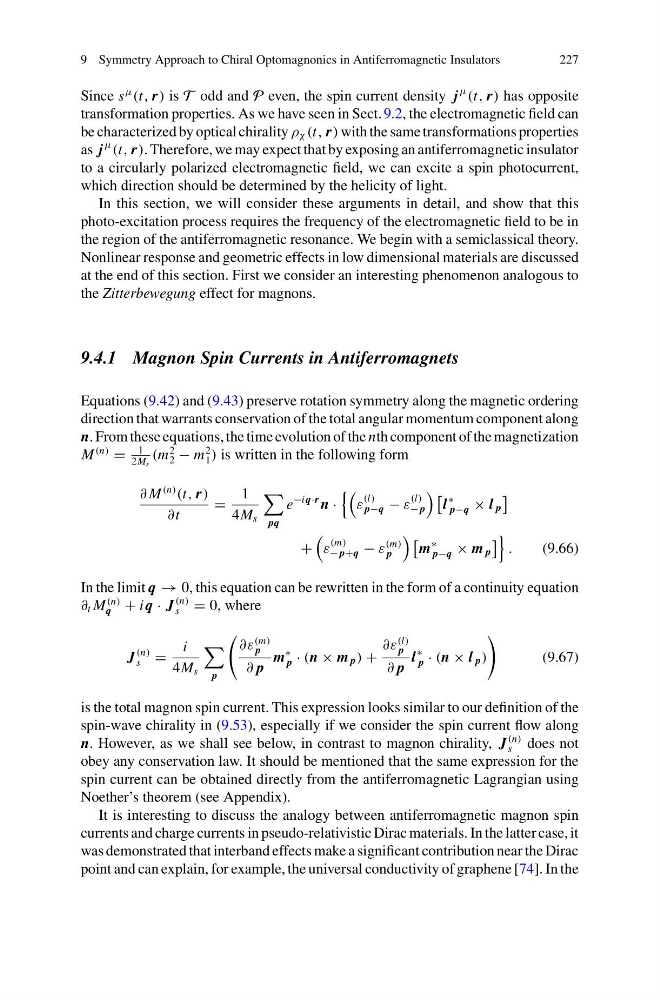
Equations (9.42) and (9.43) preserve rotation symmetry along the magnetic ordering
direction that warrants conservation of the total angular momentum component along
n. From these equations, the time evolution of the nth component of the magnetization
M
(n)
=
1
2M s
(m
2
2 − m
2
1 ) is written in the following form
∂ M
(n)
(t, r)
∂t
=
1
4M s
pq
e
−i q·r n ·
ε
(l)
p−q − ε
(l)
− p
l
∗
p−q × l p
+
ε
(m)
− p+q − ε
(m)
p
m
∗
p−q × m p
.
(9.66)
In the limit q → 0, this equation can be rewritten in the form of a continuity equation
∂ t M
(n)
q + i q · J
(n)
s = 0, where
J
(n)
s =
i
4M s
p
∂ε
(m)
p
∂ p
m
∗
p · (n × m p ) +
∂ε
(l)
p
∂ p
l
∗
p · (n × l p )
(9.67)
is the total magnon spin current. This expression looks similar to our definition of the
spin-wave chirality in (9.53), especially if we consider the spin current flow along
n. However, as we shall see below, in contrast to magnon chirality, J
(n)
s does not
obey any conservation law. It should be mentioned that the same expression for the
spin current can be obtained directly from the antiferromagnetic Lagrangian using
Noether’s theorem (see Appendix).
It is interesting to discuss the analogy between antiferromagnetic magnon spin
currents and charge currents in pseudo-relativistic Dirac materials. In the latter case, it
was demonstrated that interband effects make a significant contribution near the Dirac
point and can explain, for example, the universal conductivity of graphene [74]. In the
227
Since s
μ
(t, r) is T odd and P even, the spin current density j
μ
(t, r) has opposite
transformation properties. As we have seen in Sect. 9.2, the electromagnetic field can
be characterized by optical chirality ρ χ (t, r) with the same transformations properties
as j
μ
(t, r). Therefore, we may expect that by exposing an antiferromagnetic insulator
to a circularly polarized electromagnetic field, we can excite a spin photocurrent,
which direction should be determined by the helicity of light.
In this section, we will consider these arguments in detail, and show that this
photo-excitation process requires the frequency of the electromagnetic field to be in
the region of the antiferromagnetic resonance. We begin with a semiclassical theory.
Nonlinear response and geometric effects in low dimensional materials are discussed
at the end of this section. First we consider an interesting phenomenon analogous to
the Zitterbewegung effect for magnons.
9.4.1 Magnon Spin Currents in Antiferromagnets
Equations (9.42) and (9.43) preserve rotation symmetry along the magnetic ordering
direction that warrants conservation of the total angular momentum component along
n. From these equations, the time evolution of the nth component of the magnetization
M
(n)
=
1
2M s
(m
2
2 − m
2
1 ) is written in the following form
∂ M
(n)
(t, r)
∂t
=
1
4M s
pq
e
−i q·r n ·
ε
(l)
p−q − ε
(l)
− p
l
∗
p−q × l p
+
ε
(m)
− p+q − ε
(m)
p
m
∗
p−q × m p
.
(9.66)
In the limit q → 0, this equation can be rewritten in the form of a continuity equation
∂ t M
(n)
q + i q · J
(n)
s = 0, where
J
(n)
s =
i
4M s
p
∂ε
(m)
p
∂ p
m
∗
p · (n × m p ) +
∂ε
(l)
p
∂ p
l
∗
p · (n × l p )
(9.67)
is the total magnon spin current. This expression looks similar to our definition of the
spin-wave chirality in (9.53), especially if we consider the spin current flow along
n. However, as we shall see below, in contrast to magnon chirality, J
(n)
s does not
obey any conservation law. It should be mentioned that the same expression for the
spin current can be obtained directly from the antiferromagnetic Lagrangian using
Noether’s theorem (see Appendix).
It is interesting to discuss the analogy between antiferromagnetic magnon spin
currents and charge currents in pseudo-relativistic Dirac materials. In the latter case, it
was demonstrated that interband effects make a significant contribution near the Dirac
point and can explain, for example, the universal conductivity of graphene [74]. In the