

224
I. Proskurin and R. L. Stamps
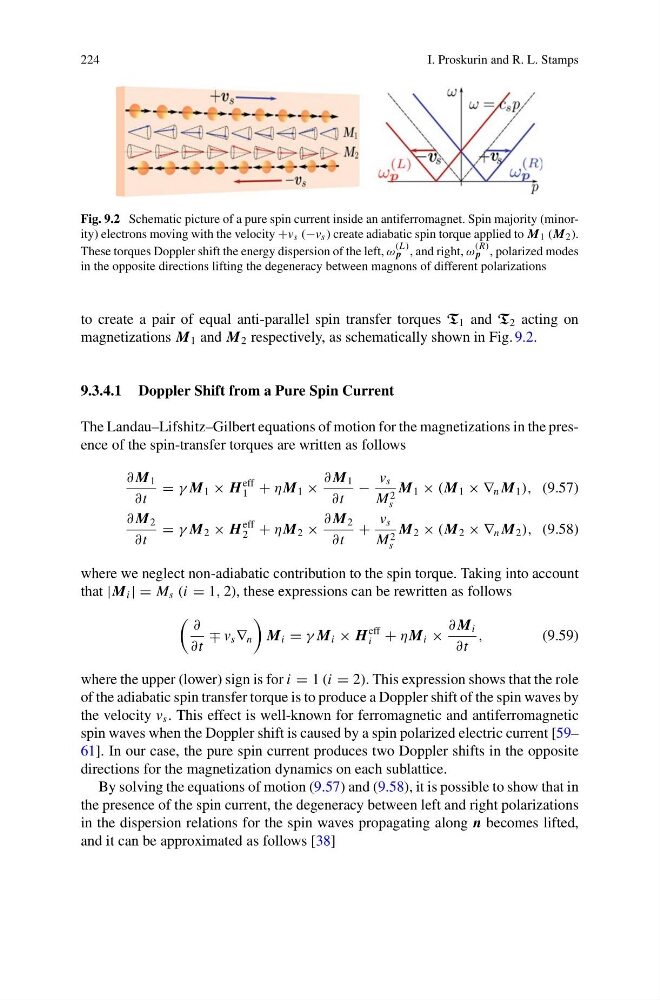
Fig. 9.2 Schematic picture of a pure spin current inside an antiferromagnet. Spin majority (minority) electrons moving with the velocity +v s (−v s ) create adiabatic spin torque applied to M 1 (M 2 ).
These torques Doppler shift the energy dispersion of the left, ω
(L)
p , and right, ω
(R)
p , polarized modes
in the opposite directions lifting the degeneracy between magnons of different polarizations
to create a pair of equal anti-parallel spin transfer torques T 1 and T 2 acting on
magnetizations M 1 and M 2 respectively, as schematically shown in Fig. 9.2.
9.3.4.1 Doppler Shift from a Pure Spin Current
The Landau–Lifshitz–Gilbert equations of motion for the magnetizations in the presence of the spin-transfer torques are written as follows
∂ M 1
∂t
= γ M 1 × H
eff
1 + ηM 1 ×
∂ M 1
∂t
−
v s
M 2
s
M 1 × (M 1 × ∇ n M 1 ), (9.57)
∂ M 2
∂t
= γ M 2 × H
eff
2 + ηM 2 ×
∂ M 2
∂t
+
v s
M 2
s
M 2 × (M 2 × ∇ n M 2 ), (9.58)
where we neglect non-adiabatic contribution to the spin torque. Taking into account
that |M i | = M s (i = 1, 2), these expressions can be rewritten as follows
∂
∂t
∓ v s ∇ n
M i = γ M i × H
eff
i + ηM i ×
∂ M i
∂t
,
(9.59)
where the upper (lower) sign is for i = 1 (i = 2). This expression shows that the role
of the adiabatic spin transfer torque is to produce a Doppler shift of the spin waves by
the velocity v s . This effect is well-known for ferromagnetic and antiferromagnetic
spin waves when the Doppler shift is caused by a spin polarized electric current [59–
61]. In our case, the pure spin current produces two Doppler shifts in the opposite
directions for the magnetization dynamics on each sublattice.
By solving the equations of motion (9.57) and (9.58), it is possible to show that in
the presence of the spin current, the degeneracy between left and right polarizations
in the dispersion relations for the spin waves propagating along n becomes lifted,
and it can be approximated as follows [38]
I. Proskurin and R. L. Stamps
Fig. 9.2 Schematic picture of a pure spin current inside an antiferromagnet. Spin majority (minority) electrons moving with the velocity +v s (−v s ) create adiabatic spin torque applied to M 1 (M 2 ).
These torques Doppler shift the energy dispersion of the left, ω
(L)
p , and right, ω
(R)
p , polarized modes
in the opposite directions lifting the degeneracy between magnons of different polarizations
to create a pair of equal anti-parallel spin transfer torques T 1 and T 2 acting on
magnetizations M 1 and M 2 respectively, as schematically shown in Fig. 9.2.
9.3.4.1 Doppler Shift from a Pure Spin Current
The Landau–Lifshitz–Gilbert equations of motion for the magnetizations in the presence of the spin-transfer torques are written as follows
∂ M 1
∂t
= γ M 1 × H
eff
1 + ηM 1 ×
∂ M 1
∂t
−
v s
M 2
s
M 1 × (M 1 × ∇ n M 1 ), (9.57)
∂ M 2
∂t
= γ M 2 × H
eff
2 + ηM 2 ×
∂ M 2
∂t
+
v s
M 2
s
M 2 × (M 2 × ∇ n M 2 ), (9.58)
where we neglect non-adiabatic contribution to the spin torque. Taking into account
that |M i | = M s (i = 1, 2), these expressions can be rewritten as follows
∂
∂t
∓ v s ∇ n
M i = γ M i × H
eff
i + ηM i ×
∂ M i
∂t
,
(9.59)
where the upper (lower) sign is for i = 1 (i = 2). This expression shows that the role
of the adiabatic spin transfer torque is to produce a Doppler shift of the spin waves by
the velocity v s . This effect is well-known for ferromagnetic and antiferromagnetic
spin waves when the Doppler shift is caused by a spin polarized electric current [59–
61]. In our case, the pure spin current produces two Doppler shifts in the opposite
directions for the magnetization dynamics on each sublattice.
By solving the equations of motion (9.57) and (9.58), it is possible to show that in
the presence of the spin current, the degeneracy between left and right polarizations
in the dispersion relations for the spin waves propagating along n becomes lifted,
and it can be approximated as follows [38]