

9 Symmetry Approach to Chiral Optomagnonics in Antiferromagnetic Insulators
219
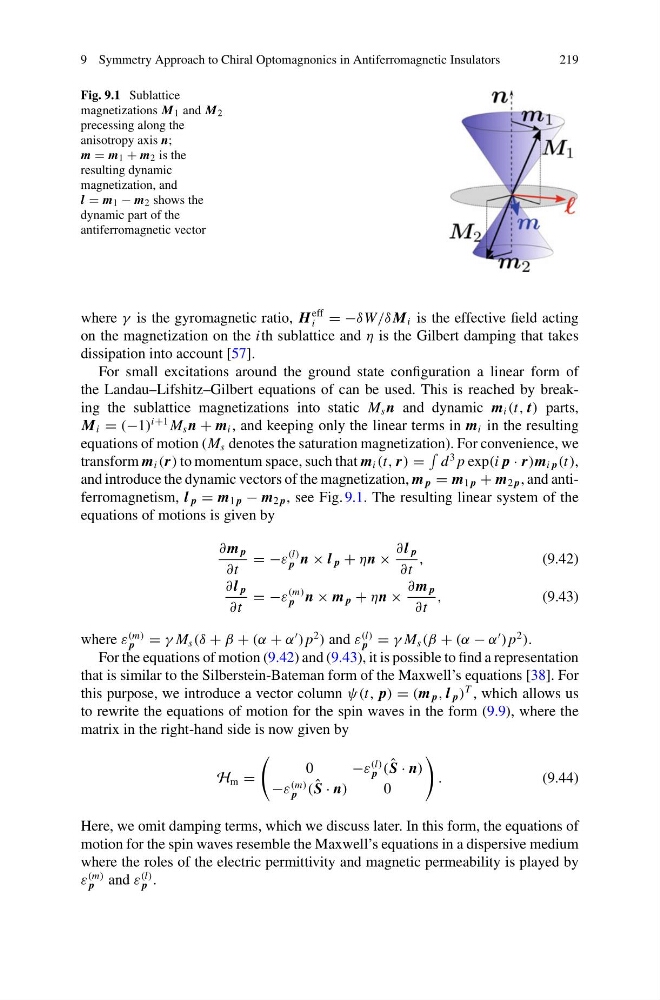
Fig. 9.1 Sublattice
magnetizations M 1 and M 2
precessing along the
anisotropy axis n;
m = m 1 + m 2 is the
resulting dynamic
magnetization, and
l = m 1 − m 2 shows the
dynamic part of the
antiferromagnetic vector
where γ is the gyromagnetic ratio, H
eff
i = −δW/δ M i is the effective field acting
on the magnetization on the ith sublattice and η is the Gilbert damping that takes
dissipation into account [57].
For small excitations around the ground state configuration a linear form of
the Landau–Lifshitz–Gilbert equations of can be used. This is reached by breaking the sublattice magnetizations into static M s n and dynamic m i (t, t) parts,
M i = (−1)
i+1 M s n + m i , and keeping only the linear terms in m i in the resulting
equations of motion (M s denotes the saturation magnetization). For convenience, we
transform m i (r) to momentum space, such that m i (t, r) =
d
3 p exp(i p · r)m i p (t),
and introduce the dynamic vectors of the magnetization, m p = m 1 p + m 2 p , and antiferromagnetism, l p = m 1 p − m 2 p , see Fig. 9.1. The resulting linear system of the
equations of motions is given by
∂ m p
∂t
= −ε
(l)
p n × l p + ηn ×
∂l p
∂t
,
(9.42)
∂l p
∂t
= −ε
(m)
p n × m p + ηn ×
∂ m p
∂t
,
(9.43)
where ε
(m)
p = γ M s (δ + β + (α + α
) p
2
) and ε
(l)
p = γ M s (β + (α − α
) p
2
).
For the equations of motion (9.42) and (9.43), it is possible to find a representation
that is similar to the Silberstein-Bateman form of the Maxwell’s equations [38]. For
this purpose, we introduce a vector column ψ(t, p) = (m p , l p )
T , which allows us
to rewrite the equations of motion for the spin waves in the form (9.9), where the
matrix in the right-hand side is now given by
H m =
0
−ε
(l)
p ( ˆ
S · n)
−ε
(m)
p ( ˆ
S · n)
0
.
(9.44)
Here, we omit damping terms, which we discuss later. In this form, the equations of
motion for the spin waves resemble the Maxwell’s equations in a dispersive medium
where the roles of the electric permittivity and magnetic permeability is played by
ε
(m)
p and ε
(l)
p .
219
Fig. 9.1 Sublattice
magnetizations M 1 and M 2
precessing along the
anisotropy axis n;
m = m 1 + m 2 is the
resulting dynamic
magnetization, and
l = m 1 − m 2 shows the
dynamic part of the
antiferromagnetic vector
where γ is the gyromagnetic ratio, H
eff
i = −δW/δ M i is the effective field acting
on the magnetization on the ith sublattice and η is the Gilbert damping that takes
dissipation into account [57].
For small excitations around the ground state configuration a linear form of
the Landau–Lifshitz–Gilbert equations of can be used. This is reached by breaking the sublattice magnetizations into static M s n and dynamic m i (t, t) parts,
M i = (−1)
i+1 M s n + m i , and keeping only the linear terms in m i in the resulting
equations of motion (M s denotes the saturation magnetization). For convenience, we
transform m i (r) to momentum space, such that m i (t, r) =
d
3 p exp(i p · r)m i p (t),
and introduce the dynamic vectors of the magnetization, m p = m 1 p + m 2 p , and antiferromagnetism, l p = m 1 p − m 2 p , see Fig. 9.1. The resulting linear system of the
equations of motions is given by
∂ m p
∂t
= −ε
(l)
p n × l p + ηn ×
∂l p
∂t
,
(9.42)
∂l p
∂t
= −ε
(m)
p n × m p + ηn ×
∂ m p
∂t
,
(9.43)
where ε
(m)
p = γ M s (δ + β + (α + α
) p
2
) and ε
(l)
p = γ M s (β + (α − α
) p
2
).
For the equations of motion (9.42) and (9.43), it is possible to find a representation
that is similar to the Silberstein-Bateman form of the Maxwell’s equations [38]. For
this purpose, we introduce a vector column ψ(t, p) = (m p , l p )
T , which allows us
to rewrite the equations of motion for the spin waves in the form (9.9), where the
matrix in the right-hand side is now given by
H m =
0
−ε
(l)
p ( ˆ
S · n)
−ε
(m)
p ( ˆ
S · n)
0
.
(9.44)
Here, we omit damping terms, which we discuss later. In this form, the equations of
motion for the spin waves resemble the Maxwell’s equations in a dispersive medium
where the roles of the electric permittivity and magnetic permeability is played by
ε
(m)
p and ε
(l)
p .