

216
I. Proskurin and R. L. Stamps
i
∂
∂t
D( p)
B( p)
=
0
i( ˆ
S · p) ˆ
μ
−1
( p)
−i( ˆ
S · p)ˆ ε
−1
( p)
D( p)
B( p)
.
(9.28)
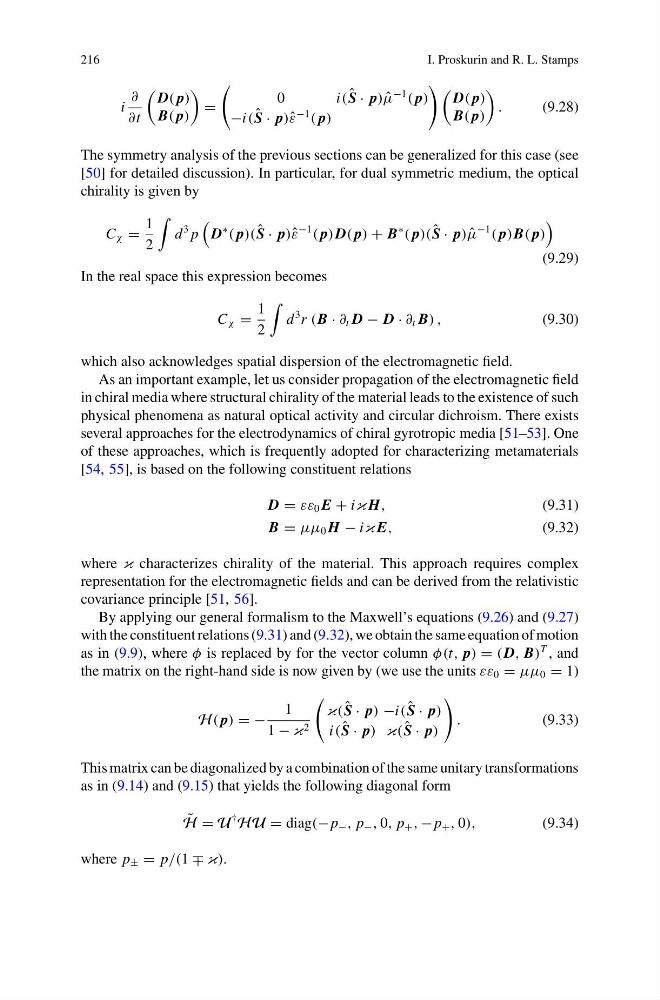
The symmetry analysis of the previous sections can be generalized for this case (see
[50] for detailed discussion). In particular, for dual symmetric medium, the optical
chirality is given by
C χ =
1
2
d
3 p
D
∗
( p)( ˆ
S · p)ˆ ε
−1
( p) D( p) + B
∗
( p)( ˆ
S · p) ˆ
μ
−1
( p)B( p)
(9.29)
In the real space this expression becomes
C χ =
1
2
d
3 r (B · ∂ t D − D · ∂ t B) ,
(9.30)
which also acknowledges spatial dispersion of the electromagnetic field.
As an important example, let us consider propagation of the electromagnetic field
in chiral media where structural chirality of the material leads to the existence of such
physical phenomena as natural optical activity and circular dichroism. There exists
several approaches for the electrodynamics of chiral gyrotropic media [51–53]. One
of these approaches, which is frequently adopted for characterizing metamaterials
[54, 55], is based on the following constituent relations
D = εε 0 E + iκ H,
(9.31)
B = μμ 0 H − iκ E,
(9.32)
where κ characterizes chirality of the material. This approach requires complex
representation for the electromagnetic fields and can be derived from the relativistic
covariance principle [51, 56].
By applying our general formalism to the Maxwell’s equations (9.26) and (9.27)
with the constituent relations (9.31) and (9.32), we obtain the same equation of motion
as in (9.9), where φ is replaced by for the vector column φ(t, p) = ( D, B)
T , and
the matrix on the right-hand side is now given by (we use the units εε 0 = μμ 0 = 1)
H( p) = −
1
1 − κ 2
κ( ˆ
S · p) −i( ˆ
S · p)
i( ˆ
S · p) κ( ˆ
S · p)
.
(9.33)
This matrix can be diagonalized by a combination of the same unitary transformations
as in (9.14) and (9.15) that yields the following diagonal form
˜
H = U
†
HU = diag(− p − , p − , 0, p + , − p + , 0),
(9.34)
where p ± = p/(1 ∓ κ).
I. Proskurin and R. L. Stamps
i
∂
∂t
D( p)
B( p)
=
0
i( ˆ
S · p) ˆ
μ
−1
( p)
−i( ˆ
S · p)ˆ ε
−1
( p)
D( p)
B( p)
.
(9.28)
The symmetry analysis of the previous sections can be generalized for this case (see
[50] for detailed discussion). In particular, for dual symmetric medium, the optical
chirality is given by
C χ =
1
2
d
3 p
D
∗
( p)( ˆ
S · p)ˆ ε
−1
( p) D( p) + B
∗
( p)( ˆ
S · p) ˆ
μ
−1
( p)B( p)
(9.29)
In the real space this expression becomes
C χ =
1
2
d
3 r (B · ∂ t D − D · ∂ t B) ,
(9.30)
which also acknowledges spatial dispersion of the electromagnetic field.
As an important example, let us consider propagation of the electromagnetic field
in chiral media where structural chirality of the material leads to the existence of such
physical phenomena as natural optical activity and circular dichroism. There exists
several approaches for the electrodynamics of chiral gyrotropic media [51–53]. One
of these approaches, which is frequently adopted for characterizing metamaterials
[54, 55], is based on the following constituent relations
D = εε 0 E + iκ H,
(9.31)
B = μμ 0 H − iκ E,
(9.32)
where κ characterizes chirality of the material. This approach requires complex
representation for the electromagnetic fields and can be derived from the relativistic
covariance principle [51, 56].
By applying our general formalism to the Maxwell’s equations (9.26) and (9.27)
with the constituent relations (9.31) and (9.32), we obtain the same equation of motion
as in (9.9), where φ is replaced by for the vector column φ(t, p) = ( D, B)
T , and
the matrix on the right-hand side is now given by (we use the units εε 0 = μμ 0 = 1)
H( p) = −
1
1 − κ 2
κ( ˆ
S · p) −i( ˆ
S · p)
i( ˆ
S · p) κ( ˆ
S · p)
.
(9.33)
This matrix can be diagonalized by a combination of the same unitary transformations
as in (9.14) and (9.15) that yields the following diagonal form
˜
H = U
†
HU = diag(− p − , p − , 0, p + , − p + , 0),
(9.34)
where p ± = p/(1 ∓ κ).