

202
M. Mochizuki
Spin polarized current
Translational motion
of magnetic texture
Motion of
magnetic texture
Spin pol. current
(a)
(b)
Magnetization Electron spin Torque
Angular-momentum transfer
Electron spins → Magnetizations
Momentum transfer
Magnetizations → Electrons
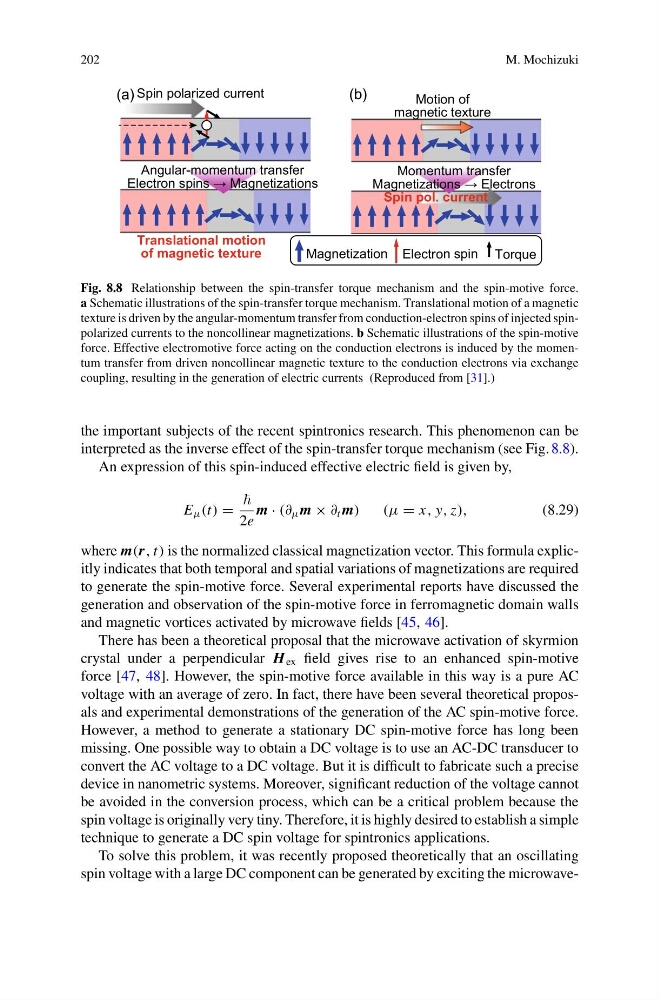
Fig. 8.8 Relationship between the spin-transfer torque mechanism and the spin-motive force.
a Schematic illustrations of the spin-transfer torque mechanism. Translational motion of a magnetic
texture is driven by the angular-momentum transfer from conduction-electron spins of injected spinpolarized currents to the noncollinear magnetizations. b Schematic illustrations of the spin-motive
force. Effective electromotive force acting on the conduction electrons is induced by the momentum transfer from driven noncollinear magnetic texture to the conduction electrons via exchange
coupling, resulting in the generation of electric currents (Reproduced from [31].)
the important subjects of the recent spintronics research. This phenomenon can be
interpreted as the inverse effect of the spin-transfer torque mechanism (see Fig. 8.8).
An expression of this spin-induced effective electric field is given by,
E μ (t) =
2e
m · (∂ μ m × ∂ t m)
(μ = x, y, z),
(8.29)
where m(r, t) is the normalized classical magnetization vector. This formula explicitly indicates that both temporal and spatial variations of magnetizations are required
to generate the spin-motive force. Several experimental reports have discussed the
generation and observation of the spin-motive force in ferromagnetic domain walls
and magnetic vortices activated by microwave fields [45, 46].
There has been a theoretical proposal that the microwave activation of skyrmion
crystal under a perpendicular H ex field gives rise to an enhanced spin-motive
force [47, 48]. However, the spin-motive force available in this way is a pure AC
voltage with an average of zero. In fact, there have been several theoretical proposals and experimental demonstrations of the generation of the AC spin-motive force.
However, a method to generate a stationary DC spin-motive force has long been
missing. One possible way to obtain a DC voltage is to use an AC-DC transducer to
convert the AC voltage to a DC voltage. But it is difficult to fabricate such a precise
device in nanometric systems. Moreover, significant reduction of the voltage cannot
be avoided in the conversion process, which can be a critical problem because the
spin voltage is originally very tiny. Therefore, it is highly desired to establish a simple
technique to generate a DC spin voltage for spintronics applications.
To solve this problem, it was recently proposed theoretically that an oscillating
spin voltage with a large DC component can be generated by exciting the microwave-
M. Mochizuki
Spin polarized current
Translational motion
of magnetic texture
Motion of
magnetic texture
Spin pol. current
(a)
(b)
Magnetization Electron spin Torque
Angular-momentum transfer
Electron spins → Magnetizations
Momentum transfer
Magnetizations → Electrons
Fig. 8.8 Relationship between the spin-transfer torque mechanism and the spin-motive force.
a Schematic illustrations of the spin-transfer torque mechanism. Translational motion of a magnetic
texture is driven by the angular-momentum transfer from conduction-electron spins of injected spinpolarized currents to the noncollinear magnetizations. b Schematic illustrations of the spin-motive
force. Effective electromotive force acting on the conduction electrons is induced by the momentum transfer from driven noncollinear magnetic texture to the conduction electrons via exchange
coupling, resulting in the generation of electric currents (Reproduced from [31].)
the important subjects of the recent spintronics research. This phenomenon can be
interpreted as the inverse effect of the spin-transfer torque mechanism (see Fig. 8.8).
An expression of this spin-induced effective electric field is given by,
E μ (t) =
2e
m · (∂ μ m × ∂ t m)
(μ = x, y, z),
(8.29)
where m(r, t) is the normalized classical magnetization vector. This formula explicitly indicates that both temporal and spatial variations of magnetizations are required
to generate the spin-motive force. Several experimental reports have discussed the
generation and observation of the spin-motive force in ferromagnetic domain walls
and magnetic vortices activated by microwave fields [45, 46].
There has been a theoretical proposal that the microwave activation of skyrmion
crystal under a perpendicular H ex field gives rise to an enhanced spin-motive
force [47, 48]. However, the spin-motive force available in this way is a pure AC
voltage with an average of zero. In fact, there have been several theoretical proposals and experimental demonstrations of the generation of the AC spin-motive force.
However, a method to generate a stationary DC spin-motive force has long been
missing. One possible way to obtain a DC voltage is to use an AC-DC transducer to
convert the AC voltage to a DC voltage. But it is difficult to fabricate such a precise
device in nanometric systems. Moreover, significant reduction of the voltage cannot
be avoided in the conversion process, which can be a critical problem because the
spin voltage is originally very tiny. Therefore, it is highly desired to establish a simple
technique to generate a DC spin voltage for spintronics applications.
To solve this problem, it was recently proposed theoretically that an oscillating
spin voltage with a large DC component can be generated by exciting the microwave-