

192
M. Mochizuki
400 ns later
96 sites
96 sites
x
y
H ex
x
y
z
x
H
|| x
30°
H ex
x
y
z
30°
H ||z
Initial configuration
Rotation mode
(counterclockwise)
B r e a th in g m o d e
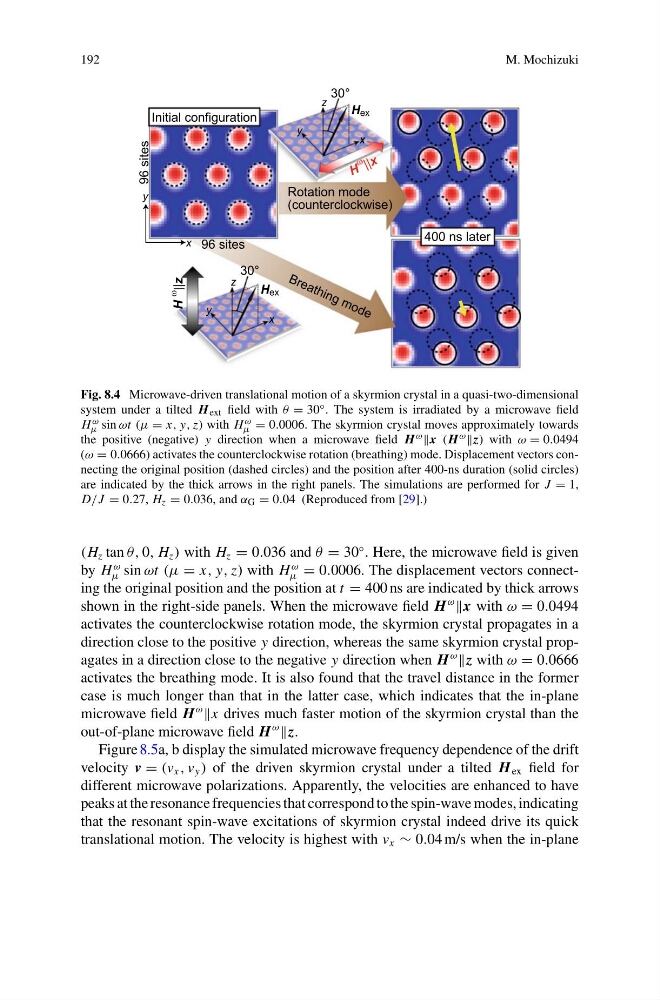
Fig. 8.4 Microwave-driven translational motion of a skyrmion crystal in a quasi-two-dimensional
system under a tilted H ext field with θ = 30 ◦ . The system is irradiated by a microwave field
H ω
μ sin ωt (μ = x, y, z) with H ω
μ = 0.0006. The skyrmion crystal moves approximately towards
the positive (negative) y direction when a microwave field H ω (H ω with ω = 0.0494
(ω = 0.0666) activates the counterclockwise rotation (breathing) mode. Displacement vectors connecting the original position (dashed circles) and the position after 400-ns duration (solid circles)
are indicated by the thick arrows in the right panels. The simulations are performed for J = 1,
D/J = 0.27, H z = 0.036, and α G = 0.04 (Reproduced from [29].)
(H z tan θ, 0, H z ) with H z = 0.036 and θ = 30
◦ . Here, the microwave field is given
by H
ω
μ sin ωt (μ = x, y, z) with H
ω
μ = 0.0006. The displacement vectors connecting the original position and the position at t = 400 ns are indicated by thick arrows
shown in the right-side panels. When the microwave field H
ω
with ω = 0.0494
activates the counterclockwise rotation mode, the skyrmion crystal propagates in a
direction close to the positive y direction, whereas the same skyrmion crystal propagates in a direction close to the negative y direction when H
ω
with ω = 0.0666
activates the breathing mode. It is also found that the travel distance in the former
case is much longer than that in the latter case, which indicates that the in-plane
microwave field H
ω
drives much faster motion of the skyrmion crystal than the
out-of-plane microwave field H
ω
Figure 8.5a, b display the simulated microwave frequency dependence of the drift
velocity v = (v x , v y ) of the driven skyrmion crystal under a tilted H ex field for
different microwave polarizations. Apparently, the velocities are enhanced to have
peaks at the resonance frequencies that correspond to the spin-wave modes, indicating
that the resonant spin-wave excitations of skyrmion crystal indeed drive its quick
translational motion. The velocity is highest with v x ∼ 0.04 m/s when the in-plane
M. Mochizuki
400 ns later
96 sites
96 sites
x
y
H ex
x
y
z
x
H
|| x
30°
H ex
x
y
z
30°
H ||z
Initial configuration
Rotation mode
(counterclockwise)
B r e a th in g m o d e
Fig. 8.4 Microwave-driven translational motion of a skyrmion crystal in a quasi-two-dimensional
system under a tilted H ext field with θ = 30 ◦ . The system is irradiated by a microwave field
H ω
μ sin ωt (μ = x, y, z) with H ω
μ = 0.0006. The skyrmion crystal moves approximately towards
the positive (negative) y direction when a microwave field H ω (H ω with ω = 0.0494
(ω = 0.0666) activates the counterclockwise rotation (breathing) mode. Displacement vectors connecting the original position (dashed circles) and the position after 400-ns duration (solid circles)
are indicated by the thick arrows in the right panels. The simulations are performed for J = 1,
D/J = 0.27, H z = 0.036, and α G = 0.04 (Reproduced from [29].)
(H z tan θ, 0, H z ) with H z = 0.036 and θ = 30
◦ . Here, the microwave field is given
by H
ω
μ sin ωt (μ = x, y, z) with H
ω
μ = 0.0006. The displacement vectors connecting the original position and the position at t = 400 ns are indicated by thick arrows
shown in the right-side panels. When the microwave field H
ω
with ω = 0.0494
activates the counterclockwise rotation mode, the skyrmion crystal propagates in a
direction close to the positive y direction, whereas the same skyrmion crystal propagates in a direction close to the negative y direction when H
ω
with ω = 0.0666
activates the breathing mode. It is also found that the travel distance in the former
case is much longer than that in the latter case, which indicates that the in-plane
microwave field H
ω
drives much faster motion of the skyrmion crystal than the
out-of-plane microwave field H
ω
Figure 8.5a, b display the simulated microwave frequency dependence of the drift
velocity v = (v x , v y ) of the driven skyrmion crystal under a tilted H ex field for
different microwave polarizations. Apparently, the velocities are enhanced to have
peaks at the resonance frequencies that correspond to the spin-wave modes, indicating
that the resonant spin-wave excitations of skyrmion crystal indeed drive its quick
translational motion. The velocity is highest with v x ∼ 0.04 m/s when the in-plane