

184
M. Mochizuki
(a) Hedgehog-type skyrmion
(c) Neel-type skyrmion
(b) Bloch-type skyrmion
: Stereo projection
: Rotation (z-axis)
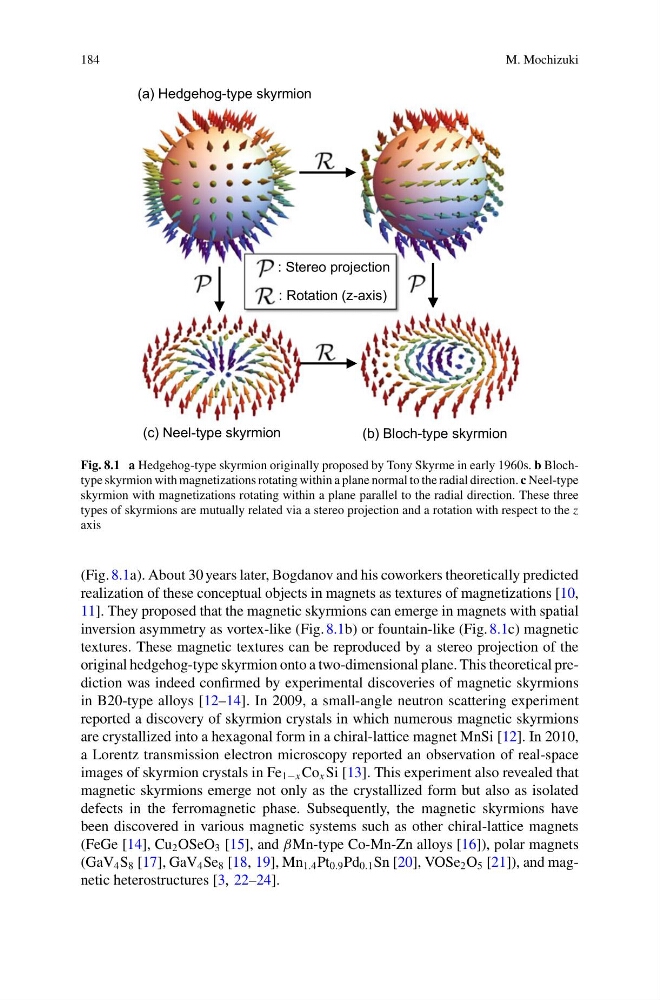
Fig. 8.1 a Hedgehog-type skyrmion originally proposed by Tony Skyrme in early 1960s. b Blochtype skyrmion with magnetizations rotating within a plane normal to the radial direction. c Neel-type
skyrmion with magnetizations rotating within a plane parallel to the radial direction. These three
types of skyrmions are mutually related via a stereo projection and a rotation with respect to the z
axis
(Fig. 8.1a). About 30 years later, Bogdanov and his coworkers theoretically predicted
realization of these conceptual objects in magnets as textures of magnetizations [10,
11]. They proposed that the magnetic skyrmions can emerge in magnets with spatial
inversion asymmetry as vortex-like (Fig. 8.1b) or fountain-like (Fig. 8.1c) magnetic
textures. These magnetic textures can be reproduced by a stereo projection of the
original hedgehog-type skyrmion onto a two-dimensional plane. This theoretical prediction was indeed confirmed by experimental discoveries of magnetic skyrmions
in B20-type alloys [12–14]. In 2009, a small-angle neutron scattering experiment
reported a discovery of skyrmion crystals in which numerous magnetic skyrmions
are crystallized into a hexagonal form in a chiral-lattice magnet MnSi [12]. In 2010,
a Lorentz transmission electron microscopy reported an observation of real-space
images of skyrmion crystals in Fe 1−x Co x Si [13]. This experiment also revealed that
magnetic skyrmions emerge not only as the crystallized form but also as isolated
defects in the ferromagnetic phase. Subsequently, the magnetic skyrmions have
been discovered in various magnetic systems such as other chiral-lattice magnets
(FeGe [14], Cu 2 OSeO 3 [15], and βMn-type Co-Mn-Zn alloys [16]), polar magnets
(GaV 4 S 8 [17], GaV 4 Se 8 [18, 19], Mn 1.4 Pt 0.9 Pd 0.1 Sn [20], VOSe 2 O 5 [21]), and magnetic heterostructures [3, 22–24].
M. Mochizuki
(a) Hedgehog-type skyrmion
(c) Neel-type skyrmion
(b) Bloch-type skyrmion
: Stereo projection
: Rotation (z-axis)
Fig. 8.1 a Hedgehog-type skyrmion originally proposed by Tony Skyrme in early 1960s. b Blochtype skyrmion with magnetizations rotating within a plane normal to the radial direction. c Neel-type
skyrmion with magnetizations rotating within a plane parallel to the radial direction. These three
types of skyrmions are mutually related via a stereo projection and a rotation with respect to the z
axis
(Fig. 8.1a). About 30 years later, Bogdanov and his coworkers theoretically predicted
realization of these conceptual objects in magnets as textures of magnetizations [10,
11]. They proposed that the magnetic skyrmions can emerge in magnets with spatial
inversion asymmetry as vortex-like (Fig. 8.1b) or fountain-like (Fig. 8.1c) magnetic
textures. These magnetic textures can be reproduced by a stereo projection of the
original hedgehog-type skyrmion onto a two-dimensional plane. This theoretical prediction was indeed confirmed by experimental discoveries of magnetic skyrmions
in B20-type alloys [12–14]. In 2009, a small-angle neutron scattering experiment
reported a discovery of skyrmion crystals in which numerous magnetic skyrmions
are crystallized into a hexagonal form in a chiral-lattice magnet MnSi [12]. In 2010,
a Lorentz transmission electron microscopy reported an observation of real-space
images of skyrmion crystals in Fe 1−x Co x Si [13]. This experiment also revealed that
magnetic skyrmions emerge not only as the crystallized form but also as isolated
defects in the ferromagnetic phase. Subsequently, the magnetic skyrmions have
been discovered in various magnetic systems such as other chiral-lattice magnets
(FeGe [14], Cu 2 OSeO 3 [15], and βMn-type Co-Mn-Zn alloys [16]), polar magnets
(GaV 4 S 8 [17], GaV 4 Se 8 [18, 19], Mn 1.4 Pt 0.9 Pd 0.1 Sn [20], VOSe 2 O 5 [21]), and magnetic heterostructures [3, 22–24].