

170
J. Masell and K. Everschor-Sitte
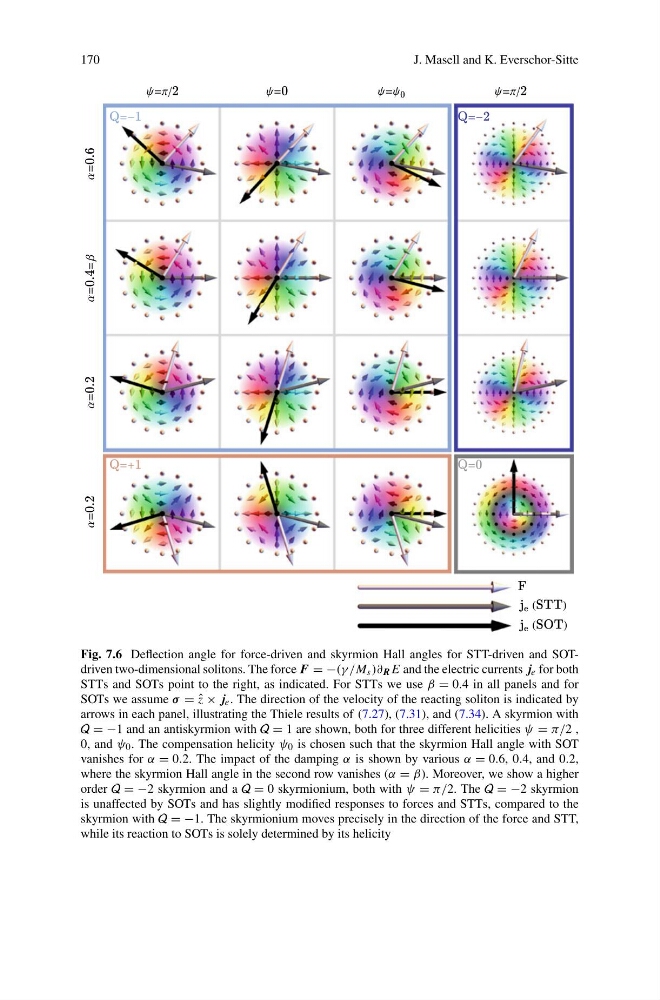
Fig. 7.6 Deflection angle for force-driven and skyrmion Hall angles for STT-driven and SOTdriven two-dimensional solitons. The force F = −(γ /M s )∂ R E and the electric currents j e for both
STTs and SOTs point to the right, as indicated. For STTs we use β = 0.4 in all panels and for
SOTs we assume σ = ˆ
z × j e . The direction of the velocity of the reacting soliton is indicated by
arrows in each panel, illustrating the Thiele results of (7.27), (7.31), and (7.34). A skyrmion with
Q = −1 and an antiskyrmion with Q = 1 are shown, both for three different helicities ψ = π/2 ,
0, and ψ 0 . The compensation helicity ψ 0 is chosen such that the skyrmion Hall angle with SOT
vanishes for α = 0.2. The impact of the damping α is shown by various α = 0.6, 0.4, and 0.2,
where the skyrmion Hall angle in the second row vanishes (α = β). Moreover, we show a higher
order Q = −2 skyrmion and a Q = 0 skyrmionium, both with ψ = π/2. The Q = −2 skyrmion
is unaffected by SOTs and has slightly modified responses to forces and STTs, compared to the
skyrmion with Q = −1. The skyrmionium moves precisely in the direction of the force and STT,
while its reaction to SOTs is solely determined by its helicity
J. Masell and K. Everschor-Sitte
Fig. 7.6 Deflection angle for force-driven and skyrmion Hall angles for STT-driven and SOTdriven two-dimensional solitons. The force F = −(γ /M s )∂ R E and the electric currents j e for both
STTs and SOTs point to the right, as indicated. For STTs we use β = 0.4 in all panels and for
SOTs we assume σ = ˆ
z × j e . The direction of the velocity of the reacting soliton is indicated by
arrows in each panel, illustrating the Thiele results of (7.27), (7.31), and (7.34). A skyrmion with
Q = −1 and an antiskyrmion with Q = 1 are shown, both for three different helicities ψ = π/2 ,
0, and ψ 0 . The compensation helicity ψ 0 is chosen such that the skyrmion Hall angle with SOT
vanishes for α = 0.2. The impact of the damping α is shown by various α = 0.6, 0.4, and 0.2,
where the skyrmion Hall angle in the second row vanishes (α = β). Moreover, we show a higher
order Q = −2 skyrmion and a Q = 0 skyrmionium, both with ψ = π/2. The Q = −2 skyrmion
is unaffected by SOTs and has slightly modified responses to forces and STTs, compared to the
skyrmion with Q = −1. The skyrmionium moves precisely in the direction of the force and STT,
while its reaction to SOTs is solely determined by its helicity