

168
J. Masell and K. Everschor-Sitte
scalar D s depends explicitly on the vorticity N , see (7.26), and, hence, also on the
winding number. Furthermore, magnetic textures with different winding numbers
usually relax to different magnetization profiles and, thus, different values of D s
[27].
Unpinned helicity. Let us assume now that the skyrmion is stabilized in a system
where the helicity ψ is a zero mode and can, in principle, be activated. However, this
activation is not straightforward. In the Thiele equation, (7.8), all matrix elements
G X ψ , G Y ψ , D X ψ , and D Y ψ vanish for circular solitons. Therefore, ψ does not couple
to the position R or derivatives thereof, which seemingly suggests that the helicity
does not show any dynamics. However, this conclusion is wrong as, for example,
simulations with a magnetic field gradient show a steady rotation of the helicity
while the skyrmion moves towards the direction of the smaller field [77, 78]. In
the following, we discuss this example in more detail and show how to resolve the
apparent contradiction.
Consider a magnetic field of the form B(r) = (B 0 + x δ B) ˆ
z. Let us assume,
moreover, that the field gradient δ B is a sufficiently small so that the skyrmion
profile is still approximately circular and the above arguments still hold. Due to the
field gradient, the position R is not a zero mode but still a good collective coordinate
which is subject to a force F R which drags the skyrmion towards regions with lower
field. While moving there, however, the skyrmion profile has to adapt to the local
magnetic field B(r), leading to an inflation of the skyrmion size ξ . Unlike R, the
collective coordinate ξ couples directly to the helicity ψ via the matrices in the Thiele
equation but, due to the circular shape, ξ does not couple to R. In a compact form,
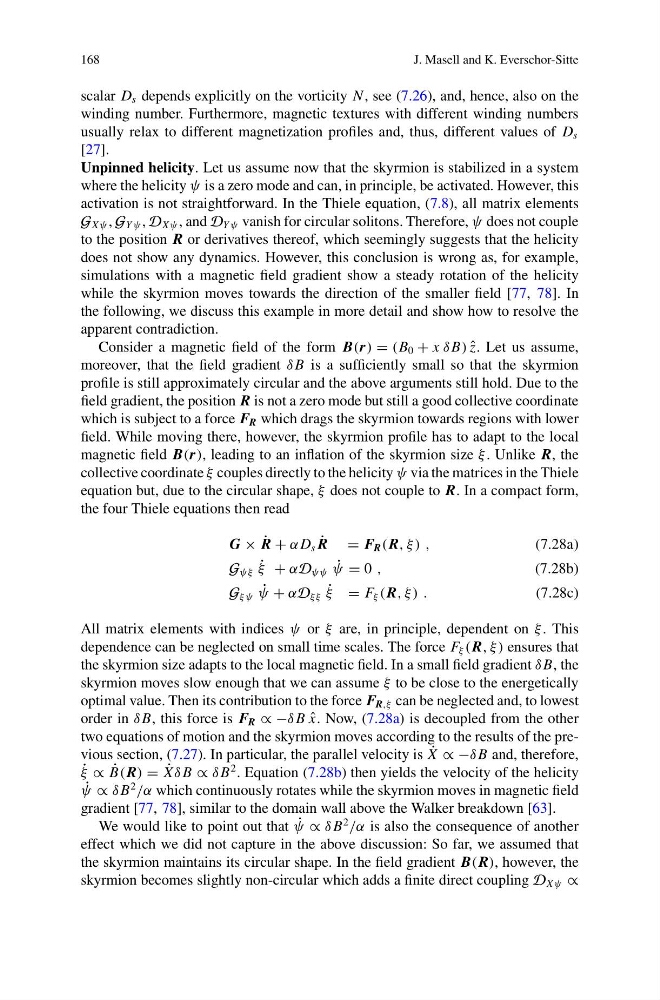
the four Thiele equations then read
G × ˙
R + α D s ˙
R = F R (R, ξ) ,
(7.28a)
G ψξ ˙
ξ + αD ψψ ˙
ψ = 0 ,
(7.28b)
G ξψ ˙
ψ + αD ξξ ˙
ξ = F ξ (R, ξ) .
(7.28c)
All matrix elements with indices ψ or ξ are, in principle, dependent on ξ . This
dependence can be neglected on small time scales. The force F ξ (R, ξ) ensures that
the skyrmion size adapts to the local magnetic field. In a small field gradient δ B, the
skyrmion moves slow enough that we can assume ξ to be close to the energetically
optimal value. Then its contribution to the force F R,ξ can be neglected and, to lowest
order in δ B, this force is F R ∝ −δ B ˆ
x. Now, (7.28a) is decoupled from the other
two equations of motion and the skyrmion moves according to the results of the previous section, (7.27). In particular, the parallel velocity is ˙
X ∝ −δ B and, therefore,
˙
ξ ∝ ˙
B(R) = ˙
X δ B ∝ δ B
2 . Equation (7.28b) then yields the velocity of the helicity
˙
ψ ∝ δ B
2
/α which continuously rotates while the skyrmion moves in magnetic field
gradient [77, 78], similar to the domain wall above the Walker breakdown [63].
We would like to point out that ˙
ψ ∝ δ B
2
/α is also the consequence of another
effect which we did not capture in the above discussion: So far, we assumed that
the skyrmion maintains its circular shape. In the field gradient B(R), however, the
skyrmion becomes slightly non-circular which adds a finite direct coupling D X ψ ∝
J. Masell and K. Everschor-Sitte
scalar D s depends explicitly on the vorticity N , see (7.26), and, hence, also on the
winding number. Furthermore, magnetic textures with different winding numbers
usually relax to different magnetization profiles and, thus, different values of D s
[27].
Unpinned helicity. Let us assume now that the skyrmion is stabilized in a system
where the helicity ψ is a zero mode and can, in principle, be activated. However, this
activation is not straightforward. In the Thiele equation, (7.8), all matrix elements
G X ψ , G Y ψ , D X ψ , and D Y ψ vanish for circular solitons. Therefore, ψ does not couple
to the position R or derivatives thereof, which seemingly suggests that the helicity
does not show any dynamics. However, this conclusion is wrong as, for example,
simulations with a magnetic field gradient show a steady rotation of the helicity
while the skyrmion moves towards the direction of the smaller field [77, 78]. In
the following, we discuss this example in more detail and show how to resolve the
apparent contradiction.
Consider a magnetic field of the form B(r) = (B 0 + x δ B) ˆ
z. Let us assume,
moreover, that the field gradient δ B is a sufficiently small so that the skyrmion
profile is still approximately circular and the above arguments still hold. Due to the
field gradient, the position R is not a zero mode but still a good collective coordinate
which is subject to a force F R which drags the skyrmion towards regions with lower
field. While moving there, however, the skyrmion profile has to adapt to the local
magnetic field B(r), leading to an inflation of the skyrmion size ξ . Unlike R, the
collective coordinate ξ couples directly to the helicity ψ via the matrices in the Thiele
equation but, due to the circular shape, ξ does not couple to R. In a compact form,
the four Thiele equations then read
G × ˙
R + α D s ˙
R = F R (R, ξ) ,
(7.28a)
G ψξ ˙
ξ + αD ψψ ˙
ψ = 0 ,
(7.28b)
G ξψ ˙
ψ + αD ξξ ˙
ξ = F ξ (R, ξ) .
(7.28c)
All matrix elements with indices ψ or ξ are, in principle, dependent on ξ . This
dependence can be neglected on small time scales. The force F ξ (R, ξ) ensures that
the skyrmion size adapts to the local magnetic field. In a small field gradient δ B, the
skyrmion moves slow enough that we can assume ξ to be close to the energetically
optimal value. Then its contribution to the force F R,ξ can be neglected and, to lowest
order in δ B, this force is F R ∝ −δ B ˆ
x. Now, (7.28a) is decoupled from the other
two equations of motion and the skyrmion moves according to the results of the previous section, (7.27). In particular, the parallel velocity is ˙
X ∝ −δ B and, therefore,
˙
ξ ∝ ˙
B(R) = ˙
X δ B ∝ δ B
2 . Equation (7.28b) then yields the velocity of the helicity
˙
ψ ∝ δ B
2
/α which continuously rotates while the skyrmion moves in magnetic field
gradient [77, 78], similar to the domain wall above the Walker breakdown [63].
We would like to point out that ˙
ψ ∝ δ B
2
/α is also the consequence of another
effect which we did not capture in the above discussion: So far, we assumed that
the skyrmion maintains its circular shape. In the field gradient B(R), however, the
skyrmion becomes slightly non-circular which adds a finite direct coupling D X ψ ∝