

160
J. Masell and K. Everschor-Sitte
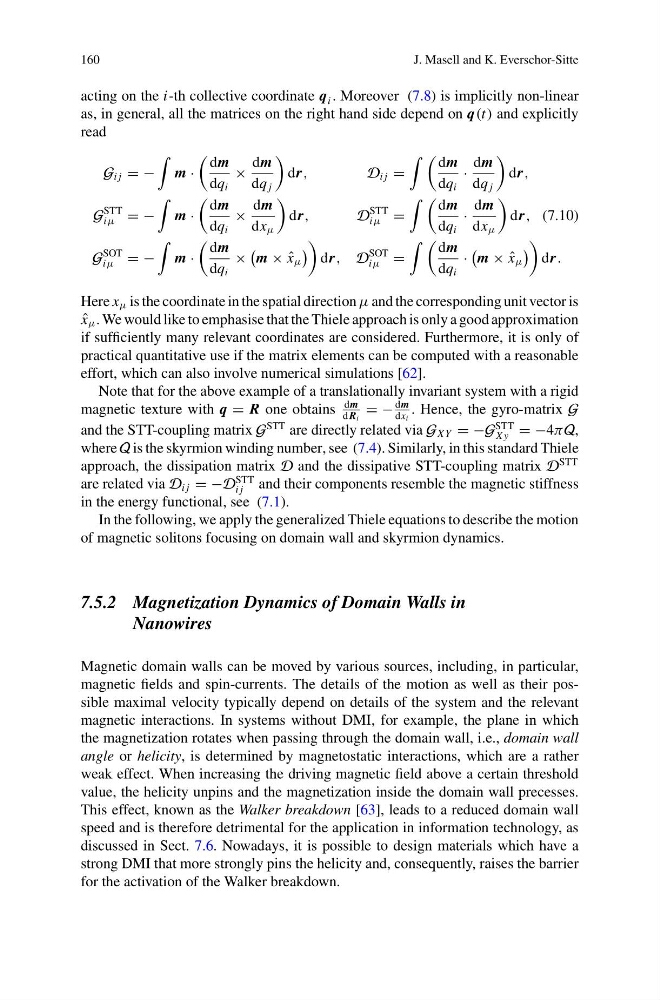
acting on the i-th collective coordinate q i . Moreover (7.8) is implicitly non-linear
as, in general, all the matrices on the right hand side depend on q(t) and explicitly
read
G i j = −
m ·
dm
dq i
×
dm
dq j
dr,
D i j =
dm
dq i
·
dm
dq j
dr,
G
STT
iμ = −
m ·
dm
dq i
×
dm
dx μ
dr,
D
STT
iμ =
dm
dq i
·
dm
dx μ
dr, (7.10)
G
SOT
iμ = −
m ·
dm
dq i
×
m × ˆ
x μ
dr, D
SOT
iμ =
dm
dq i
·
m × ˆ
x μ
dr.
Here x μ is the coordinate in the spatial direction μ and the corresponding unit vector is
ˆ
x μ . We would like to emphasise that the Thiele approach is only a good approximation
if sufficiently many relevant coordinates are considered. Furthermore, it is only of
practical quantitative use if the matrix elements can be computed with a reasonable
effort, which can also involve numerical simulations [62].
Note that for the above example of a translationally invariant system with a rigid
magnetic texture with q = R one obtains
dm
d R i
= −
dm
dx i
. Hence, the gyro-matrix G
and the STT-coupling matrix G
STT are directly related via G XY = −G
STT
X y = −4π Q,
where Q is the skyrmion winding number, see (7.4). Similarly, in this standard Thiele
approach, the dissipation matrix D and the dissipative STT-coupling matrix D
STT
are related via D i j = −D
STT
i j
and their components resemble the magnetic stiffness
in the energy functional, see (7.1).
In the following, we apply the generalized Thiele equations to describe the motion
of magnetic solitons focusing on domain wall and skyrmion dynamics.
7.5.2 Magnetization Dynamics of Domain Walls in
Nanowires
Magnetic domain walls can be moved by various sources, including, in particular,
magnetic fields and spin-currents. The details of the motion as well as their possible maximal velocity typically depend on details of the system and the relevant
magnetic interactions. In systems without DMI, for example, the plane in which
the magnetization rotates when passing through the domain wall, i.e., domain wall
angle or helicity, is determined by magnetostatic interactions, which are a rather
weak effect. When increasing the driving magnetic field above a certain threshold
value, the helicity unpins and the magnetization inside the domain wall precesses.
This effect, known as the Walker breakdown [63], leads to a reduced domain wall
speed and is therefore detrimental for the application in information technology, as
discussed in Sect. 7.6. Nowadays, it is possible to design materials which have a
strong DMI that more strongly pins the helicity and, consequently, raises the barrier
for the activation of the Walker breakdown.
J. Masell and K. Everschor-Sitte
acting on the i-th collective coordinate q i . Moreover (7.8) is implicitly non-linear
as, in general, all the matrices on the right hand side depend on q(t) and explicitly
read
G i j = −
m ·
dm
dq i
×
dm
dq j
dr,
D i j =
dm
dq i
·
dm
dq j
dr,
G
STT
iμ = −
m ·
dm
dq i
×
dm
dx μ
dr,
D
STT
iμ =
dm
dq i
·
dm
dx μ
dr, (7.10)
G
SOT
iμ = −
m ·
dm
dq i
×
m × ˆ
x μ
dr, D
SOT
iμ =
dm
dq i
·
m × ˆ
x μ
dr.
Here x μ is the coordinate in the spatial direction μ and the corresponding unit vector is
ˆ
x μ . We would like to emphasise that the Thiele approach is only a good approximation
if sufficiently many relevant coordinates are considered. Furthermore, it is only of
practical quantitative use if the matrix elements can be computed with a reasonable
effort, which can also involve numerical simulations [62].
Note that for the above example of a translationally invariant system with a rigid
magnetic texture with q = R one obtains
dm
d R i
= −
dm
dx i
. Hence, the gyro-matrix G
and the STT-coupling matrix G
STT are directly related via G XY = −G
STT
X y = −4π Q,
where Q is the skyrmion winding number, see (7.4). Similarly, in this standard Thiele
approach, the dissipation matrix D and the dissipative STT-coupling matrix D
STT
are related via D i j = −D
STT
i j
and their components resemble the magnetic stiffness
in the energy functional, see (7.1).
In the following, we apply the generalized Thiele equations to describe the motion
of magnetic solitons focusing on domain wall and skyrmion dynamics.
7.5.2 Magnetization Dynamics of Domain Walls in
Nanowires
Magnetic domain walls can be moved by various sources, including, in particular,
magnetic fields and spin-currents. The details of the motion as well as their possible maximal velocity typically depend on details of the system and the relevant
magnetic interactions. In systems without DMI, for example, the plane in which
the magnetization rotates when passing through the domain wall, i.e., domain wall
angle or helicity, is determined by magnetostatic interactions, which are a rather
weak effect. When increasing the driving magnetic field above a certain threshold
value, the helicity unpins and the magnetization inside the domain wall precesses.
This effect, known as the Walker breakdown [63], leads to a reduced domain wall
speed and is therefore detrimental for the application in information technology, as
discussed in Sect. 7.6. Nowadays, it is possible to design materials which have a
strong DMI that more strongly pins the helicity and, consequently, raises the barrier
for the activation of the Walker breakdown.