

7 Current-Induced Dynamics of Chiral Magnetic Structures
157
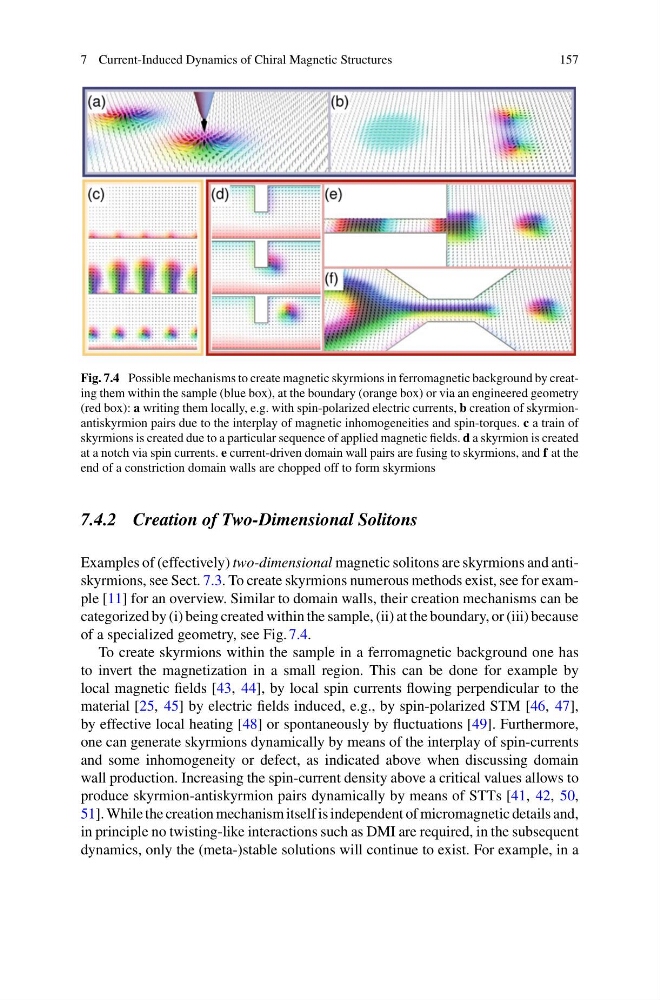
Fig. 7.4 Possible mechanisms to create magnetic skyrmions in ferromagnetic background by creating them within the sample (blue box), at the boundary (orange box) or via an engineered geometry
(red box): a writing them locally, e.g. with spin-polarized electric currents, b creation of skyrmionantiskyrmion pairs due to the interplay of magnetic inhomogeneities and spin-torques. c a train of
skyrmions is created due to a particular sequence of applied magnetic fields. d a skyrmion is created
at a notch via spin currents. e current-driven domain wall pairs are fusing to skyrmions, and f at the
end of a constriction domain walls are chopped off to form skyrmions
7.4.2 Creation of Two-Dimensional Solitons
Examples of (effectively) two-dimensional magnetic solitons are skyrmions and antiskyrmions, see Sect. 7.3. To create skyrmions numerous methods exist, see for example [11] for an overview. Similar to domain walls, their creation mechanisms can be
categorized by (i) being created within the sample, (ii) at the boundary, or (iii) because
of a specialized geometry, see Fig. 7.4.
To create skyrmions within the sample in a ferromagnetic background one has
to invert the magnetization in a small region. This can be done for example by
local magnetic fields [43, 44], by local spin currents flowing perpendicular to the
material [25, 45] by electric fields induced, e.g., by spin-polarized STM [46, 47],
by effective local heating [48] or spontaneously by fluctuations [49]. Furthermore,
one can generate skyrmions dynamically by means of the interplay of spin-currents
and some inhomogeneity or defect, as indicated above when discussing domain
wall production. Increasing the spin-current density above a critical values allows to
produce skyrmion-antiskyrmion pairs dynamically by means of STTs [41, 42, 50,
51]. While the creation mechanism itself is independent of micromagnetic details and,
in principle no twisting-like interactions such as DMI are required, in the subsequent
dynamics, only the (meta-)stable solutions will continue to exist. For example, in a
157
Fig. 7.4 Possible mechanisms to create magnetic skyrmions in ferromagnetic background by creating them within the sample (blue box), at the boundary (orange box) or via an engineered geometry
(red box): a writing them locally, e.g. with spin-polarized electric currents, b creation of skyrmionantiskyrmion pairs due to the interplay of magnetic inhomogeneities and spin-torques. c a train of
skyrmions is created due to a particular sequence of applied magnetic fields. d a skyrmion is created
at a notch via spin currents. e current-driven domain wall pairs are fusing to skyrmions, and f at the
end of a constriction domain walls are chopped off to form skyrmions
7.4.2 Creation of Two-Dimensional Solitons
Examples of (effectively) two-dimensional magnetic solitons are skyrmions and antiskyrmions, see Sect. 7.3. To create skyrmions numerous methods exist, see for example [11] for an overview. Similar to domain walls, their creation mechanisms can be
categorized by (i) being created within the sample, (ii) at the boundary, or (iii) because
of a specialized geometry, see Fig. 7.4.
To create skyrmions within the sample in a ferromagnetic background one has
to invert the magnetization in a small region. This can be done for example by
local magnetic fields [43, 44], by local spin currents flowing perpendicular to the
material [25, 45] by electric fields induced, e.g., by spin-polarized STM [46, 47],
by effective local heating [48] or spontaneously by fluctuations [49]. Furthermore,
one can generate skyrmions dynamically by means of the interplay of spin-currents
and some inhomogeneity or defect, as indicated above when discussing domain
wall production. Increasing the spin-current density above a critical values allows to
produce skyrmion-antiskyrmion pairs dynamically by means of STTs [41, 42, 50,
51]. While the creation mechanism itself is independent of micromagnetic details and,
in principle no twisting-like interactions such as DMI are required, in the subsequent
dynamics, only the (meta-)stable solutions will continue to exist. For example, in a