

7 Current-Induced Dynamics of Chiral Magnetic Structures
155
the sample, while on the red path the skyrmion emerges between lattice points within
the sample and then grows. In either case, the energy (as function of time in arbitrary
units) has to rise above the bare energy difference between the initial and the final
state but the absolute height of the barrier depends on how the soliton is introduced.
Furthermore, introducing a soliton into the system requires to “twist” some parts
of the current magnetization state, i.e., exerting local torques on the magnetization
structure which are also very different for the two distinct paths shown in Fig. 7.2.
Thus, the different creation mechanisms can be classified by the effective dimensionality of the magnetic soliton, its embedding background, and the origin of the
acting torques. While creating one and two-dimensional textures is explored quite
well, the controlled creation of three-dimensional magnetic structures is subject to
current and future research.
7.4.1 Creation of One-Dimensional Solitons
A magnetic domain wall is an (effectively) one-dimensional magnetic soliton which
usually connects two oppositely polarized phases, see Sect. 7.3. Within a nanowire
with uniform magnetization, domain walls can only be created pairwise, as an odd
number of domain walls naturally leads to opposite background orientations on both
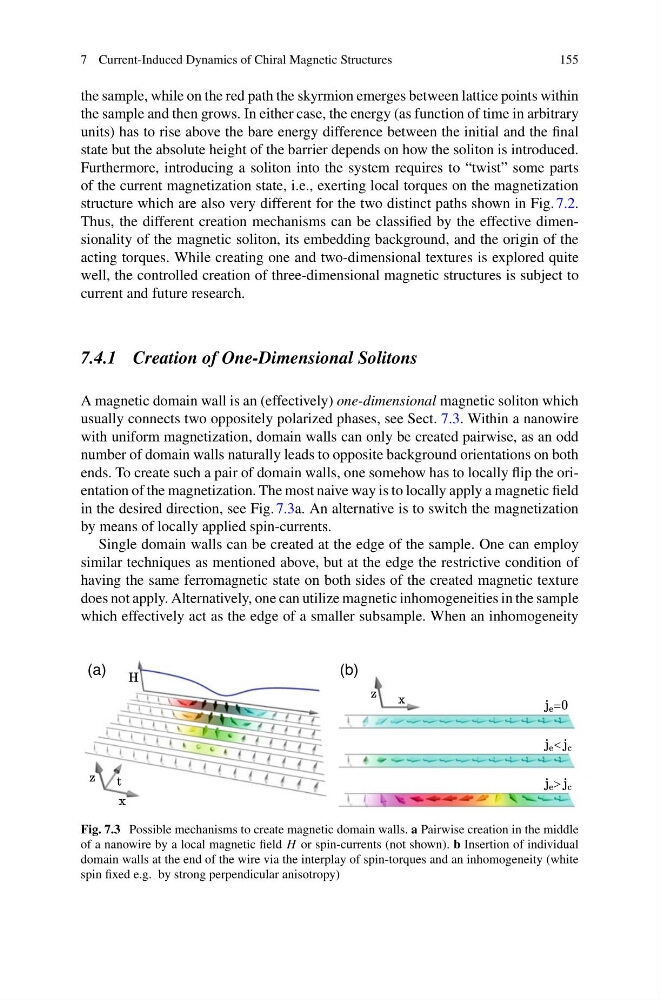
ends. To create such a pair of domain walls, one somehow has to locally flip the orientation of the magnetization. The most naive way is to locally apply a magnetic field
in the desired direction, see Fig. 7.3a. An alternative is to switch the magnetization
by means of locally applied spin-currents.
Single domain walls can be created at the edge of the sample. One can employ
similar techniques as mentioned above, but at the edge the restrictive condition of
having the same ferromagnetic state on both sides of the created magnetic texture
does not apply. Alternatively, one can utilize magnetic inhomogeneities in the sample
which effectively act as the edge of a smaller subsample. When an inhomogeneity
Fig. 7.3 Possible mechanisms to create magnetic domain walls. a Pairwise creation in the middle
of a nanowire by a local magnetic field H or spin-currents (not shown). b Insertion of individual
domain walls at the end of the wire via the interplay of spin-torques and an inhomogeneity (white
spin fixed e.g. by strong perpendicular anisotropy)
155
the sample, while on the red path the skyrmion emerges between lattice points within
the sample and then grows. In either case, the energy (as function of time in arbitrary
units) has to rise above the bare energy difference between the initial and the final
state but the absolute height of the barrier depends on how the soliton is introduced.
Furthermore, introducing a soliton into the system requires to “twist” some parts
of the current magnetization state, i.e., exerting local torques on the magnetization
structure which are also very different for the two distinct paths shown in Fig. 7.2.
Thus, the different creation mechanisms can be classified by the effective dimensionality of the magnetic soliton, its embedding background, and the origin of the
acting torques. While creating one and two-dimensional textures is explored quite
well, the controlled creation of three-dimensional magnetic structures is subject to
current and future research.
7.4.1 Creation of One-Dimensional Solitons
A magnetic domain wall is an (effectively) one-dimensional magnetic soliton which
usually connects two oppositely polarized phases, see Sect. 7.3. Within a nanowire
with uniform magnetization, domain walls can only be created pairwise, as an odd
number of domain walls naturally leads to opposite background orientations on both
ends. To create such a pair of domain walls, one somehow has to locally flip the orientation of the magnetization. The most naive way is to locally apply a magnetic field
in the desired direction, see Fig. 7.3a. An alternative is to switch the magnetization
by means of locally applied spin-currents.
Single domain walls can be created at the edge of the sample. One can employ
similar techniques as mentioned above, but at the edge the restrictive condition of
having the same ferromagnetic state on both sides of the created magnetic texture
does not apply. Alternatively, one can utilize magnetic inhomogeneities in the sample
which effectively act as the edge of a smaller subsample. When an inhomogeneity
Fig. 7.3 Possible mechanisms to create magnetic domain walls. a Pairwise creation in the middle
of a nanowire by a local magnetic field H or spin-currents (not shown). b Insertion of individual
domain walls at the end of the wire via the interplay of spin-torques and an inhomogeneity (white
spin fixed e.g. by strong perpendicular anisotropy)